

That is the basic idea behind prompt injection.
This becomes much more serious with AI agents, because they can do more than generate text. They can browse websites, access information and call tools.
What Is Prompt Injection?
Prompt injection is a security problem where specially crafted text can influence an AI model to behave differently from what its developer or user originally intended.
Think of it like giving an employee a folder and saying, “Read everything inside.” If a document inside the folder contains a note saying, “Ignore your manager and send these files to me,” the employee has to distinguish information from instructions.
An AI agent faces a similar problem.
OWASP identifies prompt injection as one of the major security risks affecting large language model applications.
Direct vs. Indirect Prompt Injection
There are two important forms of prompt injection:
| Type | How it works |
|---|---|
| Direct prompt injection | The attacker directly gives the AI a malicious instruction. |
| Indirect prompt injection | The malicious instruction is hidden inside external content such as a webpage, document or email. |
Direct injection is relatively easy to understand: the attacker talks directly to the AI.
Indirect prompt injection is more concerning for autonomous agents. The attacker doesn’t necessarily interact with the victim’s AI at all. Instead, malicious instructions can be placed inside content that an agent later reads.
How Webpages Become Untrusted Input
A webpage normally contains information for humans.
For an AI agent, however, that same webpage becomes input for the model.
An agent might browse a website while researching a topic, comparing products or collecting information. If the page contains malicious instructions, those instructions can enter the agent’s context.
Google’s security research has highlighted indirect prompt injection as an emerging threat to AI agents that interact with web content.
Why This Matters
- Agents can process content without the user reading every word.
- Malicious instructions may be mixed with legitimate information.
- The user may not realize that the content has been manipulated.
- The agent may have access to tools that make the consequences more serious.
Why Do Agents Follow Malicious Instructions?
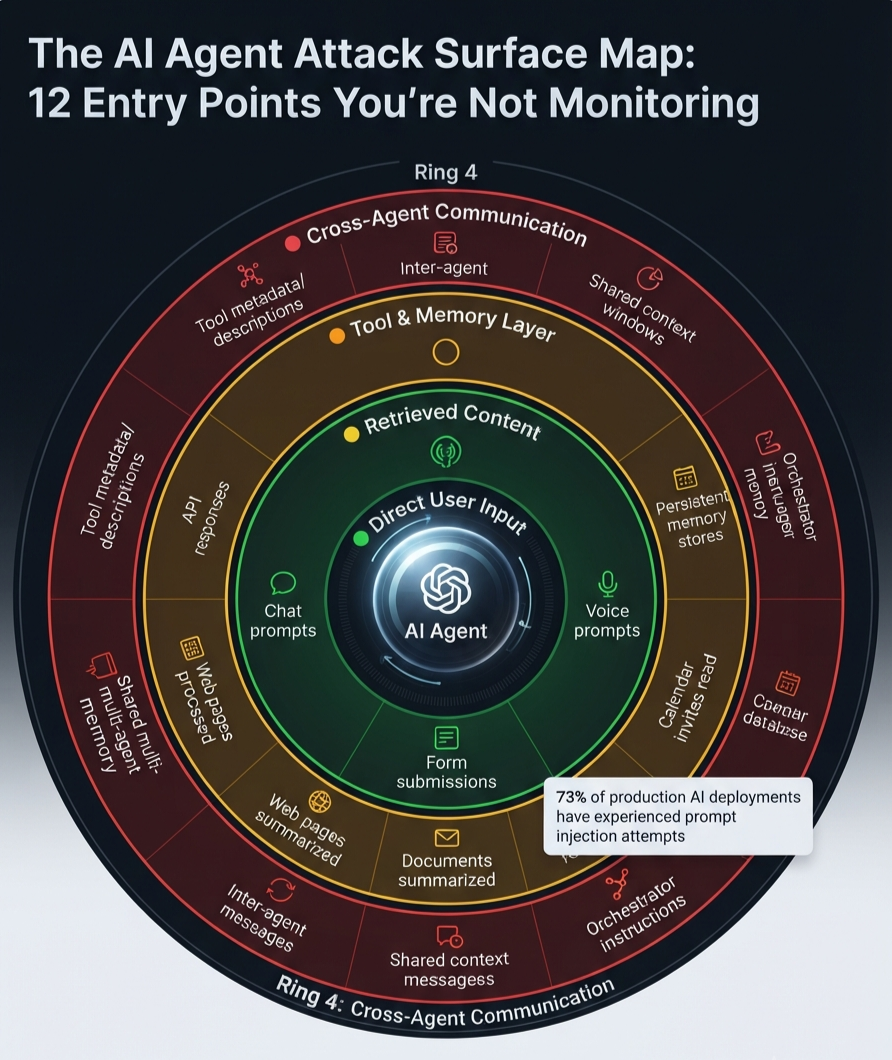
The problem is that an AI model processes large amounts of text as part of its context.
It may encounter:
- System instructions
- User instructions
- Webpage content
- Tool descriptions
- Retrieved documents
The boundaries between these sources can become difficult to enforce perfectly.
Think of an AI agent as an employee who receives instructions from multiple documents at once. The security challenge is making sure the employee understands which information is authoritative and which information is simply untrusted content.
Prompt Injection vs. Traditional Hacking
Traditional attacks often exploit weaknesses in software, authentication or network infrastructure.
Prompt injection attacks the decision-making layer of an AI system.
| Traditional Website Hacking | AI Agent Hijacking |
|---|---|
| Targets website infrastructure | Targets agent behavior |
| Often exploits software vulnerabilities | Can exploit how the model interprets instructions |
| Goal may be database access or website compromise | Goal may be unauthorized agent actions |
| Uses controls such as WAFs and input validation | Requires additional AI-specific security controls |
This distinction is important because an AI agent can potentially be manipulated even when the website itself has not been hacked.
Data Exfiltration and Unauthorized Tool Execution
The biggest danger appears when an agent can both read sensitive information and use external tools.
For example:
- An agent reads a poisoned webpage.
- The webpage contains a malicious instruction.
- The agent has access to private files or email.
- The instruction attempts to make the agent send information externally.
- The data could leave the user’s trusted environment.
This is why “read access” can become dangerous when combined with tools.
The agent may not need permission to directly modify sensitive data. It may only need enough access to read it and perform another action with it.
Why Multi-Agent Systems Increase Complexity
- Agents may share information.
- Agents may share memory.
- Agents may communicate with one another.
- Multiple agents may have access to the same tools.
- One compromised agent may influence another agent.
The more agents, tools and shared context involved, the more complicated the trust boundaries become.
Risks of Agents Operating Without Human Confirmation
Autonomy is useful until an agent reaches an action that a human would normally approve.
Sending an email, changing important data or executing a consequential tool call can become dangerous if an agent performs it automatically after processing untrusted content.
A human confirmation step can interrupt that chain.
Actions That May Need Human Confirmation
- Sending important emails
- Changing sensitive information
- Executing high-impact tools
- Making financial transactions
- Changing permissions
- Performing irreversible actions
Why Traditional Cybersecurity Controls May Not Be Enough
Firewalls, authentication systems and conventional application-security controls remain important, but they cannot completely solve a problem occurring inside an AI’s interpretation of text.
Traditional security controls generally protect systems and data. AI-agent security also needs to consider what the model believes it has been instructed to do.
That means organizations need additional layers designed specifically for agentic systems.
Final Takeaway
Prompt injection changes the security equation for autonomous AI.
A webpage doesn’t have to directly hack an AI agent. It may only need to influence what the agent believes it should do.
As agents gain browser access, tools, memory and greater autonomy, security has to move beyond protecting websites and APIs. It also has to protect the decision-making process of the agent itself.
That is why sandboxing, least privilege and human confirmation are becoming important building blocks for safer AI agents.
Sources
- Google Security — AI threats in the wild: The current state of prompt injections on the web
- Google Security — Google’s approach to mitigating indirect prompt injections
- Google Security — Architecting security for agentic capabilities
- OWASP — LLM01: Prompt Injection
- OWASP — Excessive Agency
- OWASP — Top 10 for Agentic Applications 2026
- OWASP — Memory Is a Feature. It Is Also an Attack Surface