
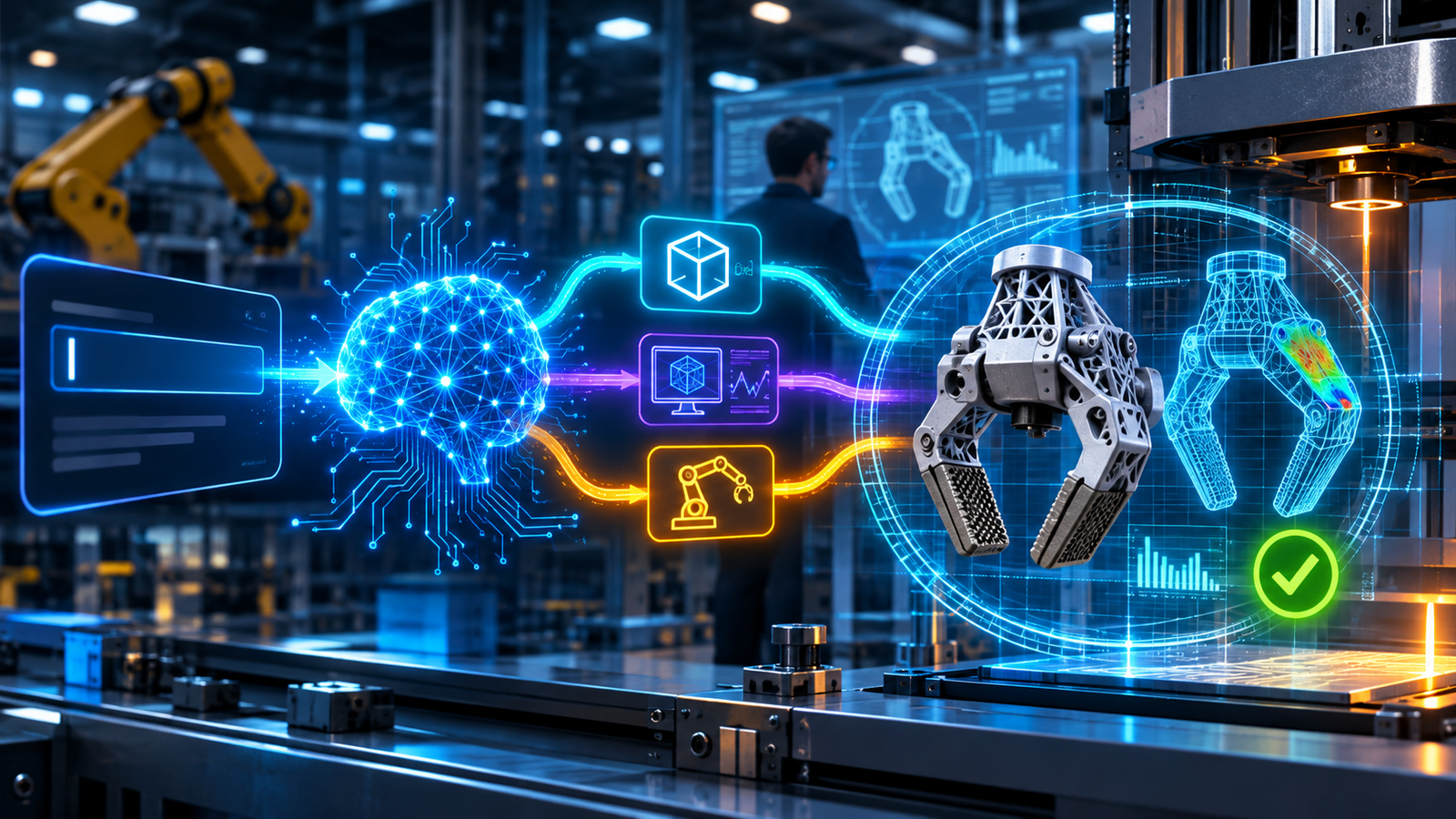
For a long time, the slow part of building industrial products was design. Engineers built CAD models by hand, reworked them for every new requirement, ran simulations, prepared manufacturing data, and then waited on physical testing.
Agentic AI is starting to flip that.
Instead of adapting a component by hand for each job, an engineer can now describe the object, the operating conditions, and the result they want. An AI agent handles the rest: picking a design concept, adjusting the geometry, running simulations, checking interfaces, and preparing the part for additive manufacturing. Siemens and AGIBOT showed this with a humanoid-robot gripper, moving part of the engineering work from manual CAD to prompt-based engineering.
That creates an awkward paradox. When CAD becomes a prompt, quality assurance becomes the product.
The question is no longer whether AI can produce a workable design. It’s whether a company can prove, quickly, repeatably, and in a way that holds up under scrutiny, that an AI-generated physical part is safe, manufacturable, traceable, and right for its real operating environment.
From manual design to prompt-based engineering
In the traditional process, a design change starts with an engineer opening CAD software. They edit the geometry, check tolerances, run simulations, update drawings, talk to manufacturing, and release a controlled revision.
Agentic manufacturing squeezes all of that together.
In the Siemens workflow, a user describes the object to be handled and the task. The agent picks a gripper type, adapts the geometry in Siemens Designcenter, runs simulations, validates the robot interface and the handling, and prepares the data for additive manufacturing.
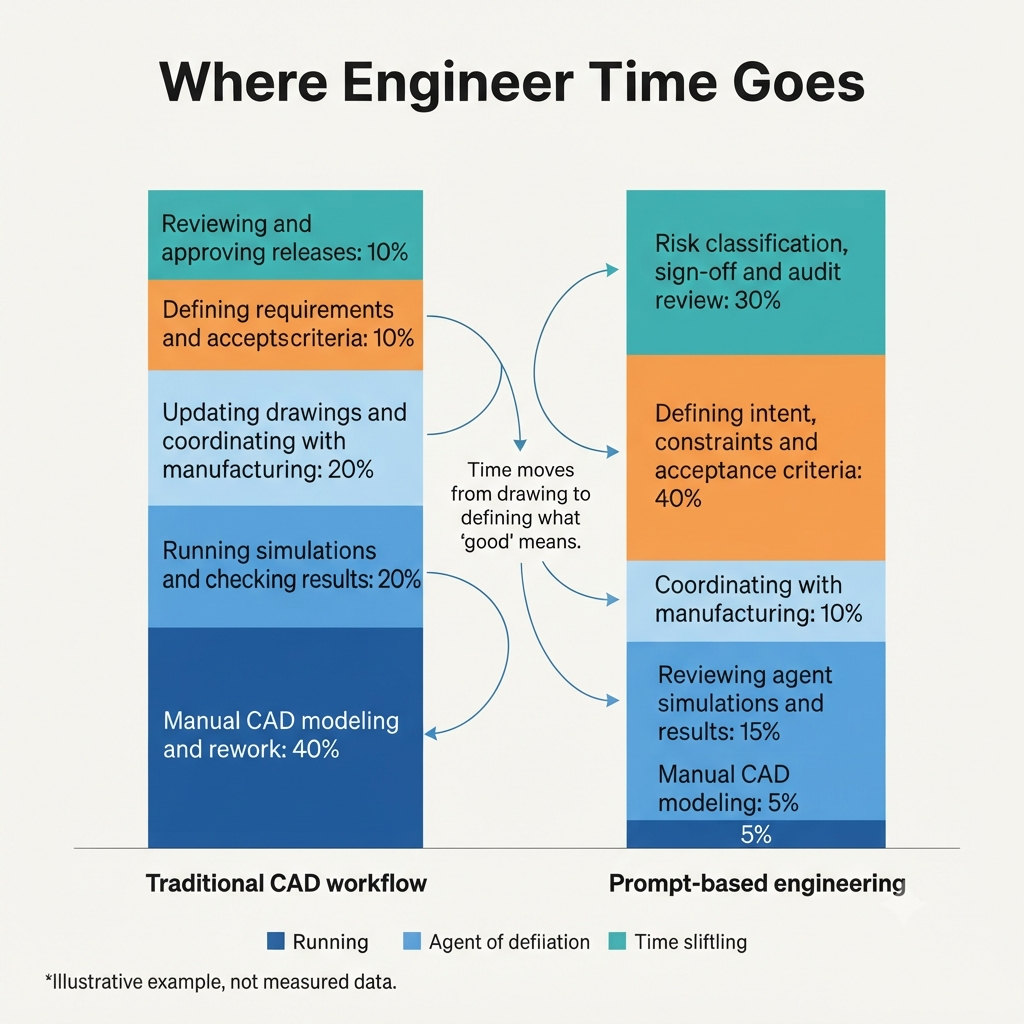
That’s more than “AI-assisted CAD.” It’s AI-orchestrated engineering. The agent coordinates design, simulation, validation, and manufacturing prep, while the human’s job shifts from drawing every feature to defining intent, constraints, acceptance criteria, and the limits within which the agent can decide on its own.
This is a big deal. More people can work with complex engineering workflows, and task-specific parts no longer mean rebuilding every variant from scratch. But it also brings a new kind of risk: systems that can generate plausible designs faster than traditional quality processes can check them.
The zero-manual-CAD dilemma
“Zero-manual CAD” doesn’t mean zero engineering responsibility. The responsibility just moves.
Engineers spend less time modeling geometry and more time defining what “good” actually means:
- What loads must the component withstand?
- Which failure modes are unacceptable?
- What materials, tolerances, surface conditions, and thermal limits apply?
- Which regulatory, safety, and traceability requirements govern the part?
- Which decisions can an agent make alone, and which need a qualified human to sign off?
A prompt like “make the gripper stronger” isn’t a specification. It’s a wish. To make something safely, it has to become measurable: load cases, safety factors, material properties, deflection limits, fatigue cycles, temperature ranges, interface tolerances, and inspection criteria.
That’s the dilemma:
AI can generate design variants at machine speed, but physical trust still depends on evidence generated at engineering speed.
If a company removes the manual CAD bottleneck without rebuilding how it assures quality, it hasn’t built a faster factory. It has built a faster way to produce unverified physical risk.
Why traditional QA breaks down
Traditional quality control assumes stable designs, controlled revisions, and repeatable production runs. Agentic manufacturing breaks several of those assumptions.
| Traditional quality model | Agentic manufacturing reality |
|---|---|
| A design is frozen before release | Many viable variants may be generated rapidly |
| QA validates a known drawing and process | QA must validate intent, generated geometry, assumptions, process parameters, and the physical result |
| Human engineers review each release | Human review cannot scale if every generated variant needs manual sign-off |
| Software QA checks code behavior | Physical QA must account for materials, microstructure, tolerances, fatigue, and real-world loads |
| Digital twins visualize the product | Digital twins must become real-time verification and release systems |
| Accountability is relatively clear | Accountability spans prompt author, agent, model, data, simulation, manufacturer, and approver |
The toughest problem is non-determinism. Generative systems can return different designs from similar prompts, and each can look perfectly valid. That doesn’t make them unsafe, but it makes repeatability, auditing, and design control much harder.
Recent research on agentic smart manufacturing points to the same core challenge: turning loosely defined requirements into feasible, verifiable, executable manufacturing actions. It matters most where precision, safety, real-time quality checks, and personalization are involved.
An agent may understand words like “fragile,” “strong,” “lightweight,” or “easy to handle.” A production system needs numbers, constraints, test methods, and acceptance thresholds.
The real bottleneck: verification capacity
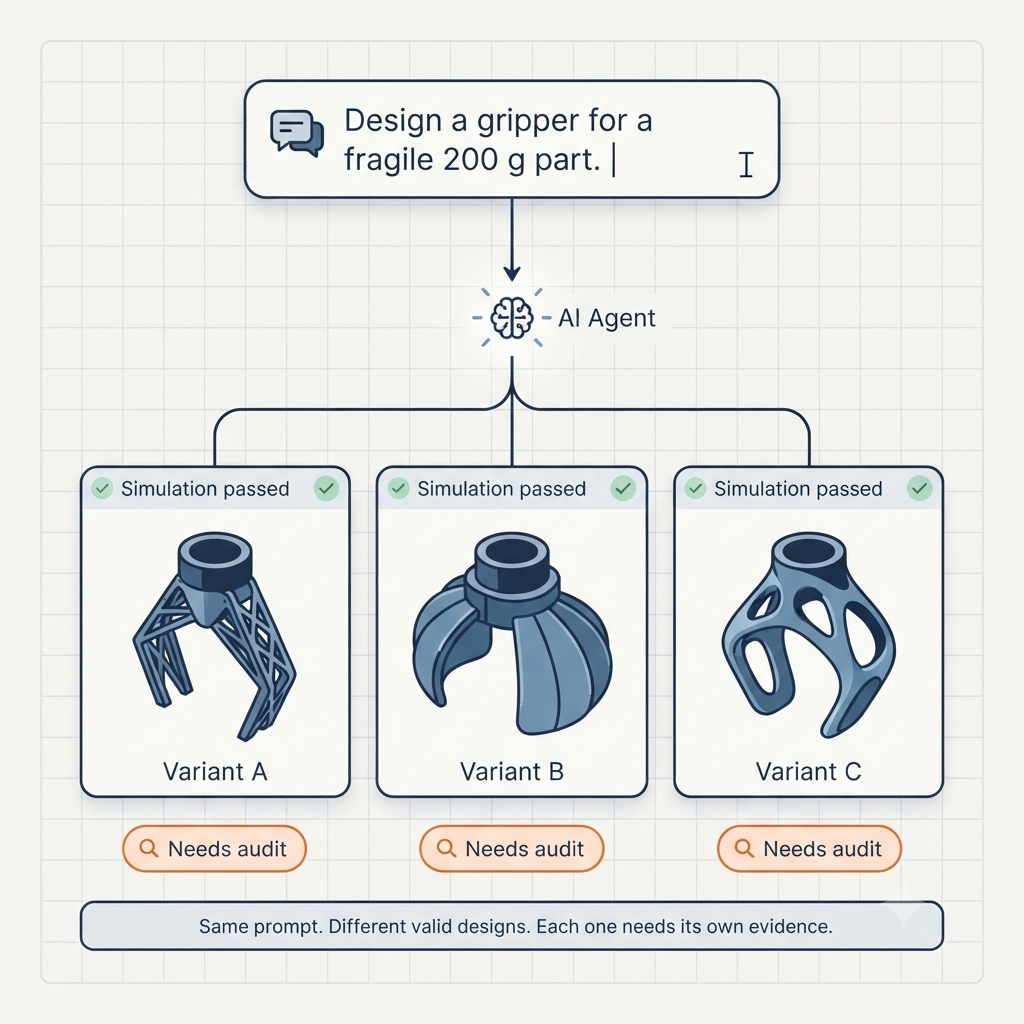
Additive manufacturing makes customization physically possible. Agentic AI makes it scalable on the thinking side. Quality assurance decides whether either can grow responsibly.
Take a humanoid-robot gripper. It might pass a virtual handling simulation, fit the robot interface, and look structurally sound in CAD. But before it touches a real product, a company needs answers that simulation alone can’t fully give:
- Did the printed material reach the expected mechanical properties?
- Were residual stresses, porosity, surface defects, or dimensional deviations within limits?
- Did post-processing change the part in ways the simulation never modeled?
- Will it survive repeated handling cycles, vibration, temperature swings, and unexpected contact?
- Can the company reconstruct exactly how this specific part was designed, approved, produced, and inspected?
So the real constraint isn’t compute, CAD automation, or printer speed. It’s verification capacity.
The factory of the future won’t be limited by how fast it can make parts. It’ll be limited by how fast it can prove those parts deserve to exist in the physical world.
The digital twin becomes a release gate
The answer isn’t to slow agentic manufacturing down. It’s to make validation continuous, automated, and proportional to risk.
The digital twin has to grow from a visualization layer into an assurance system: a live control plane linking design intent, simulation, production data, inspection results, and field performance.
The Agent-to-Asset Assurance Loop
- Formalize the requirement. Turn the prompt into structured engineering requirements: loads, materials, tolerances, safety factors, environmental conditions, regulatory constraints, and acceptance tests.
- Generate candidate designs. The agent produces geometry, a manufacturing strategy, and candidate process parameters within approved boundaries.
- Run virtual verification. Structural, fatigue, thermal, kinematic, collision, manufacturability, and process simulations run automatically.
- Classify risk. A low-risk fixture shouldn’t be treated like a safety-critical, load-bearing part. Risk tiers set how deep validation goes and how much human oversight is needed.
- Apply conditional human review. Qualified engineers review high-consequence or novel designs. Lower-risk variants can move ahead under governed automated rules.
- Adapt production. The production cell adjusts fixtures, build parameters, post-processing, and inspection plans for that specific variant.
- Capture in-process evidence. Sensors record thermal history, process stability, dimensional data, surface condition, and other indicators during production and post-processing.
- Qualify the physical part. Metrology, CT scanning, material testing, or destructive sampling is applied according to the part’s risk class.
- Update the digital twin. As-built measurements and operational performance feed back into simulation models, agent constraints, and future design rules.
- Create an audit-ready release record. The system stores the prompt, model version, retrieved knowledge, design files, simulation assumptions, deviations, approvals, process parameters, and inspection evidence.
Siemens itself stresses that integrated software and data chains are essential for connecting design, simulation, manufacturing preparation, production, and operations. It also names quality, traceability, security, and human responsibility as key requirements for industrial deployment.
That last part matters. In agentic manufacturing, a digital twin isn’t just a 3D model on a screen. It’s how a company answers the question: “Can we trust this specific physical object?”
From pass/fail to proof of fitness
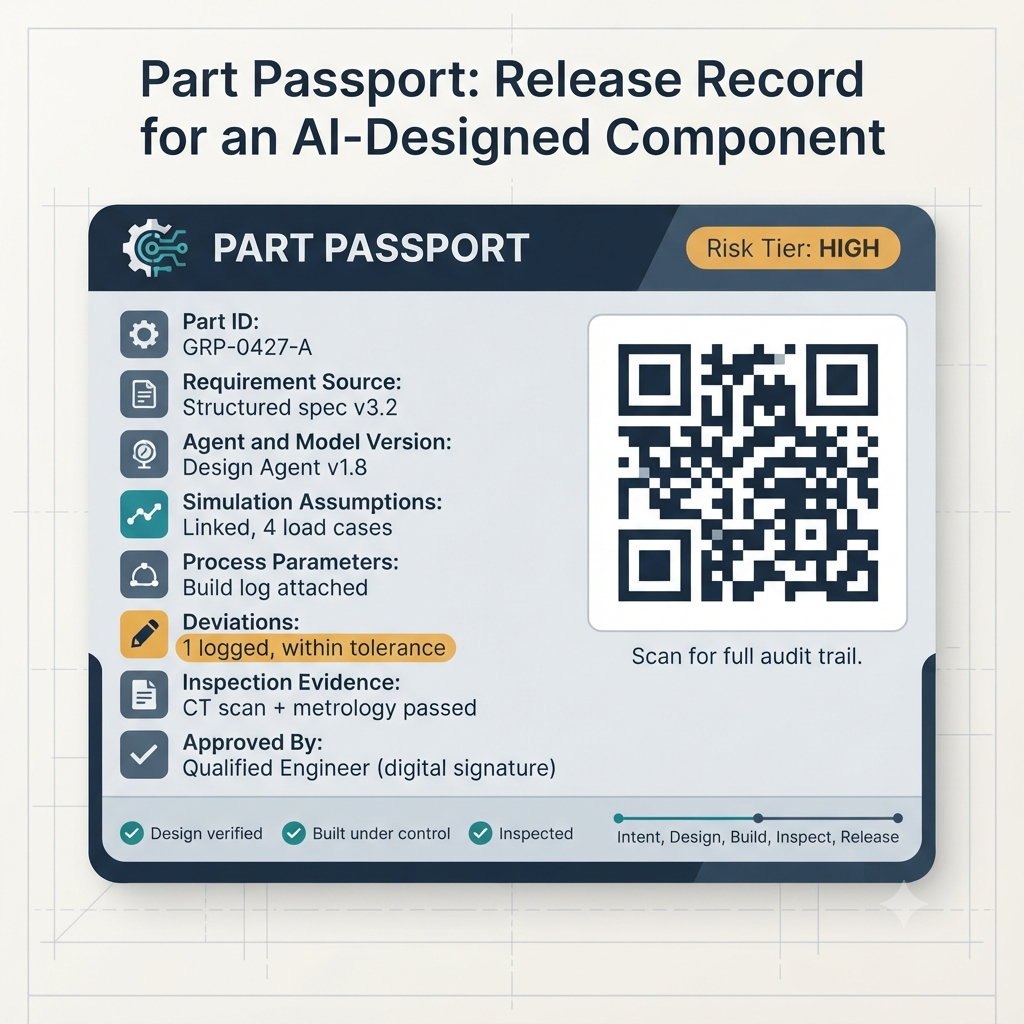
Traditional QA asks a narrow question: did this part pass inspection?
Agentic manufacturing needs a bigger one: can we show that this part is fit for its intended purpose, made under controlled conditions, and traceable across its whole lifecycle?
A release record for an agent-designed part should answer:
- What was requested, and how was it translated into exact engineering requirements?
- Which agent, model version, tools, and data sources created the design?
- Which constraints and guardrails were enforced?
- What simulations were run, and what assumptions did they rely on?
- What physical measurements confirm the simulation?
- Which human or automated policy approved the release?
- What deviations happened during production?
- How does the part perform in operation over time?
This turns quality assurance from a final checkpoint into a verifiable chain of custody from intent to asset. The evidence package becomes as important as the component.
Liability doesn’t disappear. It spreads out.
When an AI-generated component fails, “the AI did it” won’t fly as an answer. Liability gets spread across a longer, less visible chain.
| Actor | Potential responsibility |
|---|---|
| Prompt author | Provided incomplete, ambiguous, contradictory, or unsafe requirements |
| Agent | Misinterpreted intent, selected an unsuitable design, or bypassed constraints |
| Model provider | Failed to disclose limitations or provide a model unfit for the claimed engineering use case |
| Simulation provider | Used inappropriate physics, boundary conditions, material data, or validation ranges |
| Manufacturer | Failed to control additive production, post-processing, or inspection |
| Human approver | Approved a high-risk design without meaningful review |
| Operator | Used the part outside its qualified operating envelope |
The practical answer isn’t to keep agents out of engineering. It’s to set clear accountability boundaries before deployment. Companies need:
- Human-in-the-loop thresholds for safety-critical decisions
- Clear ownership of prompt quality, agent behavior, model risk, process control, and final release
- Immutable audit trails that preserve every material decision
- Firm rules for when an agent can act on its own and when it must escalate
- Contracts and governance frameworks that cover model, data, simulation, and manufacturing responsibility
AI doesn’t eliminate liability. It makes the chain of responsibility longer, more technical, and more dependent on evidence.
Mass customization meets safety-critical engineering
Mass customization pays off most when products have to adapt to individual tasks, users, or environments. Additive manufacturing makes that affordable, and agentic AI makes it workable at scale.
But the highest-value uses, like robotic grippers, aerospace brackets, medical devices, industrial tooling, and autonomous machinery, are often the ones where failure has real consequences. A badly designed gripper might drop a product. A badly designed structural part might injure a worker, damage equipment, or shut down a whole line.
So companies can’t treat every AI-generated variant the same. They need risk-tiered assurance:
- Low-risk components: Automated checks, process monitoring, and sampled inspection may be enough.
- Medium-risk components: Enhanced simulation, first-article inspection, and controlled process qualification.
- High-risk or safety-critical components: Human engineering approval, physical testing, certification evidence, and continuous field monitoring.
The aim isn’t to push every generated design through the same expensive manual process, which would wipe out the economic benefit of customization. The aim is to make assurance proportional to consequence.
What industrial leaders should build now
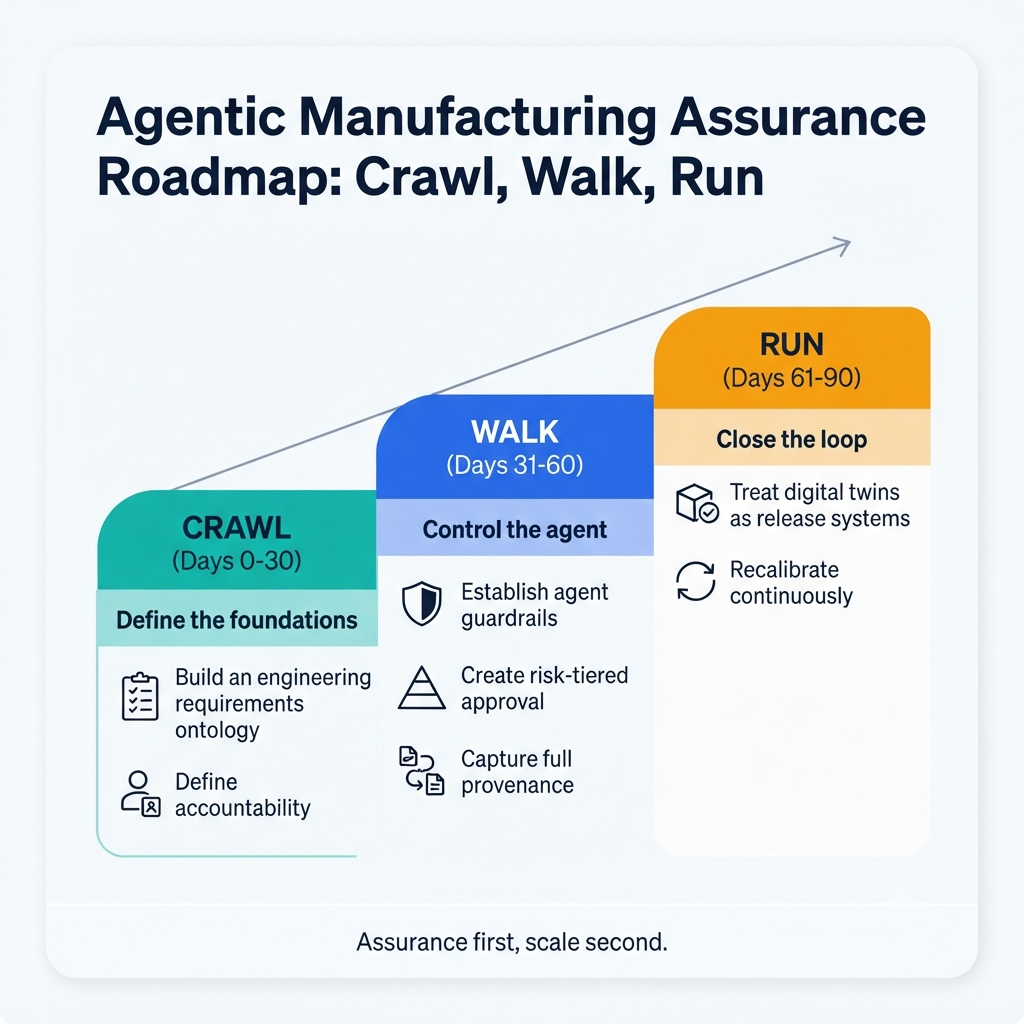
Companies preparing for agentic manufacturing shouldn’t start by buying another generative-design tool. They should start by building the assurance infrastructure that makes autonomous engineering safe to deploy.
Build an engineering requirements ontology. Translate natural-language intent into structured, testable requirements. Every prompt should map to measurable constraints, acceptance criteria, and risk classifications.
Establish agent guardrails. Limit the geometries, materials, load cases, manufacturing processes, and autonomous decisions an agent can use. It shouldn’t be free to invent a structural solution without boundaries.
Create risk-tiered approval. Automate low-risk validation, and require qualified human review for safety-critical, novel, or high-consequence designs.
Treat digital twins as release systems. Connect CAD, simulation, MES, quality management, inspection, and field telemetry. The twin should be the system of record for design intent, production reality, and operational performance.
Capture full provenance. Record the prompt, model version, tool calls, data sources, assumptions, revisions, approvals, process parameters, and as-built measurements.
Recalibrate continuously. Compare predicted performance with what you actually observe, and use field data and inspection results to improve simulation models, agent constraints, and quality rules.
Define accountability before scale. Assign an owner to every link in the chain: prompt, agent, model, simulation, manufacturing process, inspection, release, and operation.
The new industrial advantage
The companies that win the next phase of manufacturing won’t necessarily be the ones with the flashiest generative-design demos. They’ll be the ones who can answer a harder question:
“Can we prove, at production speed, that every AI-created component is safe, traceable, and fit for purpose?”
Agentic manufacturing won’t fail because AI can’t design parts. It’ll stall because companies can’t yet prove that every AI-created part deserves to exist in the physical world.
The next advantage will go to the organizations that make quality assurance, traceability, and accountability as automated, adaptive, and intelligent as the design systems they’re deploying. Siemens’ own framing points the same way: industrial AI can connect engineering and production, but quality, traceability, security, and human responsibility remain the foundation.