

Kubernetes was built to orchestrate stable, long-running microservices. Autonomous agents don’t behave that way. They spin up environments on demand, run code nobody has reviewed, fork state in parallel, and throw everything away when the job is done.
That mismatch is nudging cloud architecture toward a new foundation: a microVM-based, agent-native runtime. Google’s Agent Substrate, now donated to the CNCF alongside gVisor, is an early sign of where things are heading.
The workload has changed
For the past decade, the typical cloud-native workload was the microservice: a fairly predictable application that starts, serves traffic, scales out, and stays up.
A coding agent looks nothing like that. It gets a task, clones a repository, installs dependencies, edits files, runs tests, reads documentation, calls tools, and then either commits a result or discards the whole environment. Its unit of work isn’t a long-lived service. It’s a short-lived, stateful, security-sensitive sandbox.
Agent Substrate is built around exactly this. It manages the lifecycle and execution targets of multi-turn agent workflows on Kubernetes, and it treats the agent’s environment, not just the container, as the thing being operated.
Why containers aren’t enough
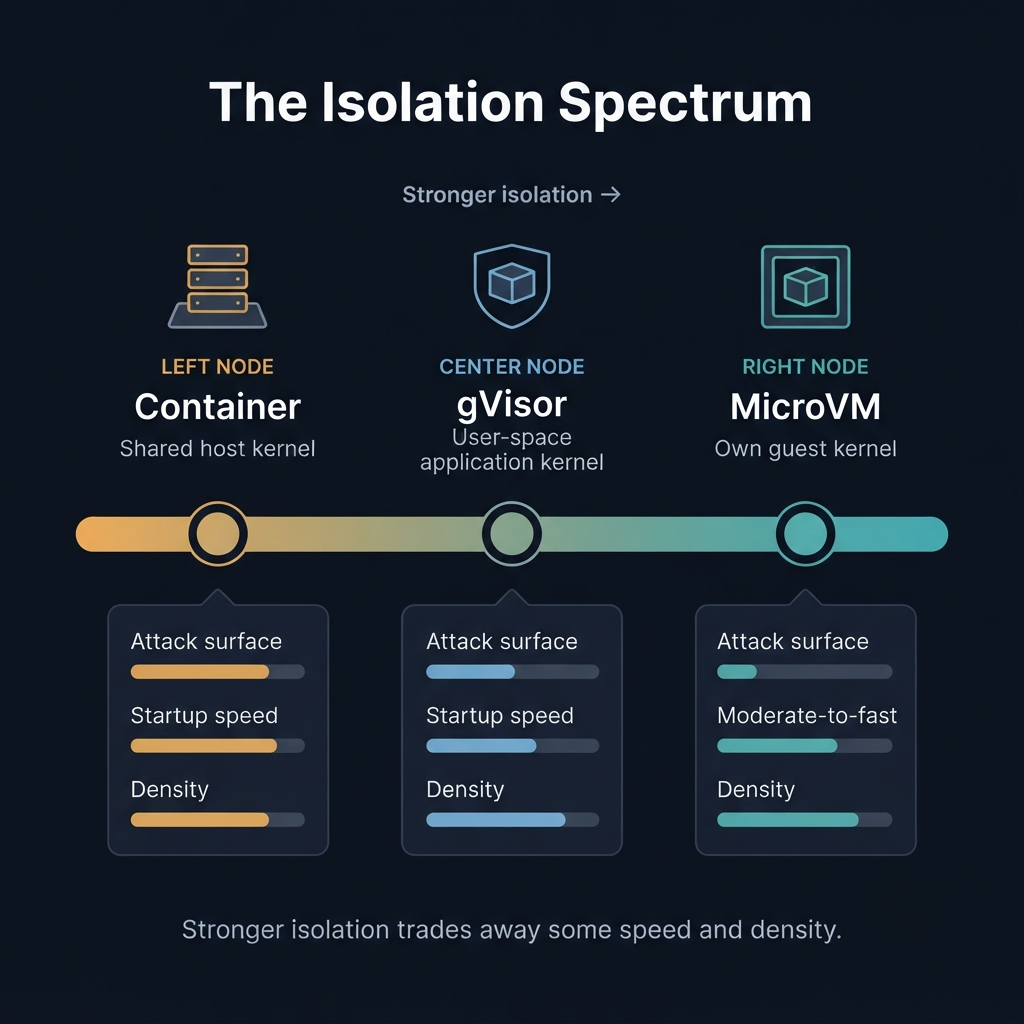
Containers are still great for conventional services. They start fast, schedule efficiently, and are easy to standardize.
Agents bring a different kind of risk. They run shell commands the model wrote, install packages nobody vetted, change source code, reach into repositories, browse the web, and call outside tools. Often you don’t know in advance what code will actually run. The security question stops being “how do I reliably run a trusted service?” and becomes “how do I safely run arbitrary code?”
gVisor handles part of that by putting an application-kernel boundary between the workload and the host kernel. Agent Substrate can use either gVisor or Cloud Hypervisor microVMs as its isolation layer, so platform teams can choose between lightweight sandboxing and stronger VM-level isolation.
None of this means containers are obsolete. It means that for agent workloads, isolation has to be the default rather than an optional hardening step.
The agent-native execution contract
Traditional infrastructure assumes a service has a stable identity, a known runtime, and predictable ways of failing. Agents need a different contract.
| Property | Traditional microservice | Autonomous agent |
|---|---|---|
| Lifecycle | Long-running and stable | Short-lived and task-scoped |
| Environment | Defined at deployment | Created, mutated, and discarded per task |
| State | Mostly externalized | Often lives in local files, Git state, tool sessions, and memory |
| Concurrency | Scale replicas | Fork many execution branches |
| Failure model | Restart or roll back | Retry in a clean environment; preserve useful artifacts |
| Trust model | Known application code | Untrusted generated code and tool actions |
State deserves special attention. A coding agent’s working context can include a live language runtime, a local repo, uncommitted edits, browser sessions, installed dependencies, and tool credentials. If the platform tears that down too early, the agent can’t pick the task back up.
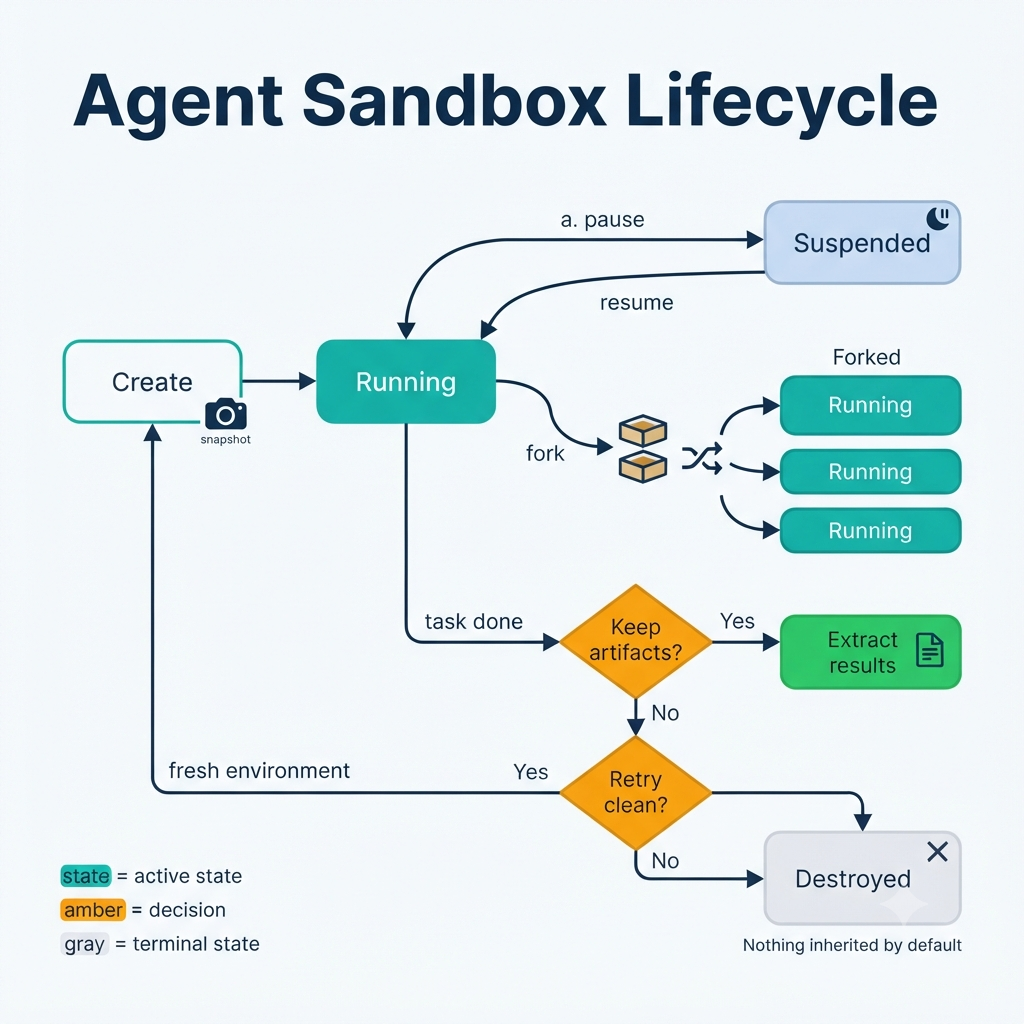
That’s why “just deploy the agent as a Kubernetes Deployment” falls short. The platform needs to handle a much richer lifecycle: create, suspend, resume, fork, fan out, inspect, preserve, and destroy.
The microVM era
A microVM gives each workload its own lightweight virtual machine with a dedicated guest Linux kernel. Compared with a regular container, you get a stronger isolation boundary while keeping most of the operational flexibility of cloud-native infrastructure.
The emerging stack looks like this:
Agent / IDE / CI workflow
          ↓
Agent orchestration and policy
          ↓
Agent Substrate: sandbox lifecycle, forking, resume, scheduling
          ↓
gVisor or Cloud Hypervisor microVM
          ↓
Kubernetes / cloud compute
Kubernetes doesn’t go away. It stays as the scheduling and capacity layer, but it moves down a level. Kubernetes supplies the compute, and an agent substrate manages the higher-level execution lifecycle on top of it.
Agent Substrate runs on GKE Standard clusters and uses gVisor or Cloud Hypervisor to isolate each workload in its own sandbox. In this model the microVM becomes the default execution unit for autonomous software engineering, rather than a security upgrade reserved for sensitive workloads.
Fork, suspend, resume
Traditional cloud primitives are pretty simple:
- Start
- Scale
- Restart
- Drain
- Terminate
Agent-native infrastructure needs a new set:
- Snapshot
- Fork
- Suspend
- Resume
- Clone
- Fan out
- Merge or discard
- Destroy
Take a bug-fix task. An agent might want to try 1,000 candidate patches. Rather than launching 1,000 environments from scratch, the platform builds one prepared environment, snapshots it, forks it into many parallel sandboxes, runs each patch, and keeps only the branch that works.
That’s a different kind of horizontal scale. What you’re scaling isn’t a replica count, it’s branching execution state.
Google reports that Agent Substrate supports more than 500 suspend-and-resume activations per second and millions of sandboxes, with 10 times the density of standard container runtimes. Whether those numbers hold in every production setup matters less than the direction they point: agent platforms have to make environment lifecycle operations cheap, fast, and routine.
Agent Substrate as the missing layer
Agent Substrate isn’t another Kubernetes distribution. It’s an execution runtime that sits on top of Kubernetes and treats sandboxes as first-class, disposable workloads.
Its workers are pre-warmed Kubernetes Pods in a shared WorkerPool, already equipped with container runtimes and sandbox boundaries. That matters because agent execution comes in bursts. You can’t afford to cold-start a full virtualized environment for every trivial action, but you also can’t leave sensitive environments running forever.
The result is a layered model:
- Kubernetes schedules capacity and manages nodes.
- Agent Substrate manages sandboxes, lifecycle, forking, and execution targets.
- gVisor or Cloud Hypervisor provides the isolation boundary.
- The agent framework decides what the agent actually does.
This separation lets teams keep Kubernetes as their operational backbone while adding an agent-specific runtime above it.
Security becomes a platform primitive
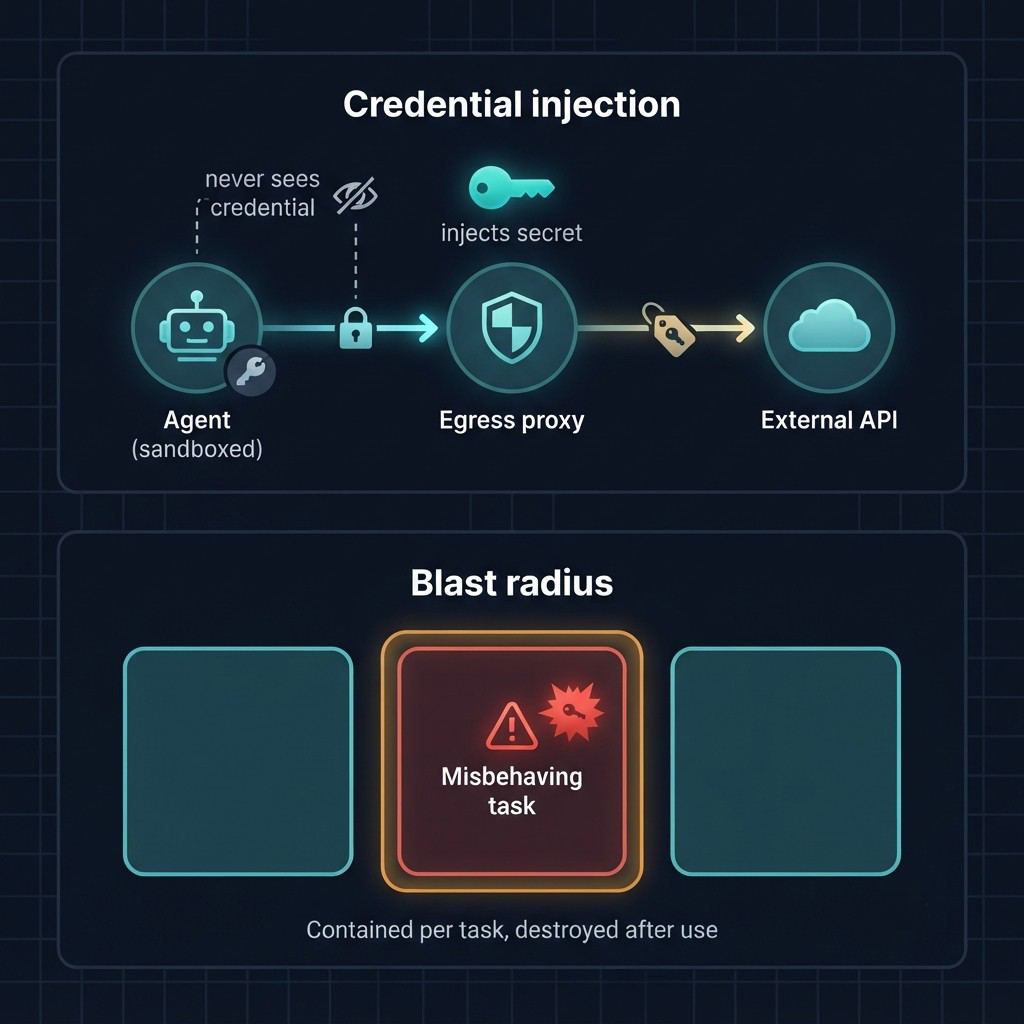
You can’t secure agents with prompt guardrails and code review alone. Once an agent can run code and call tools, the infrastructure itself has to limit what it can do.
Agent Substrate pairs sandbox isolation with egress proxies, fine-grained network policies, and credential injection that keeps secrets out of the agent’s reach.
The practical pattern is least-privilege ephemeral infrastructure:
- Every task gets a fresh environment.
- Credentials are narrowly scoped and injected outside the agent’s direct access.
- Network egress is controlled.
- Sandboxes are destroyed after use.
- Useful artifacts are pulled out deliberately, not inherited by default.
This turns security from perimeter defense into per-task blast-radius containment. The question shifts from “can the agent access this resource?” to “if this agent misbehaves, how much can it affect, and for how long?”
What platform teams need to rethink
Agent infrastructure isn’t just Kubernetes with more pods. It challenges several core assumptions.
- Capacity planning: Move from steady-state replica counts to bursty parallel sandbox creation, warm pools, and fast teardown.
- Cost control: Track sandbox lifetime, idle time, snapshot storage, fork depth, and fan-out volume, not just node utilization.
- Observability: Measure task completion, tool-call traces, sandbox reuse, fork success rates, rollback frequency, and time to first useful environment.
- Policy: Shift from namespace-level access rules to per-task identity, egress policy, repository scope, and credential lifetime.
- Developer experience: Move past Deployment manifests toward agent execution profiles covering base image, tools, network policy, resource limits, retention rules, and fork strategy.
The platform team’s job becomes enabling safe autonomy at scale, not just deploying one more AI service.
The strategic shift
The next cloud-native abstraction probably won’t be “AI on Kubernetes.” It will be agent-native infrastructure on Kubernetes.
Google donating Agent Substrate and gVisor to the CNCF looks like an effort to make sandboxed agent execution shared, vendor-neutral infrastructure instead of a proprietary cloud feature. If autonomous agents end up taking a meaningful share of enterprise compute, the winning platforms will be the ones that make secure environment creation, state forking, and instant teardown as effortless as Kubernetes made container deployment.
Kubernetes solved the problem of running many reliable services. The microVM era is about a new problem: running many unreliable, autonomous, high-risk agent tasks safely, at the speed and scale modern software engineering demands.