
AI shopping agents have gotten really good at the tedious parts of buying things. They research products, compare prices, wade through reviews, read the fine print on returns, and put together a cart that makes sense. But when it’s time to actually pay, most people still want their own finger on the button.
That last click isn’t a small UX detail. It’s where a suggestion becomes a financial commitment. People are happy to hand off the thinking part of shopping. They’re much less happy to hand off the consequences.
The numbers back this up. In a global Bain Consumer Lab survey, 55% of shoppers who use AI said they don’t fully trust it to complete a purchase. In the US, only 11% of consumers have ever used AI to finish a transaction, even though AI is increasingly where shopping starts. People aren’t uninterested in AI. They just don’t want to give up control of their money.
The Invisible Wall Between Intent and Purchase
I’ll call it the “final click barrier“: the moment an agent’s work stops being informational and starts being financially binding.
Before that moment, mistakes are cheap. If an AI suggests the wrong laptop, picks an ugly color, or misses a better deal, you just ignore it. After the click, that same mistake can turn into a charge, a shipment, a subscription, a return headache, or a dispute.
That’s why checkout feels so different from searching, comparing, or filling a cart. It’s the point where wanting something turns into owing something.
Folks in the industry usually call this a trust problem, but that’s only half right. Consumers aren’t waiting for AI to become perfect. What they’re asking for is a clear split of authority: the AI can prepare the transaction, but the human authorizes it.
What Consumers Will Delegate and What They Won’t
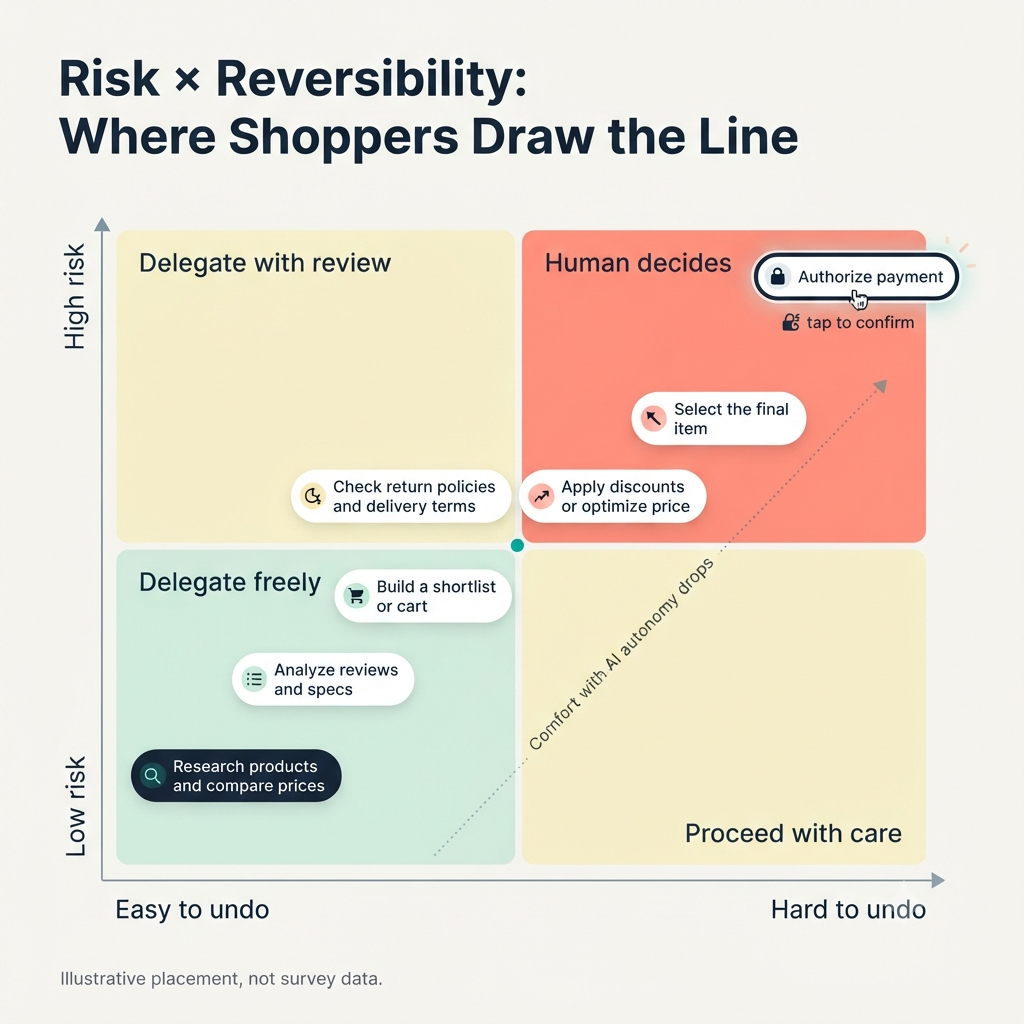
The pattern isn’t “AI does everything” or “AI does nothing.” People divide the work based on risk, whether it can be undone, and who’ll be blamed if it goes wrong.
| Task | Consumer comfort | Why |
|---|---|---|
| Research products and compare prices | High | Low risk and easily discarded |
| Analyze reviews and specifications | High | AI reduces cognitive effort |
| Build a shortlist or cart | Moderate to high | The user can inspect before acting |
| Check return policies and delivery terms | Moderate | Useful, but mistakes can affect the purchase |
| Apply discounts or optimize price | Moderate | Value is clear, but accuracy matters |
| Select the final item | Low to moderate | Taste, context, and accountability remain personal |
| Authorize payment | Very low | Money leaves the account; consequences may be irreversible |
Consumers are especially wary of giving agents unlimited spending power. Only 5% would trust an AI platform itself to process an agent’s payment, and 41% said they wouldn’t trust any of the payment options that were tested.
That doesn’t mean people reject agentic commerce. They just want it fenced in.
The Fear of Un-Doable Errors
At the core of the barrier is a simple imbalance: a bad recommendation costs almost nothing, but a bad purchase can cost a lot.
A wrong suggestion wastes a few seconds. A wrong order wastes money, time, and patience. The risks are easy to spot at checkout:
- Wrong variant: size, color, storage, compatibility, model number, or quantity.
- Wrong seller: a marketplace listing with weaker returns, counterfeit risk, or sloppy fulfillment.
- Wrong financial terms: price, taxes, shipping, currency conversion, fees, or a promo code that never applied.
- Unwanted commitments: subscriptions, auto-renewals, add-ons, insurance, or bundled services.
- Wrong delivery details: address, recipient, timing, or account.
- Security exposure: fraud, account takeover, or unauthorized charges.
People don’t judge an AI agent by how it does on average. They judge it by the worst thing that could plausibly happen. Even a system that’s right 99 times out of 100 has to answer an uncomfortable question: what happens the one time it’s wrong?
Hallucinated Order Specifications
A hallucination in a research chat is irritating. At checkout it’s a financial risk.
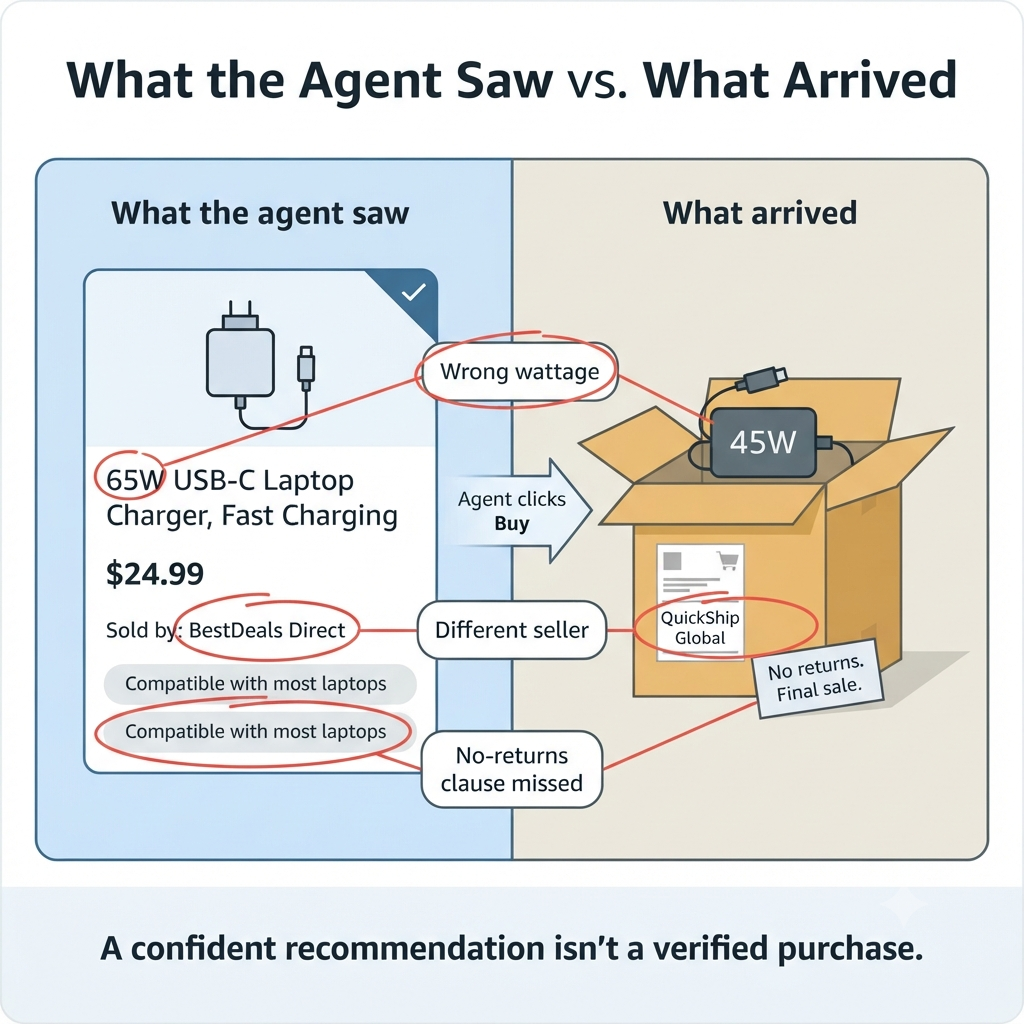
An agent can confidently produce a product title, SKU, configuration, delivery date, warranty, or return policy that looks right but doesn’t match what the merchant actually sells. The problem isn’t only that the model gets a fact wrong. It’s that you might have no easy way to check what the agent saw, what it picked, and what it’s about to buy.
Say you ask an agent to buy a compatible laptop charger. It finds the right brand and connector, but picks the wrong wattage, orders from a third-party seller, or misses a no-returns clause. You don’t end up with a bad answer on a screen. You end up with a package at your door that you can’t safely use.
That’s why “show your work” matters so much in commerce. A confident recommendation isn’t enough. People need a verifiable trail: the exact product, seller, variant, price, fees, delivery promise, and return terms.
The Trust Gap Is Really an Agency Gap
Consumers aren’t asking AI to leave the buying journey. They’re asking it to stay in a clearly defined role.
The final click satisfies three very human needs:
- Control: “I chose this.”
- Verification: “I know exactly what I’m buying.”
- Accountability: “If something goes wrong, I know who’s responsible.”
A fully autonomous agent squashes all three into one opaque action. A human-in-the-loop model keeps them intact.
So the most promising version of agentic commerce isn’t “AI buys for you.” It’s AI prepares, human authorizes. The agent narrows the options, checks the constraints, builds the cart, and flags the risks. The person keeps the power to approve, edit, or reject the result.
Human-in-the-Loop Is Not Failure
It’s tempting to read mandatory human approval as proof that agentic commerce hasn’t worked. I think it’s closer to the opposite.
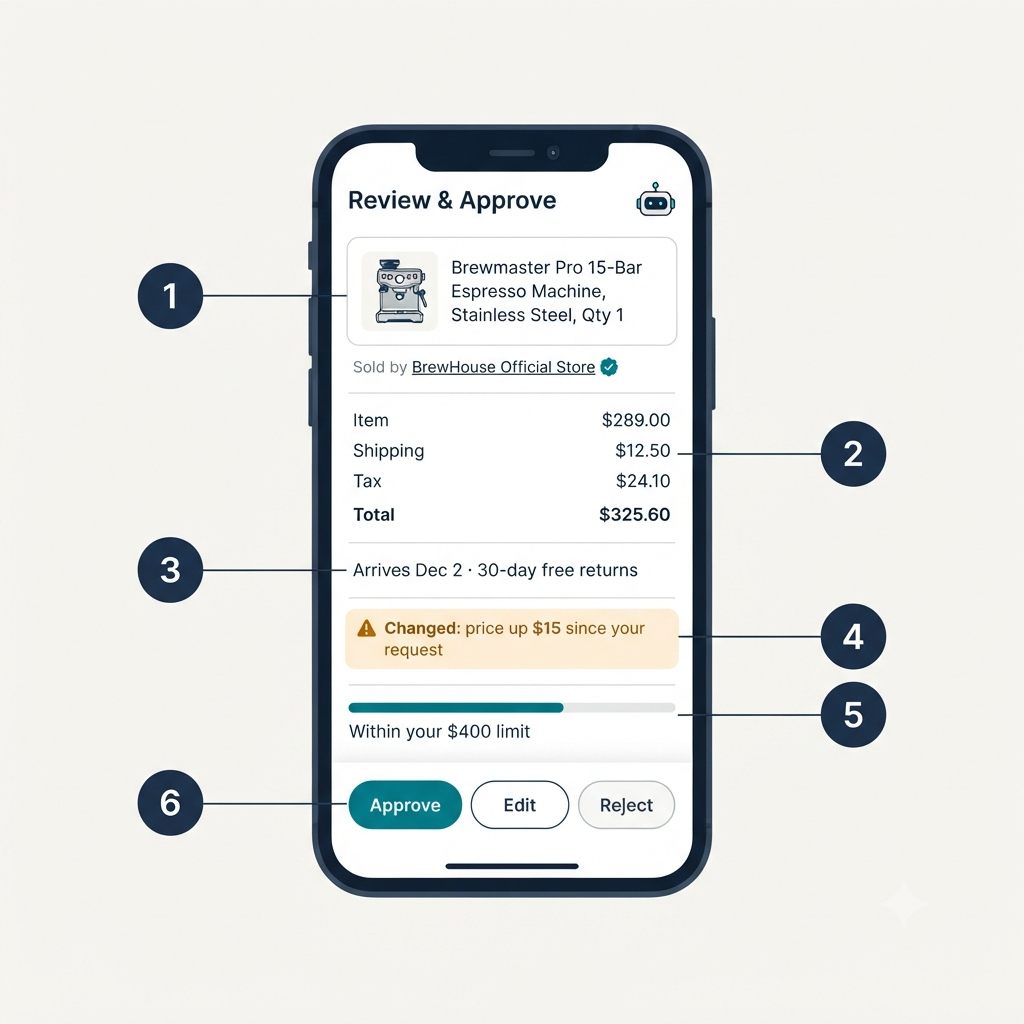
A final approval step isn’t friction for its own sake. It’s a trust interface. The real job for product teams is making that step quick, clear, and actually useful, not burying it under a pile of checkboxes.
A good approval screen should show:
- The exact item, variant, seller, and quantity.
- The final all-in price, including taxes, shipping, and fees.
- The delivery estimate and return policy.
- Anything that changed from the user’s original instruction.
- A simple choice: approve, edit, or reject.
- Clear spending limits, merchant restrictions, and approval thresholds.
The aim isn’t to rebuild the whole manual checkout. It’s to squeeze it down into one moment of informed consent.
From Recommendation Engine to Controlled Executor
Most AI shopping tools today are, honestly, very smart recommendation engines. They help you discover and decide, then stop before executing.
That isn’t necessarily a weakness. It may be the right design for where trust stands today.
| Stage | Agent’s role | Human’s role | Example |
|---|---|---|---|
| Discovery | Finds and compares options | Chooses and buys | “Find me a good espresso machine.” |
| Preparation | Builds a cart, checks terms, optimizes price | Reviews and clicks checkout | “Build the best-value cart under $500.” |
| Conditional execution | Acts within pre-approved rules | Sets guardrails and approves exceptions | “Reorder coffee monthly, but ask me above $75.” |
Progress will probably be gradual. People are more relaxed about cheap, repeat purchases than big or complicated ones. In Wildfire’s 2026 survey, 29% of consumers said they were “very comfortable” letting an agent buy something under $20, but only 6% said the same about purchases of $500 or more.
Autonomy won’t show up as one big switch. It’ll arrive as a series of small, bounded permissions.
What Builders Must Fix Before Full Autonomy
If the industry wants people to trust agents past the final click, it has to make autonomy safer, more transparent, and easier to undo.
- Deterministic checkout state: Show the exact final cart, seller, variant, and total before anything is authorized.
- Source-linked evidence: Tie key claims (price, stock, delivery, returns, compatibility) to verifiable merchant data.
- Reversibility by design: Make cancellations, returns, receipts, and dispute paths easy to find.
- Scoped credentials: Use limited, tokenized payment access instead of broad wallet control.
- Policy guardrails: Offer spending caps, category rules, merchant allowlists, time windows, and approval thresholds.
- Audit trails: Let users see what the agent did, why, and on whose instruction.
- Failure recovery: Escalate to the human when data is ambiguous, prices change, items go out of stock, or checkout can’t be verified.
None of this is compliance box-ticking. These are the product requirements that decide whether people ever move from “AI helped me shop” to “AI bought this for me.”
The Business Opportunity in the Barrier
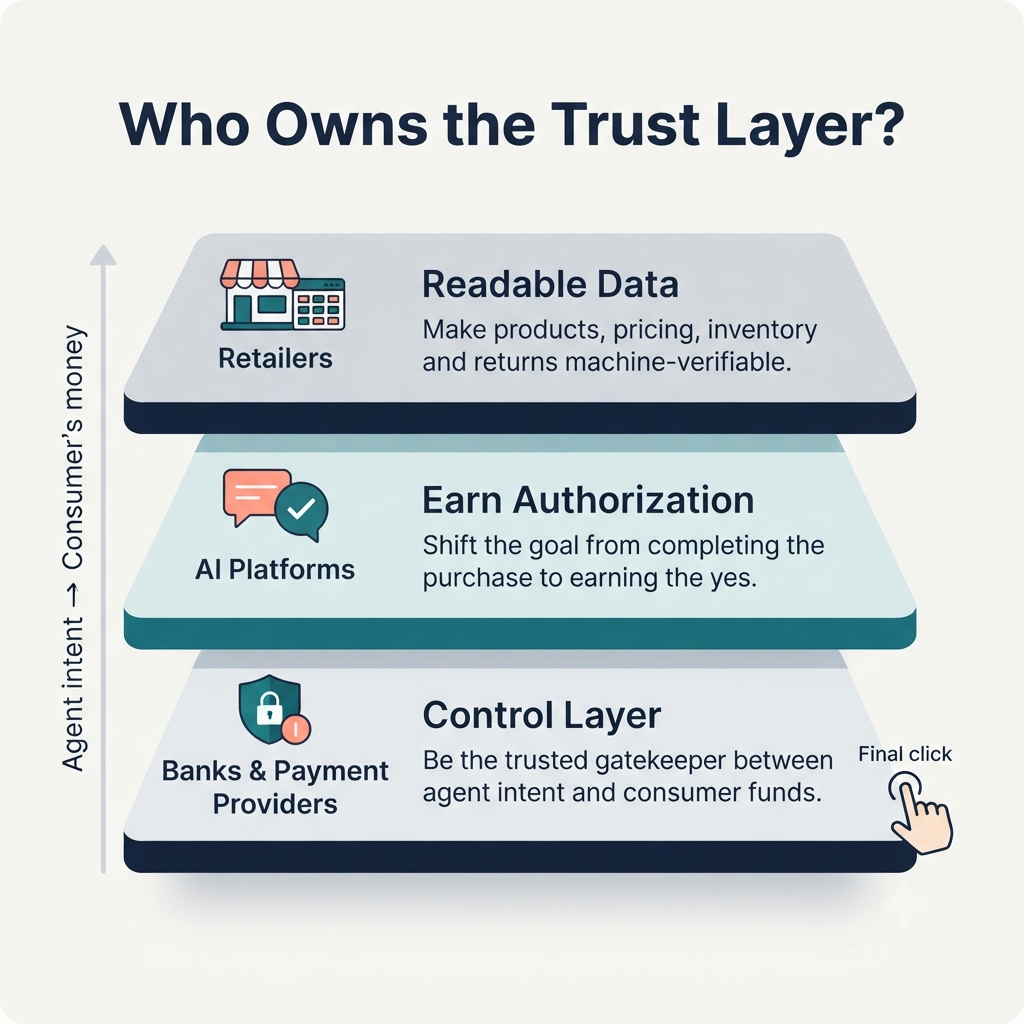
The final click is usually treated as a leak in the conversion funnel. It’s more useful to see it as a trust surface.
For retailers, the opportunity is making product, pricing, inventory, returns, and checkout data reliably readable by machines. For AI platforms, it’s shifting the goal from “complete the purchase” to “earn the authorization.” For banks and payment providers, the upside may be the biggest: becoming the trusted control layer between an agent’s intent and a consumer’s money.
Wildfire’s research suggests consumers trust their bank more than anyone else to handle an AI agent’s payment. That hints at a future where the winning checkout isn’t the most autonomous one. It’s the one that gives people precise control with the least effort.
Will Consumers Eventually Relinquish the Click?
Some autonomy is inevitable. People already accept automation where stakes are low, the task repeats, and the rules are clear: managing subscriptions, routine restocking, small household buys.
But the final click will probably stick around for purchases that are expensive, ambiguous, emotional, or personal. Nobody wants an agent quietly booking a nonrefundable flight, picking out a gift, or buying a medical device without a clear moment to say yes.
So the future of agentic commerce isn’t about removing the human. It’s about changing the human’s job, from operator to authorizer.
AI can do the shopping. Humans will still own the consequences.