
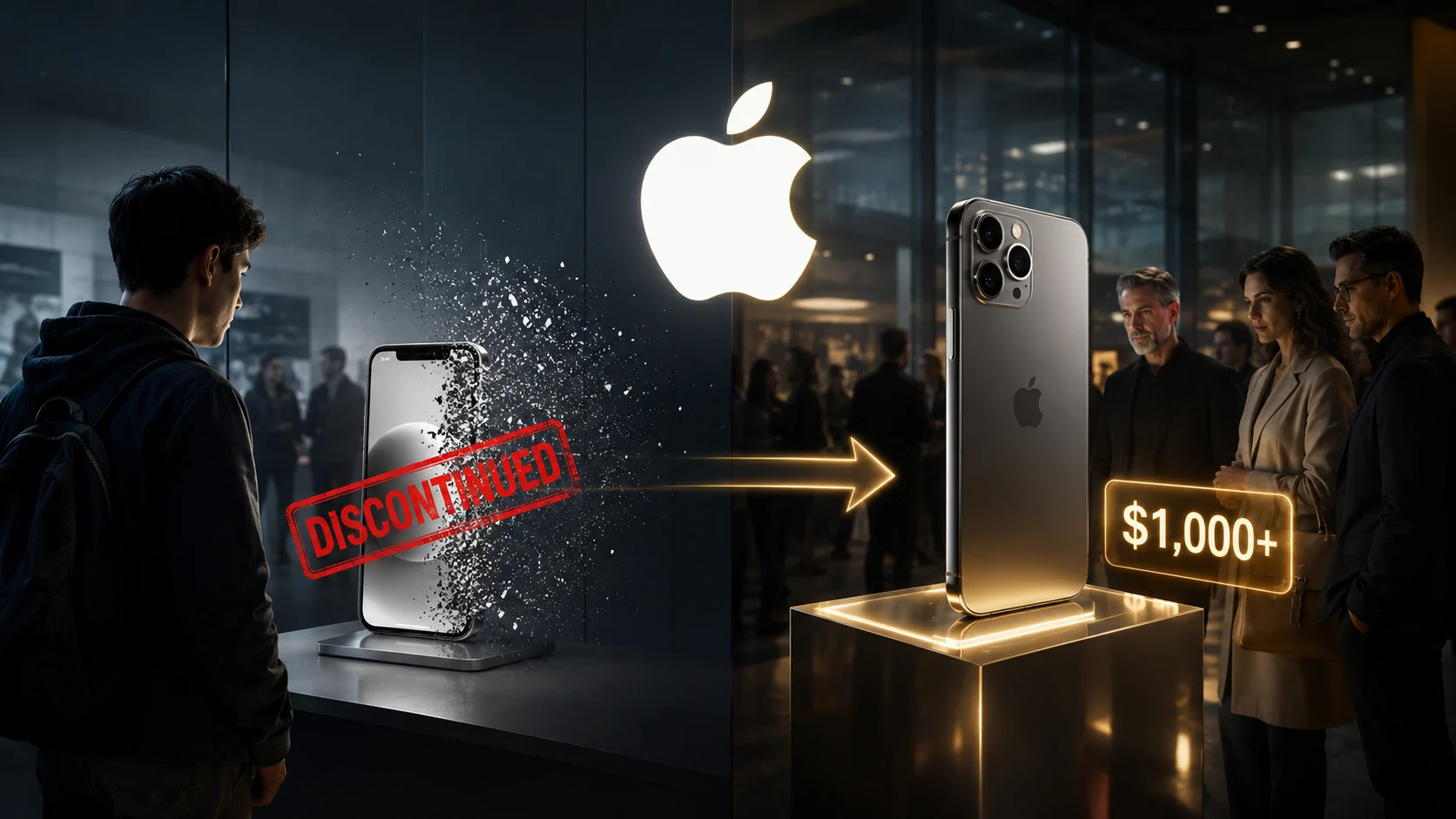
Apple is breaking its 15-year tradition. This September, only the iPhone 18 Pro ($1,200), iPhone 18 Pro Max ($1,399), and a new flagship iPhone Fold will launch. The standard base iPhone 18? Postponed to spring 2027.
The underlying driver: Global memory prices have quadrupled due to enterprise AI server demand, crushing margins on sub-$1,000 devices. Apple’s new playbook is clear: focus exclusively on high-margin luxury devices.
Apple’s 15-Year Tradition Just Ended
For over a decade, Apple launched its complete flagship iPhone lineup simultaneously every September: standard, Pro, and Pro Max.
This year, the standard base model is missing from the fall lineup.
Apple’s fall event will reportedly focus on three ultra-premium devices:
- iPhone 18 Pro (6.3″) — Launching September 2026
- iPhone 18 Pro Max (6.9″) — Launching September 2026
- First-Generation iPhone Fold — Launching September 2026
The base iPhone 18 and new entry-level variants have been pushed to spring 2027—a multi-month separation that marks an unprecedented shift in Apple’s historical hardware strategy.
The $1,000 Tipping Point
| Model | Projected Price | Estimated Margin | Status |
|---|---|---|---|
| iPhone 18 Pro | $1,200 – $1,300 | 45% | Confirmed for Fall |
| iPhone 18 Pro Max | $1,299 – $1,499 | 48% | Confirmed for Fall |
| iPhone 17 (Legacy Base) | $999 | 22% | Remains on sale |
| iPhone 18 (Base) | TBD | ~18% ❌ | Delayed to 2027 |
The Supply Chain Math
Memory component costs surged through late 2025 and into 2026 as global silicon fabrication shifted toward enterprise AI hardware.
- The Impact: Base model margins have compressed toward the sub-20% threshold.
- The Result: Apple can no longer deliver next-generation base hardware under $1,000 without sacrificing its core profitability targets.
Why Apple Delayed the Base iPhone 18
1. The Global Memory Crunch
During Apple’s fiscal Q1 earnings call, CEO Tim Cook described the ongoing memory component environment as a significant supply challenge. Hyperscalers and AI data center operators are buying up high-bandwidth memory (HBM) capacity, forcing suppliers like Samsung, SK Hynix, and Micron to reallocate production lines away from standard mobile DRAM and NAND flash.
2. Strategic Inventory Protection
With standard DRAM supply constrained, Apple is reserving its allocated memory stock—upgraded to 12GB RAM to power on-device Apple Intelligence—strictly for its highest-margin Pro and Foldable hardware. Delaying the base model allows Apple to clear older component inventory via the extended lifecycle of the iPhone 17.
“Memory had a minimal impact in the first quarter, but we believe it will have a more significant ripple effect moving forward as supply and demand remain imbalanced.”
Premium Is the Only Growth Tier Left
The global smartphone landscape has splintered along distinct price brackets:
| Price Tier | Market Trend | Apple’s Position |
|---|---|---|
| Below $800 | Shrinking (-12% YoY) | Exiting primary focus |
| $800 – $1,200 | Flat / Stable | Transitionally filled by legacy models |
| $1,200+ | Growing (+18% YoY) | Dominating with Pro & Foldables |
Rather than struggling against rising bill-of-materials (BOM) costs in the shrinking mid-tier market, Apple is choosing to concentrate its fall sales cycle entirely on the expanding $1,200+ luxury demographic.
Industry Perspectives
Counterpoint Research:
“Memory prices spiking due to enterprise AI demand makes lower-margin, high-volume consumer models structurally difficult to price without aggressive margin compression.”
IDC Analytics:
“The cost structure of next-generation 2nm silicon combined with specialized memory means flagship smartphones are stepping up into permanent higher price tiers.”
What Happens Next?
SEPTEMBER 2026 (Fall Launch)
- iPhone 18 Pro Unveiled (TSMC 2nm A20 Pro)
- iPhone 18 Pro Max Unveiled
- First-Gen iPhone Fold Introduced
SPRING 2027 (Secondary Window)
- Base iPhone 18 Debuts
- iPhone 18e / iPhone Air 2 Announced
Apple’s Strategic Shift
This split isn’t an accidental product delay—it represents a deliberate restructuring of Apple’s consumer portfolio:
- High-End ($1,200+): Prioritized for high margins, immediate access to new silicon, and luxury positioning.
- Entry-Level (<$1,000): Repositioned to off-peak spring launch cycles to manage supply chain costs.
If your smartphone budget is under $1,000, Apple’s message for September is clear: rely on previous-generation hardware or wait until 2027.