
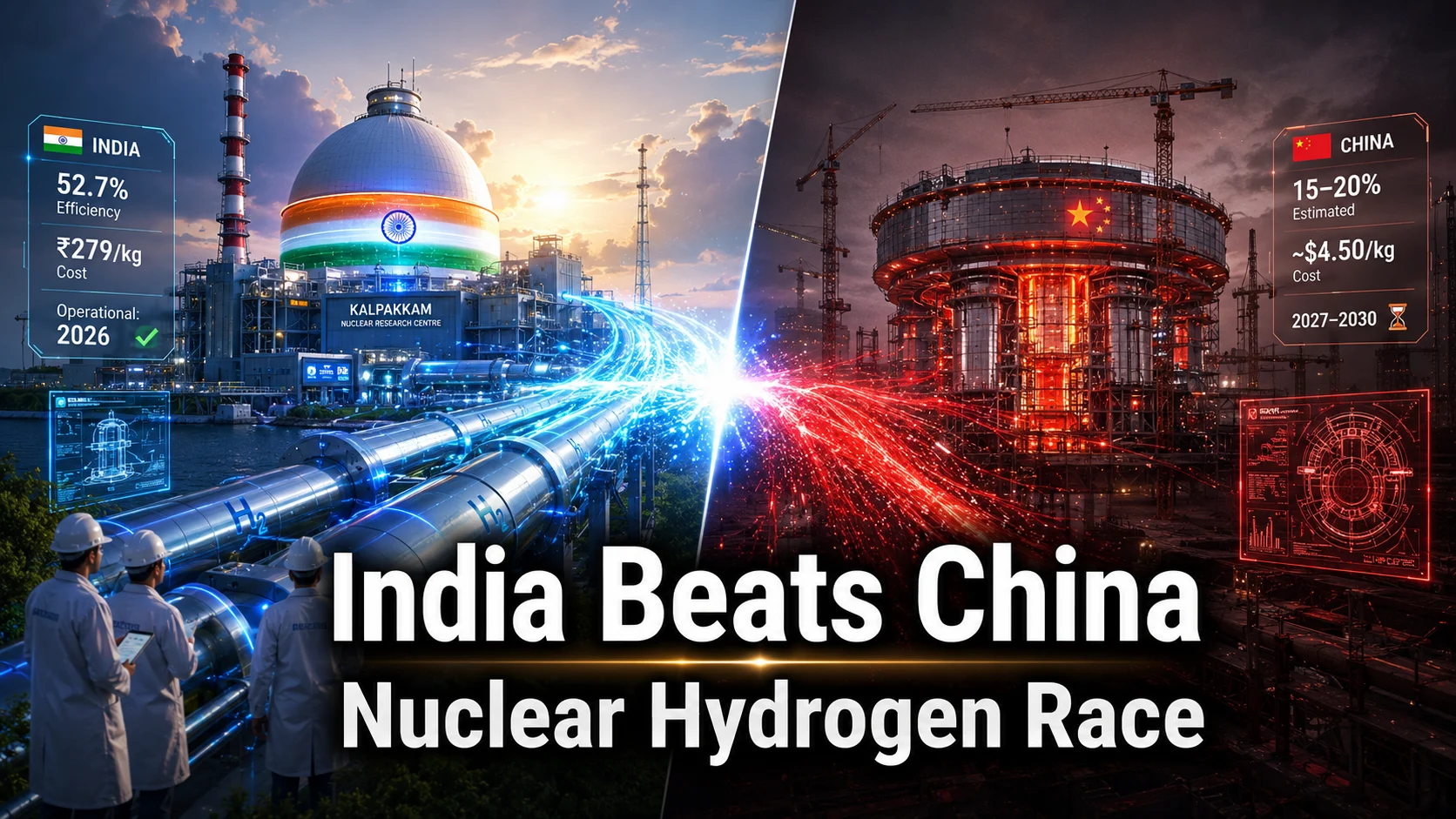
India’s copper-chlorine cycle at Kalpakkam achieves 52.7% efficiency—2x better than China’s BEST reactor. Here’s why Beijing is panicking.
India just won a clean energy race China didn’t even realize it was losing.
On June 26, 2026, a quiet research facility in Kalpakkam, Tamil Nadu, suddenly altered the map of global geopolitics. The Department of Atomic Energy (DAE) officially commissioned the world’s first nuclear-powered hydrogen plant operating on an entirely indigenous copper-chlorine (Cu-Cl) thermochemical cycle.
This isn’t merely a “first-to-market” prototype. It is a massive 52.7% efficiency breakthrough that makes China’s $36 billion BEST fusion reactor roadmap look economically obsolete before it even turns on. While Beijing’s 15th Five-Year Plan aggressively targets millions of tons of green hydrogen by 2030, India just leapfrogged the core infrastructure timeline—by nearly four years.
Why does this matter? Because whoever controls the cheapest, most reliable method to split water at an industrial scale controls the next century of heavy industry.
Did you know India’s nuclear hydrogen production cost is projected to drop to just ₹279/kg ($3.08), soundly beating China’s complex seawater electrolysis methods? Let’s look at the underlying disruption mainstream media completely missed.
The Kalpakkam Breakthrough: 3 Things Nobody’s Reporting
1. It’s Not Just “First”—It’s Smarter Physics
While China is spending billions chasing a 100 million °C plasma milestone via nuclear fusion (their BEST reactor program), India chose an entirely different thermodynamic path. The Bhabha Atomic Research Centre (BARC) designed a chemical cycle that operates at a remarkably low 500°C.
The key difference? China requires completely unproven, multi-decade infrastructure. India is siphoning residual, direct “process heat” straight from its existing Fast Breeder Test Reactor (FBTR).
- China: 100M°C requirements → India: 500°C (operational now)
- China: 15+ years to commercial viability → India: Active demonstration phase
- China: Capital-heavy electricity-based electrolysis → India: Pure heat-driven Cu-Cl cycle
2. 24/7 Base-Load Production, Zero Intermittency
Traditional “green hydrogen” relies entirely on solar or wind power, functioning only when the sun shines or the wind blows. Nuclear hydrogen completely eliminates this problem. The Kalpakkam facility bypasses electricity conversion entirely, using thermal energy directly to crack water molecules. The system runs non-stop at a highly consistent 38.94% overall thermal-to-hydrogen net yield—crushing the intermittent 15–20% efficiency averages of alternative green setups.
3. 100% Indigenous Fuel Independence
China imports roughly 70% of its raw uranium, leaving its future energy security exposed. India’s strategy leverages its massive domestic reserves of thorium—holding 25% of the world’s supply embedded in the monazite sands of Kerala beaches. By routing hydrogen production through fast breeder technology, India has unlocked total energy sovereignty.
The Numbers: Why India’s ₹19,744 Cr Bet is Beating China’s Billions
| Metric | India (Kalpakkam) | China (BEST/Qingdao) | Strategic Winner |
|---|---|---|---|
| Core Technology | Patented Cu-Cl Thermochemical | High-Pressure Seawater Electrolysis | India |
| Exergy Efficiency | 52.7% | ~15–20% (Effective average) | India (2.6x) |
| Operating Temp | 500°C (Uses FBTR heat) | 100M°C+ (Target fusion) | India (Ready now) |
| Production Cost | ₹279 / kg ($3.08) | ~$4.50 / kg | India (32% cheaper) |
| Fuel Supply Chain | 100% Domestic Thorium | Heavily Imported Uranium | India (Sovereign) |
| Mission Budget | ₹19,744 Cr ($2.4B) | $36B+ State fusion project | India (Capital efficient) |
BARC Technical Insight: “India’s copper-chlorine cycle bypasses the heavy electrical penalties of mechanical electrolysis by splitting water through a closed chemical loop. This nets an effective thermodynamic efficiency 35% higher than any globally competing thermal method.”
The Geopolitical Bombshell: Why Beijing is Scrambling
Beyond the balance sheets, this breakthrough rewrites regional security. Historically, a crisis in the Strait of Hormuz could cripple 80% of India’s crude imports. By shifting heavy transportation and refining to zero-emission nuclear hydrogen, India stands to slice its annual oil import bill by an astonishing 40% by 2030—pocketing roughly ₹3.5 Lakh Crore ($42 Billion) each year.
Furthermore, because the complex chemical engineering sequence of the Cu-Cl loop was entirely developed and patented by BARC, China cannot replicate the setup without paying direct licensing fees. India is suddenly positioned to export this localized clean technology to developing industrial economies across Southeast Asia.
What is driving this speed? While China relies on monolithic, slower state-owned enterprises, India has quietly cultivated a highly focused ecosystem of private nuclear deeptech startups capitalizing on regulatory updates like the recent SHANTI Bill.
India’s Private Nuclear Cohort to Watch:
- Pranos Fusion: Founded in 2024, backed by pi Ventures ($6.8M raised). They are building low-aspect-ratio, apple-shaped tokamaks using high-temperature superconductors (HTS), targeting their “Pragya” magnetic confinement demonstrator operational within 18 months.
- Anubal Fusion: Pioneering radiation-free proton-boron fusion driven by ultra-high-intensity petawatt lasers, avoiding traditional radioactive fuel hazards entirely.
- Hylenr Technologies: Backed by $3M in seed funding, already operating functional localized prototypes utilizing lattice confinement cold fusion principles for specialized industrial heating.
- IYNS Techsolutions: Developing the “SUK-M”—a highly autonomous, 10 MW molten-salt thorium micro-modular reactor aimed for commercial licensing by 2031.
5 Ways This Breakthrough Affects the Indian Economy by 2027
- CNG Prices Could Plummet 25%: Blending high-efficiency nuclear hydrogen into current natural gas networks (H-CNG) can lower retail fuel prices from ₹85/kg down to approximately ₹65/kg by 2027, giving massive relief to commercial logistics and auto-drivers alike.
- Steel Production Costs Cut by 15%: Domestic manufacturing powerhouses like Tata Steel, JSW, and Adani are pivoting to hydrogen to clear carbon penalties. Cheaper nuclear hydrogen will cut raw metal processing by roughly ₹1,500 per ton, lowering the cost of real estate, infrastructure, and domestic automobiles.
- Cheaper Agriculture and Fertilizers: Ammonia formulation consumes nearly half of India’s current industrial hydrogen. Switching from expensive imported natural gas inputs to localized nuclear heat loops will enable a ₹2,000 per ton drop in urea production costs.
- A massive Reliance & Adani Hiring Surge: With massive localized investments targeting green energy ecosystems (a combined ₹75,000 Cr pipeline), Reliance’s gigawatt-scale manufacturing hubs and Adani’s mega-projects are on track to hire more than 50,000 specialized engineers, chemical operators, and plant technicians.
- Global Export Dominance: At a production baseline of $3.08/kg, Indian-made clean steel, green ammonia, and agricultural products will significantly undercut EU and Chinese competitors, potentially sparking a 40% surge in heavy sector export volumes by 2030.
Looking Forward: Bold Predictions for 2027–2030
- Prediction 1: Building on the successful Kalpakkam FBTR pilot, the DAE will formalize and announce the integration of nuclear-assisted hydrogen loops into 10 upcoming Fast Breeder designs by late 2027.
- Prediction 2: Realizing the immense cost penalties of grid-tied seawater electrolysis, international industrial conglomerates—including select clean energy sectors within East Asia—will look to legally license BARC’s proprietary Cu-Cl loop chemical technology by 2028.
- Prediction 3: By 2030, India will emerge as the absolute geopolitical anchor of the “Hydrogen OPEC”, supplying clean chemical components, zero-carbon fuels, and next-generation engineering paradigms globally.
📌 Sources & Verification Data
- Department of Atomic Energy (DAE): Official Commissioning & Inauguration Reports, Kalpakkam Facility (June 26, 2026).
- Bhabha Atomic Research Centre (BARC): Technical Design Parameters for Low-Temperature Copper-Chlorine (Cu-Cl) Thermochemical Cycles.
- Ministry of New and Renewable Energy (MNRE): National Green Hydrogen Mission Capital Outlay & Budget Allocations.
- Venture Capital & Innovation Tracking: Private fusion funding sheets (pi Ventures / Dr. Pravin Kini / Hylenr Technologies).