
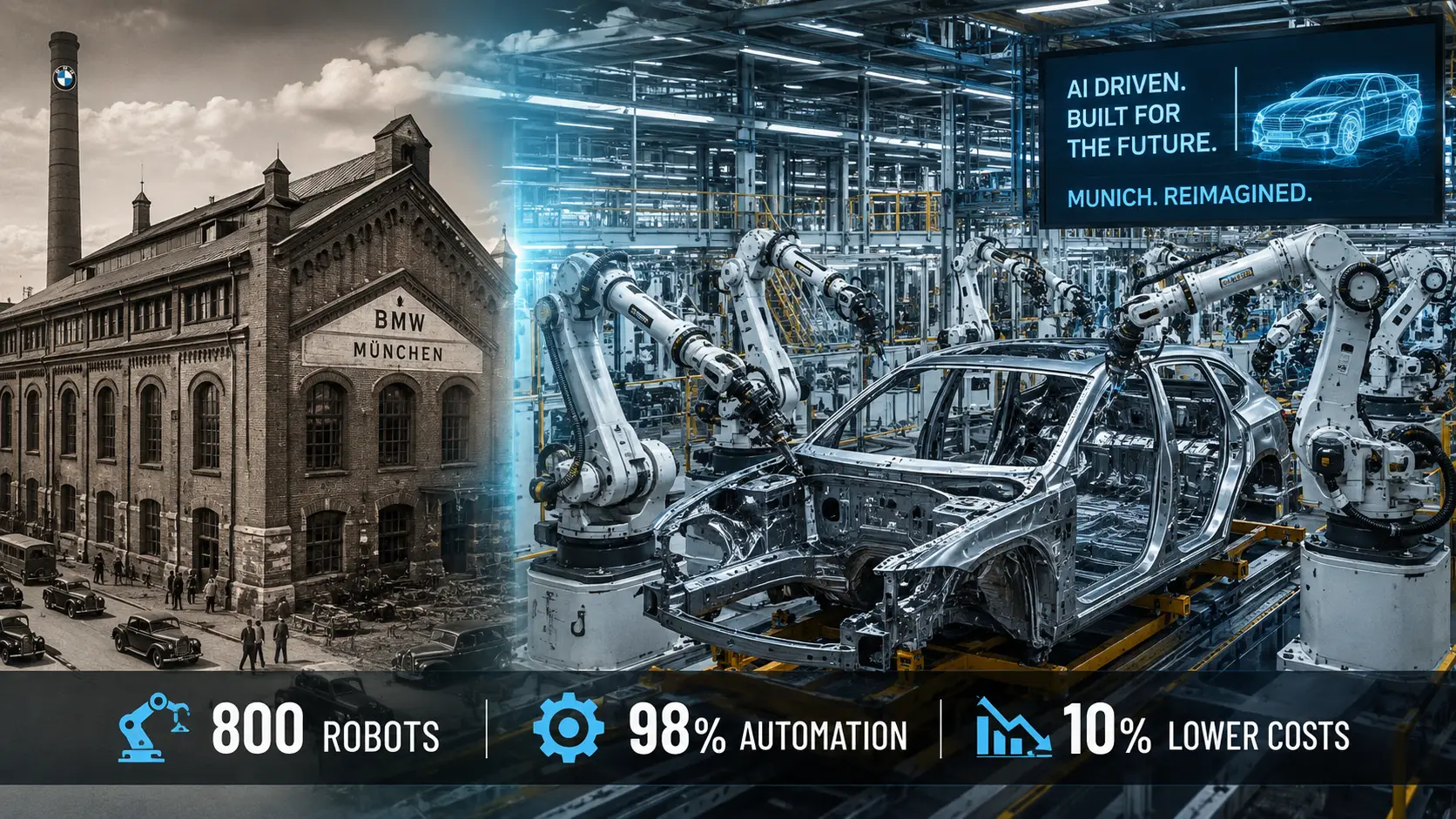
BMW is tearing up the traditional factory playbook. The automaker is integrating 800 AI-driven industrial robots into its historic Munich plant, targeting 98% assembly automation and a reported 10% reduction in production costs compared with legacy 3 Series builds.
How does a factory with roughly a century of manufacturing history become a high-automation EV site without being demolished? BMW’s answer is a production overhaul built around flexible tooling, connected machinery, and software-led quality control.
The stakes are immediate: as EV competition intensifies, manufacturers must lower costs while reengineering factories designed for combustion-engine vehicles.
1. The Transformation at a Glance
| Metric | Reported figure | Why it matters |
|---|---|---|
| AI-driven industrial robots | 800 | Shows the scale of automation |
| Assembly automation | 98% | Indicates how much of production is machine-assisted |
| Production-cost reduction | 10% | Connects technology to business impact |
| Facility age | Approximately 100 years | Highlights the engineering challenge |
Note: Figures are attributed to BMW official announcements and corporate reporting.
Can a century-old factory outperform a purpose-built EV plant?
2. Why Munich Matters
Operating for over 100 years, BMW’s Munich facility is facing its most radical evolution. Converting an existing plant is drastically harder than building a brand-new facility on an empty plot of land. Engineers had to navigate strict structural constraints, legacy equipment, and continuous assembly lines.
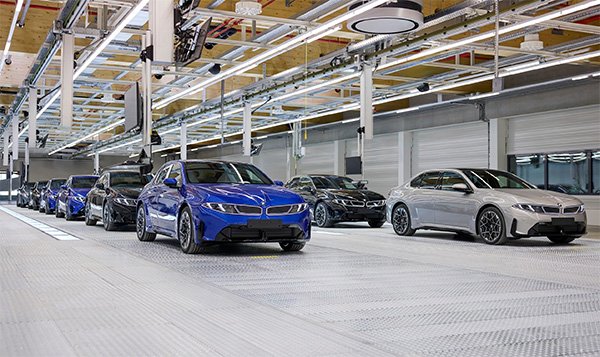
Remarkably, BMW managed this overhaul while keeping up to 1,000 vehicles a day rolling off the line during construction. By 2027, the site will transition entirely to producing electric vehicles like the Neue Klasse i3.
3. How the Robots Change Production
The engineering upgrade goes far beyond simply placing machines on a shop floor. According to BMW Group Newsroom, the overhaul uses precise digital blueprints:
- Virtual planning: A complete digital twin modeled the body shop before physical installation.
- Body assembly: 800 new industrial robots manage joining processes at a 98% automation rate.
- AI inspection: Smart cameras scan the paint shop in real time to catch minor surface defects instantly.
- Software coordination: Vehicles on the line transmit the status of up to 20,000 features directly to production systems.
Does 98% assembly automation make production cheaper—or simply shift costs into software and maintenance?
4. The 10% Cost Question
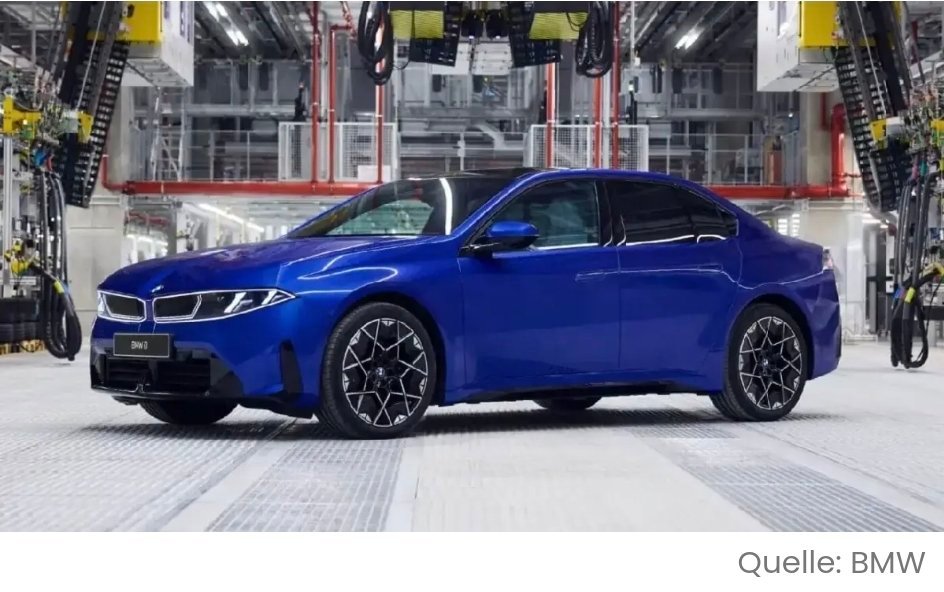
BMW plant leadership notes that overall production costs will drop by an additional 10% with the rollout of the new electric i3, bringing expenses below the level of older gas-powered models.
This savings is driven by simplified vehicle architecture and streamlined manufacturing processes rather than just labor cutbacks. However, analysts note that lower manufacturing expenses do not automatically translate to immediate price drops for retail customers.
5. Automation Does Not Eliminate People
High-tech factories still rely heavily on human expertise. While machines handle heavy lifting and repetitive welding, workers are transitioning into software monitoring, system integration, and quality management roles.
“The people at the factory played an essential role in making this transformation a success,” states Peter Weber, Head of BMW Group Plant Munich. “With their high level of expertise, enthusiasm and tremendous dedication, our employees have shown that world-class industrial production is possible even under the toughest conditions.”
For broader industry context on automated manufacturing systems, explore analyses by Automotive News Europe and Manufacturing Digital.
BMW says:
— Greg Kable (@GregKable) August 6, 2026
– Its Munich plant has been rebuilt
– Manufacturing costs fall another 10% with the start of i3 sedan production
– From 2027, the plant is set to become EV-only
Big industrial shift@BMWGroup pic.twitter.com/t64rqb3i1B
6. What This Means for BMW
- Lower manufacturing costs, driven by scaled automation and the simplified Neue Klasse platform.
- Faster layout flexibility using digital twin simulations.
- Consistent quality control via AI-driven optical sensors.
- A proven blueprint for converting other legacy automotive plants worldwide.
Would you trust a vehicle built almost entirely by connected machines?