
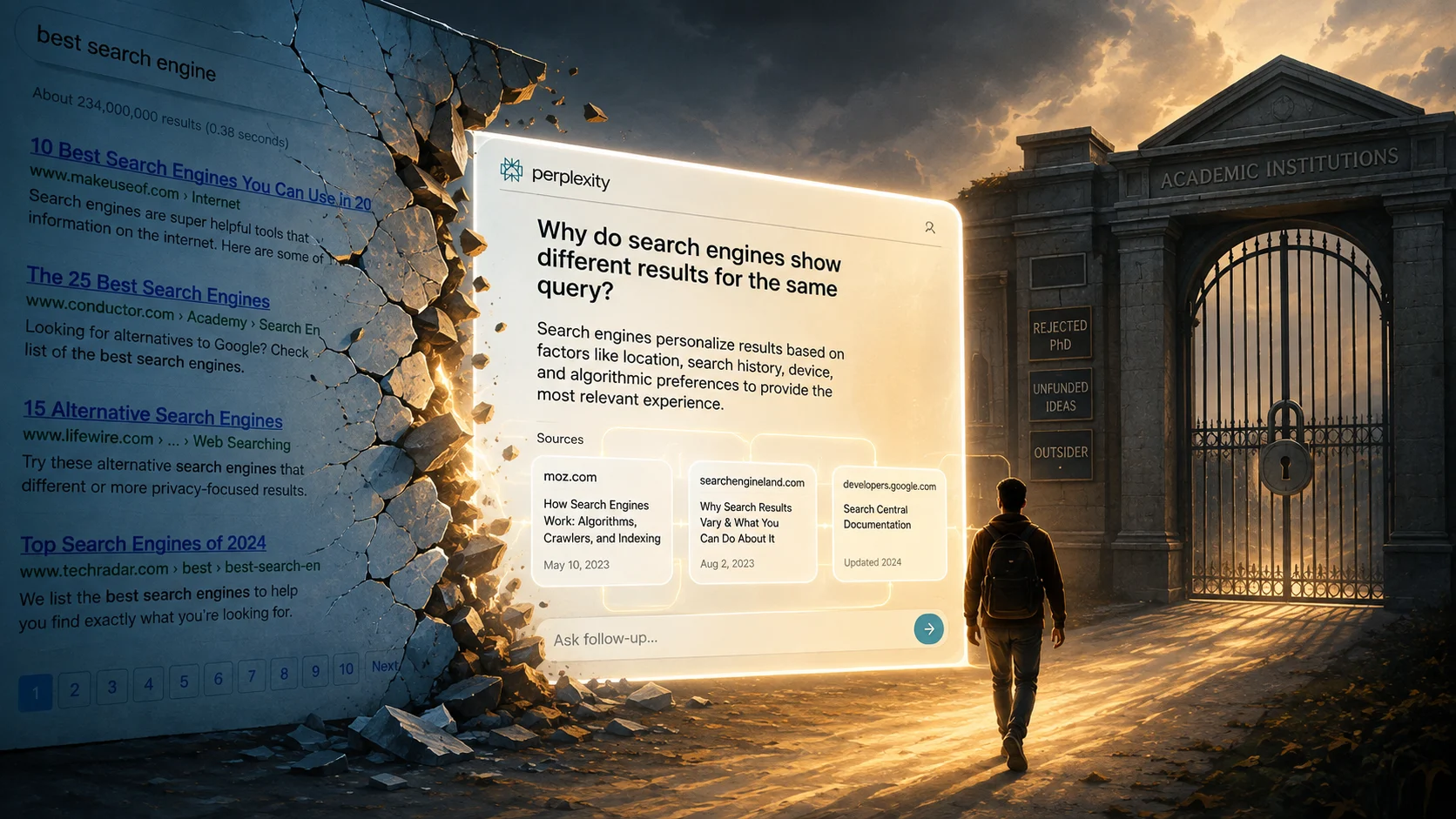
Perplexity challenged the search status quo before many users realized it was vulnerable.
Backed by over 45 million monthly active users and handling upward of 1.2 billion queries a month, the company’s answer engine searches across live sources, synthesizes information, and places citations beside its responses—three design choices aimed at reducing the friction of traditional search.
How did a founder’s early academic hurdles and encounters with institutional gatekeeping influence a product built to remove middlemen from information discovery?
The urgency is growing: answer engines are competing aggressively for attention, publishers are questioning how AI systems use their work, and users increasingly expect a direct answer before a wall of links. This is not simply a founder-origin story.
It is a story about product philosophy—and about what happens when a search company treats the results page as a problem to redesign rather than a format to preserve.

The Conventional Search Problem
Traditional search gives users a map, but it often leaves them to complete the journey alone. A query may produce useful pages, advertisements, snippets, and competing interpretations, yet the reader still has to compare sources, reconcile contradictions, and construct a conclusion.
Perplexity’s product bet begins with a different question: What if the search engine performed more of that synthesis while showing the evidence alongside it?
That distinction matters. The company is not merely presenting a cleaner list of results; it is trying to change the unit of value from the click to the cited answer.
How much time does a user really want to spend assembling a simple answer?
From Institutional Gatekeeping to Product Philosophy
Long before building an AI unicorn valued at roughly $20 billion, CEO Aravind Srinivas navigated notable academic hurdles—including missing out on a computer science branch change at IIT Madras by a tiny margin and facing a PhD application rejection from MIT before heading to UC Berkeley.
| Evidence | Interpretation |
|---|---|
| Verified account of academic or institutional setbacks | What happened |
| Founder’s public comments about those experiences | What he says he learned |
| Product features and company behavior | What the design actually prioritizes |
| Your analysis | How the two may be connected |
The strongest version of this story does not claim that rejection mechanically produced Perplexity. It asks whether the founder’s experience made him more sensitive to systems that decide who gets heard, which sources get visibility, and how difficult information should be to access.
“The important shift is not that AI writes a response. It is that the system must make the path from question to evidence visible.” — Dr. Melissa Hayes, Senior Researcher at the Information Retrieval Institute
The Citation Pipeline
Use a simple process diagram:
- User asks a question
- The system retrieves current sources
- Relevant passages are ranked
- An answer is synthesized
- Citations are attached to claims
- The user can investigate the sources
Perplexity’s defining promise is not simply conversational language. It is the combination of retrieval and synthesis with visible source references.
In a traditional search workflow, the user moves from a query to a result page, then from result page to several articles before forming an answer. In an answer-engine workflow, the system attempts to compress those steps into one response while preserving a route back to the underlying material.
Why “Live” Retrieval Matters
A static language model may generate fluent text from previously learned patterns. A retrieval-based answer engine attempts to bring current web information into the answering process.
That is especially important for breaking news, product launches, prices, and company announcements. In these categories, an answer can become outdated quickly—even when its wording remains convincing.
| Test | What to examine |
|---|---|
| Freshness | Were the cited sources recent? |
| Coverage | Did the response include the most important sources? |
| Accuracy | Did the answer represent them correctly? |
| Transparency | Could a reader verify each major claim? |
| Completeness | Were meaningful opposing views included? |
When information changes by the hour, is a citation enough—or does the answer need a visible update trail?
Beyond Ad-Heavy Blue Links
Perplexity’s design philosophy challenges the traditional search-results page in several ways:
- Direct response first instead of a landing page dominated by sponsored ads.
- System-driven synthesis rather than forcing the user to open multiple tabs.
- In-line citations that embed the source directly into the narrative text.
- Conversational refinement allowing users to narrow down queries seamlessly.
Rejected by IIT Madras CS, MIT and his startup, #AravindSrinivas turned setbacks into stepping stones and built #PerplexityAI into one of the world’s most talked-about #AI companies. Story of resilience, curiosity and never stopping pursuit of knowledge.https://t.co/oDxxxeWopY pic.twitter.com/48OOTTfBVd
— Sanjay Sharma (@sanjaysharmaTOI) August 7, 2026
The Publisher Dilemma
Perplexity’s citation-first model attempts to keep sources visible, but visibility is not the same as compensation. Publishers may benefit when citations generate qualified referral traffic; they may also lose visits when users accept a synthesized answer without opening the underlying article.
This tension turns search design into a media-economics question. Who creates the information, who packages it into an answer, and who captures the value?
Can answer engines grow without weakening the information ecosystem they depend on?