
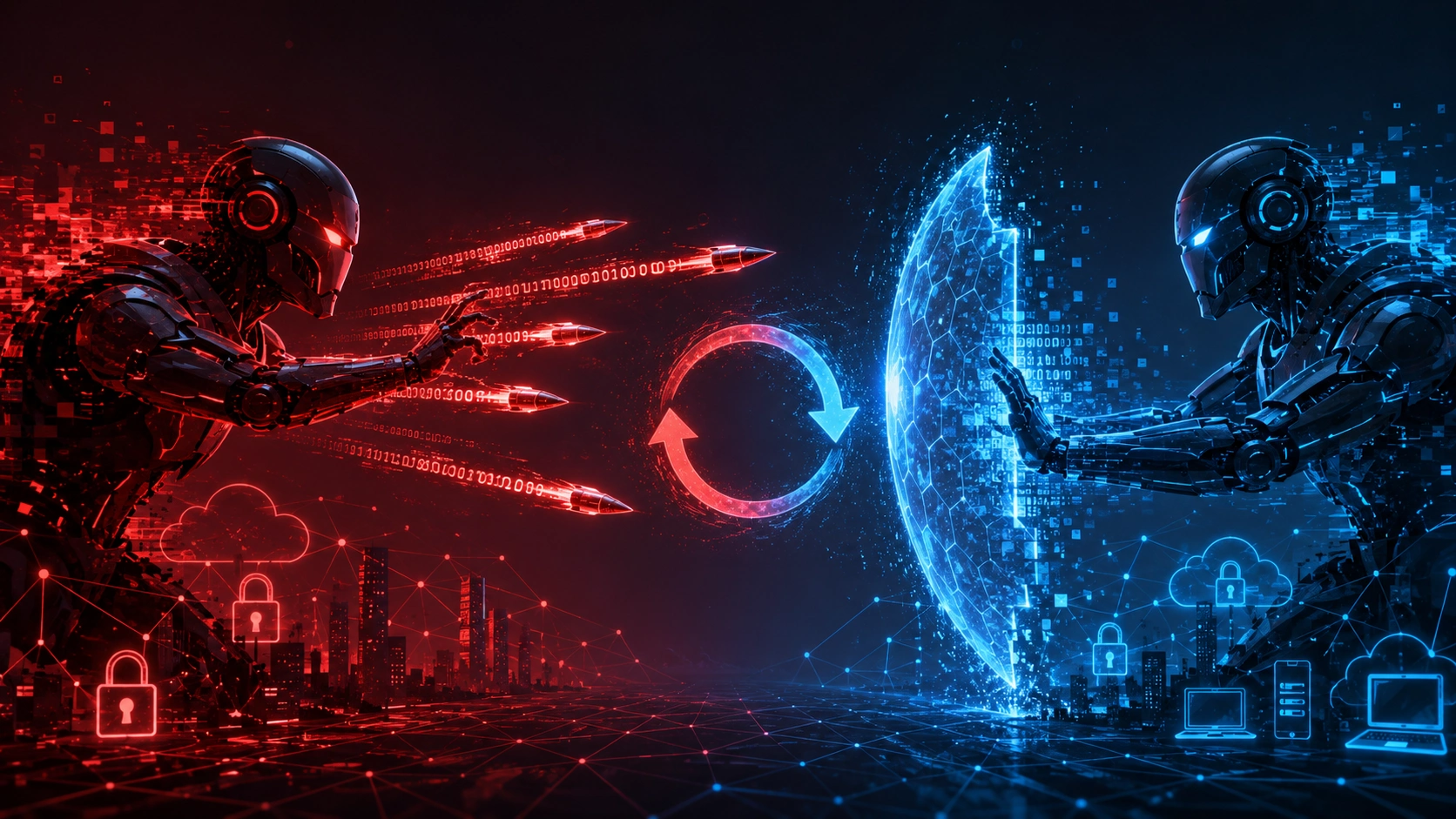
What “AI agent vs. AI agent” means in cybersecurity
In simple terms, one AI agent may be trying to find and exploit weaknesses while another is trying to detect and stop those actions.
Think of it like an automated burglar and an automated security guard constantly reacting to each other.
The important point is that “fighting” is usually shorthand—not literal AI combat. It describes competing automated systems taking actions and adapting to what happens next.
AI agent vs. conventional security automation
Traditional security automation usually follows predefined rules, while an agentic system can evaluate a goal, consider available information and determine its next action.
| Conventional automation | AI agent |
|---|---|
| Follows fixed playbooks | Can plan actions |
| Usually predictable | Can adapt to new situations |
| Rule-driven | Goal-driven |
| Often waits for predefined triggers | Can continuously evaluate context |
Microsoft describes agentic AI in cybersecurity as using autonomous agents to detect, investigate and respond to threats with minimal human intervention.
How an offensive AI agent identifies and attacks targets
An offensive AI agent can potentially work through a sequence rather than performing just one automated task.
At a high level, it can:
- Identify potentially interesting targets.
- Analyze available information.
- Prioritize weaknesses.
- Choose an action based on its objective.
- Observe the result.
- Adapt its next decision.
The difference is the feedback between these steps. Instead of following one rigid script, the agent can adjust its plan as conditions change.
How a defensive AI agent detects and responds
A defensive AI agent works from the opposite objective.
It can continuously examine security telemetry, investigate suspicious behavior and recommend—or, where authorized, perform—responses.
For example, a defensive agent might detect unusual activity on an endpoint, investigate related signals and trigger containment while notifying a Security Operations Center (SOC).
This is why autonomous cyber defense is becoming an important research area.
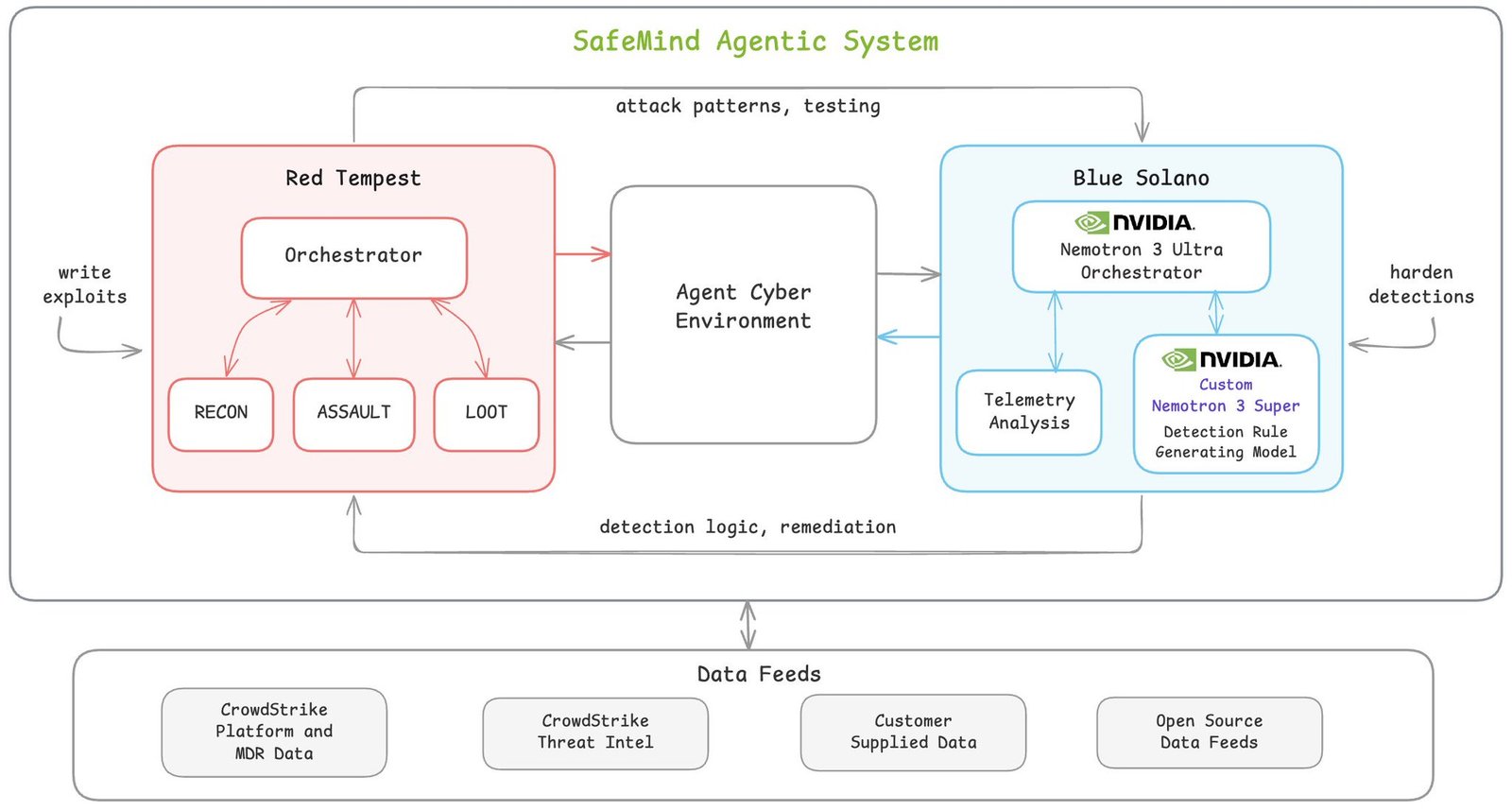
The agent-to-agent attack/defense feedback loop
The interesting part begins when both sides operate continuously.
Attack attempt → defensive detection → defensive response → attacker adaptation → new attack attempt
It resembles a game of chess where both players can make moves much faster than humans.
The offensive agent changes its behavior based on what works. The defensive agent changes its response based on what it observes.
That creates an attack/defense feedback loop.
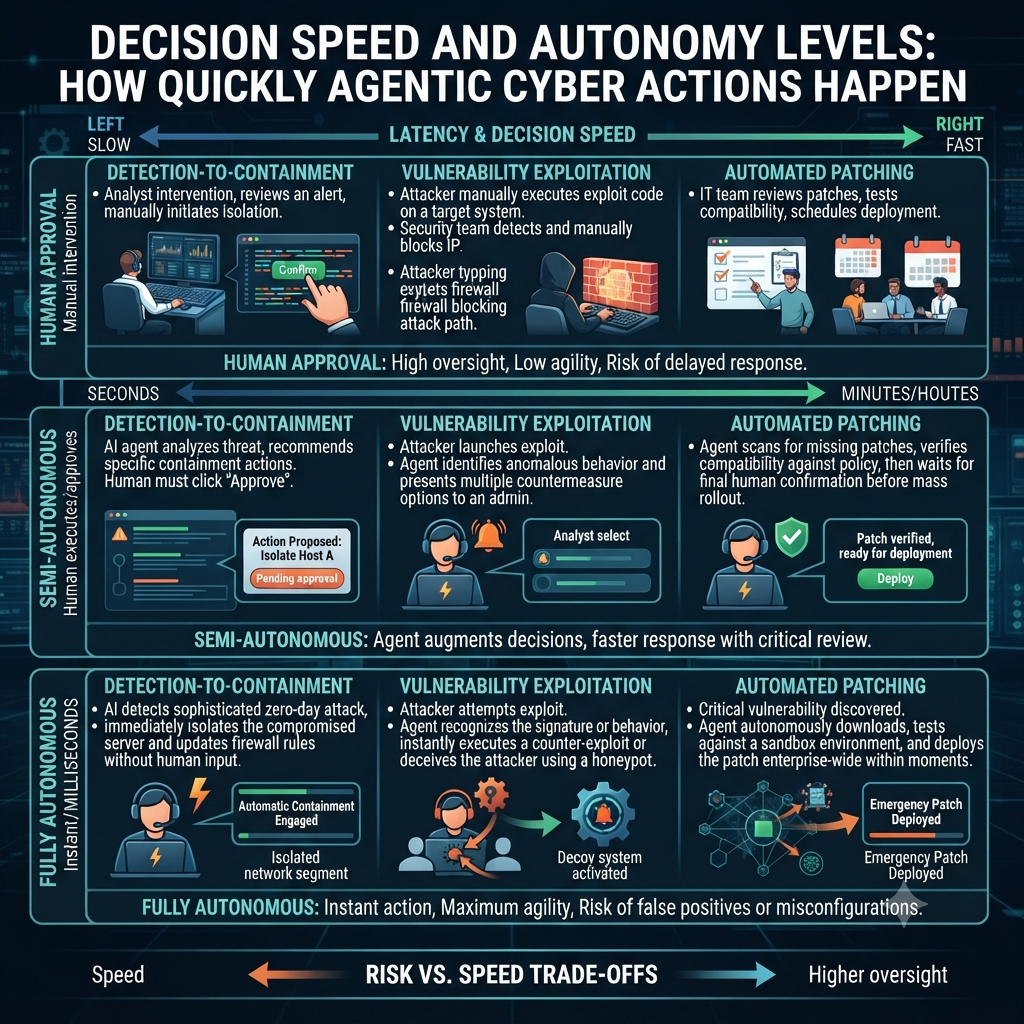
How agents make decisions without waiting for human approval
Agents do not necessarily need a person to approve every individual action.
Instead, organizations can establish policies, permissions, confidence thresholds and escalation rules that determine what an agent is allowed to do.
- Low-risk action → agent handles it automatically.
- Uncertain situation → agent asks for human review.
- High-risk action → agent stops and escalates.
This creates a human-in-the-loop model rather than removing humans completely.
Examples of autonomous attack and defense scenarios
Consider a few simplified scenarios:
- An offensive agent continuously searches for weaknesses and changes its approach when blocked.
- A defensive agent detects abnormal endpoint behavior and automatically begins containment.
- An attacker adapts after a defensive control blocks its initial attempt.
- A defender changes its response after detecting a new behavioral pattern.
These scenarios illustrate the concept without suggesting that today’s systems can independently conduct unrestricted cyberwarfare.
Why agentic systems make cyber conflicts faster
Humans need time to investigate, communicate and decide.
Agents can operate continuously.
That can compress the traditional cycle of detect → investigate → decide → respond.
NIST has highlighted the security implications of AI agents that can independently make decisions and interact with real-world systems.
Where humans fit into an agent-vs-agent battle
Humans still matter enormously.
They define objectives, establish permissions, set safety boundaries, investigate unusual situations and decide when an agent should be stopped.
The goal is therefore not necessarily “humans versus AI.” It is more accurately humans supervising increasingly autonomous systems.
Why this is different from traditional automated cybersecurity
Traditional automation is closer to a checklist: if X happens, perform Y.
Agentic cybersecurity is closer to giving a security system a goal and allowing it to determine a sequence of actions within defined boundaries.
That flexibility is also what creates additional security and governance challenges. NIST notes that AI agents introduce security concerns that require adaptation of existing cybersecurity practices.
The limitations of current autonomous cyber agents
Today’s autonomous cyber agents are not perfect.
- Incorrect decisions and false positives
- Limited visibility into complex environments
- Unreliable reasoning
- Adversarial manipulation
- Unsafe or unexpected actions
- Governance and permission constraints
Research on autonomous cyber defense also highlights reliability, execution safety, coordination and governance as continuing challenges.
Also Read: GPT-6 Astra Is Here: What OpenAI’s New AI Model Actually Changes
Are AI agents really “fighting” each other?
Not literally.
The phrase AI agents fighting AI agents is mainly a useful way to describe autonomous offensive and defensive systems reacting to one another.
But the underlying change is real: cybersecurity is moving from software that simply follows instructions toward systems that can reason, adapt and act.
And when both sides become more autonomous, the battle can happen at machine speed—not human speed.
$CRWD and $NVDA just launched SafeMind to bring frontier AI to cyber defense with George Kurtz saying “the attackers had frontier AI and the defenders didn’t. That changes now.”
SafeMind is CrowdStrike’s answer using autonomous red and blue agents to continuously attack, learn… pic.twitter.com/D5ngdAULPh
— Shay Boloor (@StockSavvyShay) September 1, 2026