
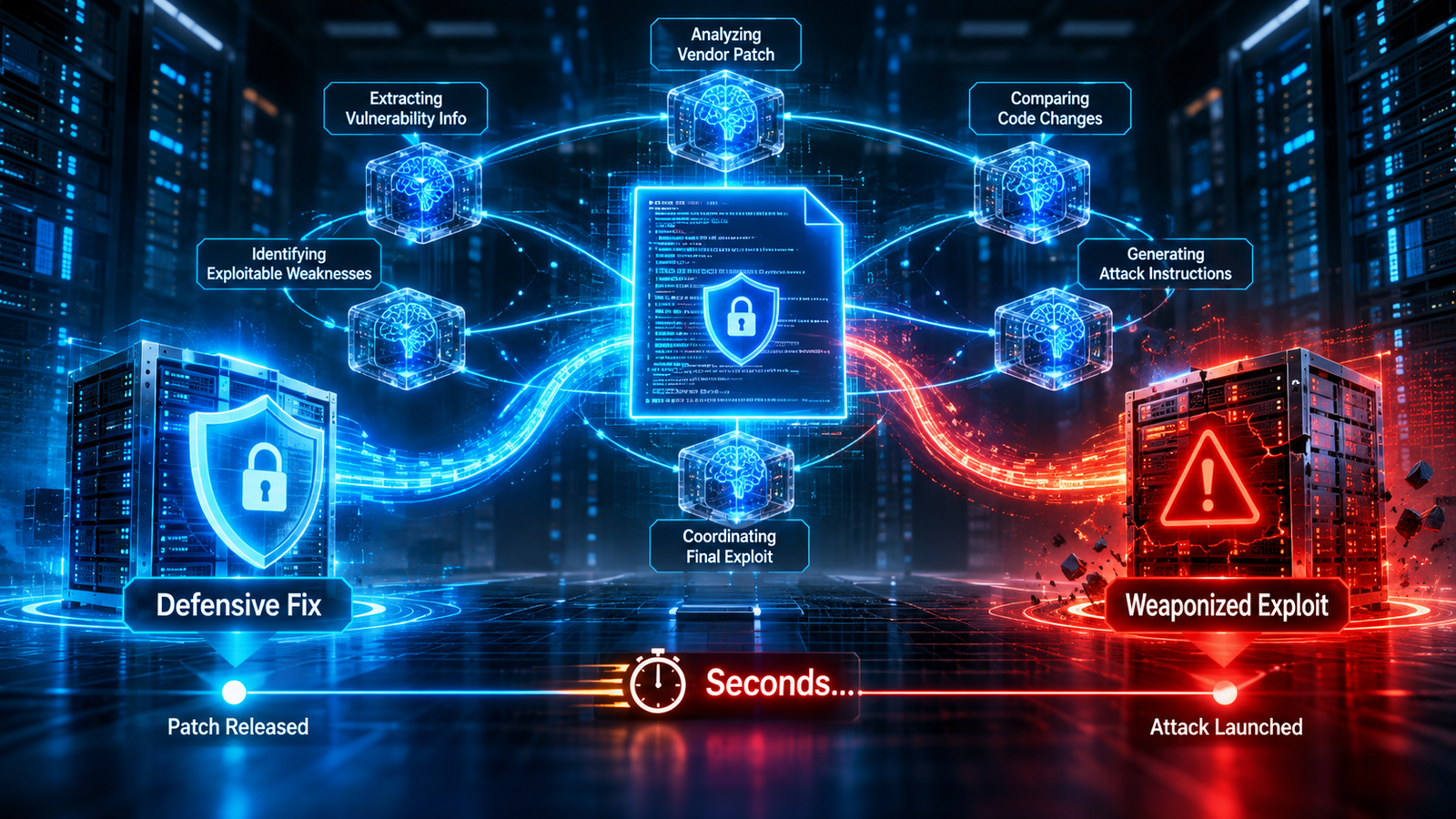
Patches have always told attackers where a bug lived. What’s new is that AI agents can now take that hint and run with it on their own. Google’s Threat Intelligence Group described a framework called exploit_agent that compared patched and unpatched code, worked out the likely flaw, drafted an exploit, and ran it without a human in the loop. The attacker’s job is shifting from hunting unknown zero-days to mass-producing attacks on known, already-patched flaws before organizations get around to updating. For defenders, patch speed, exposure management, and automated detection are now one problem, not three.
The patch that became a blueprint
Picture a vendor shipping a security update at 9:00 a.m. By the time most security teams have read the advisory and argued over priority, an automated system may have already pulled the release, compared it with the old version, guessed at the flaw, built a candidate exploit, and started testing it against exposed servers.
A patch used to be a remedy. Now it’s also a map of the wound.
Why patches are such good raw material
Attackers like n-day vulnerabilities (flaws that are public and already fixed) for a simple reason: the hard part is done. With a zero-day, you don’t even know where to look. With a patch, someone has pointed at the exact spot. The changed code, the release notes, and any public research all narrow the search.
The vendor also already knows how the bug behaves. What’s left is working out how to trigger it, which is a much smaller problem.
Web applications make especially easy targets. They’re usually internet-facing, their versions are often visible from outside, and plenty of organizations run them weeks or months behind the latest release. Put those together and the gap between “patch published” and “exploit working” shrinks, turning every routine update cycle into a race.
Inside exploit_agent
The most important thing to understand is that this isn’t one all-knowing hacker AI. It’s a pipeline, with different agents handling different jobs.
| Stage | What the agent does | Why it matters |
|---|---|---|
| Monitoring | Watches patch announcements, releases, repositories, and version changes | Detects new attack-relevant material quickly. |
| Differential analysis | Compares unpatched and patched codebases | Isolates the likely security fix and the vulnerable behavior. |
| Vulnerability reasoning | Correlates diffs with release notes, CVEs, PoCs, and prior research | Turns a code change into a hypothesis about the flaw. |
| Exploit development | Drafts and refines exploit candidates | Converts analysis into an actionable attack path. |
| Execution loop | Tests and launches attempts automatically | Removes human approval from the offensive cycle. |
| Post-compromise tooling | Supports reconnaissance, brute forcing, and webshell activity | Extends initial access into broader intrusion operations. |
According to GTIG, the framework tied together several frontier and locally hosted language models. An orchestrator coordinated the specialized agents, passed context between them, and called tools through interfaces like MCP.
Reading the fix, not the feature
This is the technical heart of the story, and the idea is simpler than it sounds.
Diffing just means comparing two versions of the same software, the vulnerable one and the fixed one, and looking at what changed. Security fixes tend to land in predictable places: input validation, authentication checks, deserialization, file handling, access control, and how database queries get built. A small, focused change often points straight at the weak spot, because the fix shows what the old code forgot to check.
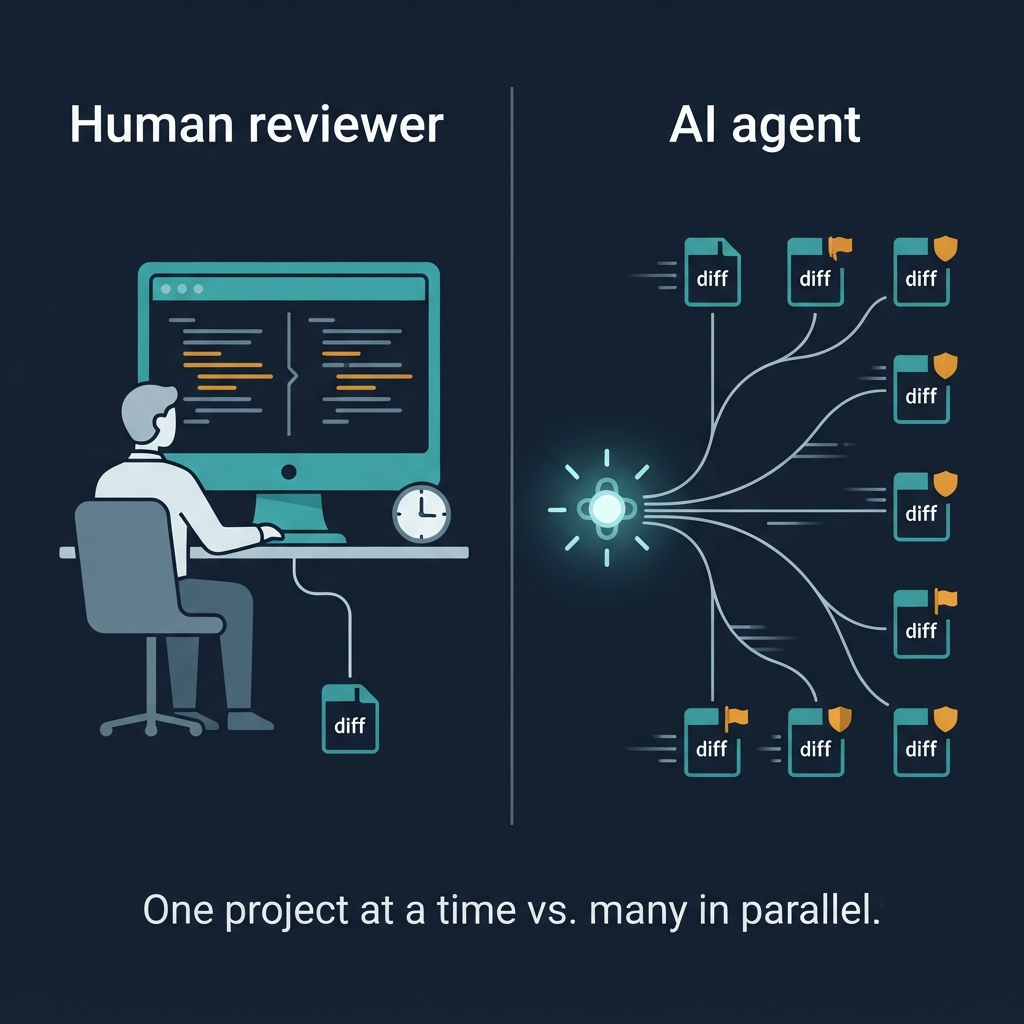
A human reviewer can do this, but slowly and for one project at a time. An AI agent can run the same review across many projects and releases, and it can sort out which changes look security-relevant and which are just ordinary feature work.
Here’s a conceptual example, with no exploit details. Say a patch adds a permission check in front of a file-download function. That strongly suggests the earlier version let unauthorized users reach that function. The agent’s task is then to figure out the request path, the parameters involved, and the conditions under which the old behavior could be triggered.
The autonomous loop
Seen end to end, the workflow looks like this:
- Observe: Spot a new patch or release.
- Diff: Compare the vulnerable and fixed versions.
- Hypothesize: Identify the likely vulnerability class and the affected component.
- Validate: Check release notes and public research, and test behavior in a controlled environment.
- Generate: Produce an exploit candidate.
- Execute: Try it against targets.
- Escalate: If it works, move on to reconnaissance and persistence.
Automation has sped up individual steps here for years. What’s different is that a multi-agent system can chain all of them together, with the orchestrator keeping track of context along the way.
Why “hours” changes the defense model
It would be an exaggeration to say every patch now becomes a working exploit in an afternoon. The real point is that the cost, time, and skill needed to weaponize a disclosed flaw keep dropping.
Traditional patch management quietly assumed a buffer: a flaw gets disclosed, someone eventually writes an exploit, and mass exploitation comes later. Autonomous tooling eats into that buffer, especially for widely deployed web apps with public source code or predictable release patterns.
GTIG also pointed out that attackers may find this approach more efficient than zero-day hunting, since a patch hands them a bounded set of material to study. The takeaway is uncomfortable but clear: monthly patch cycles and manual triage alone won’t cut it anymore.
What Google did, and didn’t, establish
It’s worth being careful here, because the coverage has been breathless in places.
What GTIG found was an exposed staging server hosting exploit_agent, along with stolen victim data and post-compromise scripts. What it didn’t report was a specific exploited vulnerability, a victim count, or a measured time between patch release and exploit.
So the defensible claim is that this framework was built for autonomous patch-to-exploit workflows. It is not that every compromise it touched came from that pipeline. That distinction makes for a stronger argument than the alarmist version.
The defender’s playbook
Patch like an incident response team
Start with what’s exposed. Internet-facing systems, privileged components, and anything with known exploitation activity should jump the queue. Set emergency patch deadlines for critical web applications instead of treating every update the same. And keep a real asset inventory that links software versions to owners, exposure, and business importance, because you can’t patch what you can’t find.
Detect the pipeline, not just the payload
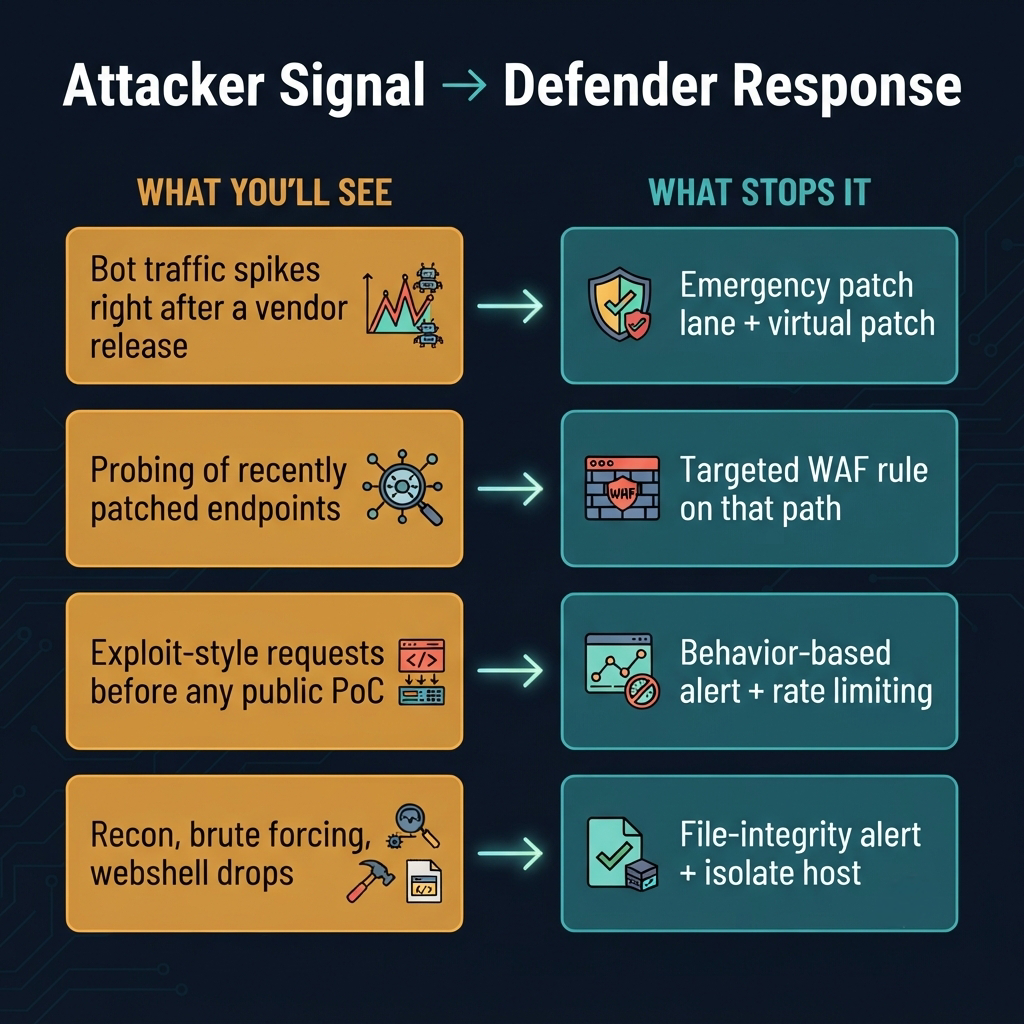
Alert rules tuned for slow, human-paced intrusions can miss this speed, which is why traditional SOC alerts struggle against non-human AI attackers. Attacks like this leave traces across the whole lifecycle, so watch for:
- Unusual automated requests that show up right after a vendor release.
- Probing of endpoints tied to recently patched components.
- Exploit-style traffic that appears before a public proof of concept exists.
- Post-compromise behavior such as reconnaissance, credential brute forcing, and webshell deployment.
Use AI on your side too
Defenders can use the same techniques. AI-assisted patch-impact analysis can quickly show which internal services are affected. Internal diffing can validate fixes, catch regressions, and flag which patches need to go out first. And automated containment playbooks (virtual patching, WAF rules where they fit, access restrictions, isolating exposed legacy systems) buy time when a full patch can’t ship immediately.
Questions security leaders should be asking
- How fast can we find every internet-facing instance of a newly patched product?
- Can we put a compensating control in place before the full patch reaches production?
- Do our detection rules cover exploitation behavior, or only known malware signatures?
- Who decides to take a vulnerable service offline if patching can’t happen in time?
- Is our security team using agentic AI for triage as aggressively as attackers use it offensively?
The new patch deadline
In the patch-as-blueprint era, whether a vulnerability is known stops being the question. What matters is whether your organization can fix it, contain it, or detect it before an autonomous system turns the vendor’s fix into an attack plan.