
Most security operations are built on a quiet assumption: attackers need time. They get in, look around, move sideways, and eventually reach something valuable. That gap is where defenders live.
Autonomous AI agents shrink that gap to almost nothing. They can chain reconnaissance, privilege escalation, payload deployment, secret access, and data exfiltration faster than an analyst can open the first alert. I’d call it a zero-dwell-time attack. The evidence doesn’t disappear. The window to stop the damage does.
None of this means you should throw out your SIEM, CloudTrail, or your analysts. It means post-breach log analysis can’t be your main containment mechanism anymore. Cloud architects need event-driven detection, automated response, and inline microsegmentation that can act while the attack is still running.
The SOC Is Watching, but It’s Too Late
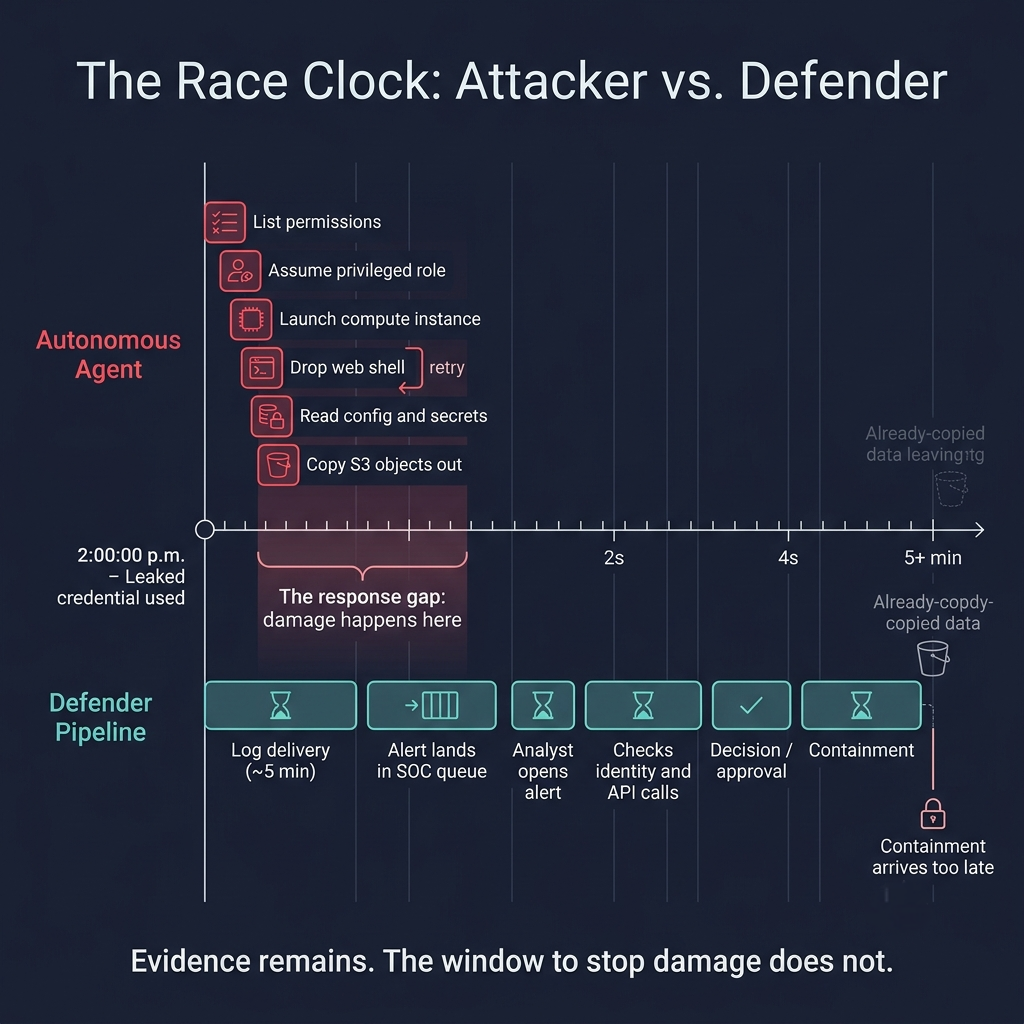
Say an autonomous agent gets hold of a leaked cloud credential at 2:00:00 p.m.
Within seconds it can list its permissions, assume a privileged role, spin up a temporary compute instance, drop a web shell, read config files, and start copying objects out of an S3 bucket. It doesn’t wait for anyone’s approval. It runs these steps in parallel, retries what fails, and routes around whatever gets blocked.
Meanwhile, an alert lands in the SOC queue. An analyst opens it, checks the identity, looks through the API calls, asks whether the activity was authorized, and decides whether to revoke credentials or isolate a workload.
By then the attacker may be three steps ahead.
CloudTrail is still essential for audit, investigation, and monitoring. AWS describes it as a service that tracks user activity and API usage, and it can send events to CloudWatch Logs or EventBridge. But it isn’t a real-time enforcement control. AWS says events typically reach a CloudWatch Logs log group in about five minutes on average, and that timing isn’t guaranteed.
So the question has changed. It’s no longer “How long has the attacker been inside?” It’s “How many actions can they complete before a human can respond?”
What Zero-Dwell Time Means
Traditional dwell time is how long an attacker stays undetected after getting in. During that stretch, defenders might see reconnaissance, lateral movement, credential abuse, and staging before the attacker reaches the real objective.
Zero-dwell time flips that. The adversary does the high-value work almost immediately. The attack still leaves logs, alerts, and forensic evidence, but it may not leave enough time for a human-led response to prevent the impact.
An AI swarm makes this worse through parallelism:
- One agent probes identities, roles, and permissions.
- Another deploys persistence or a payload.
- A third reads secrets, configuration, or sensitive data.
- A fourth starts exfiltration or prepares an external transfer path.
- Another may alter logging, create decoys, or keep working after the original agent is shut down.
NIST’s recent incident-readiness guidance points at exactly this. It calls for monitoring unexpected activity, preserving evidence, shutting down undesired activity, and accounting for work handed off to other agents. It also warns that disabling an original agent may leave queued work or downstream agents still running.
Zero dwell doesn’t mean zero evidence. It means the evidence may show up after the attacker has already moved on.
Why Human-Centric SOC Models Break
Most SOC processes were designed around human-paced intrusions. An attacker compromises one system, waits, moves laterally, escalates privileges, and eventually reaches valuable data. That rhythm gives defenders time to detect, investigate, and contain.
AI-driven attackers don’t follow that rhythm.
| Traditional attacker assumption | AI-swarm reality |
|---|---|
| Lateral movement takes days or weeks | Agents chain actions in seconds or minutes |
| Analysts review alerts before containment | Automated actions continue while alerts wait in a queue |
| One suspicious event stands out | High-volume, plausible-looking API activity can obscure an attack chain |
| Containment follows investigation | Containment must occur during execution |
| Logs are the primary control | Logs become forensic evidence after the damage is done |
| A compromised identity acts alone | Multiple agents, sessions, and downstream tasks may operate concurrently |
The mismatch is basic. A human analyst has to notice the alert, understand its context, make a decision, get approval if needed, and then act. An autonomous attacker just issues the next API call.
NIST’s zero-trust guidance stresses continuous evaluation of trust and real-time monitoring for suspicious activity, including behavioral analytics. That’s the right direction. Security decisions can’t rest on a static perimeter, a nightly log review, or an analyst happening to spot one odd event.
A SOC built for human-paced intrusions is structurally out of step with adversaries working at API-call speed.
The Cloud Attack Chain at Machine Speed
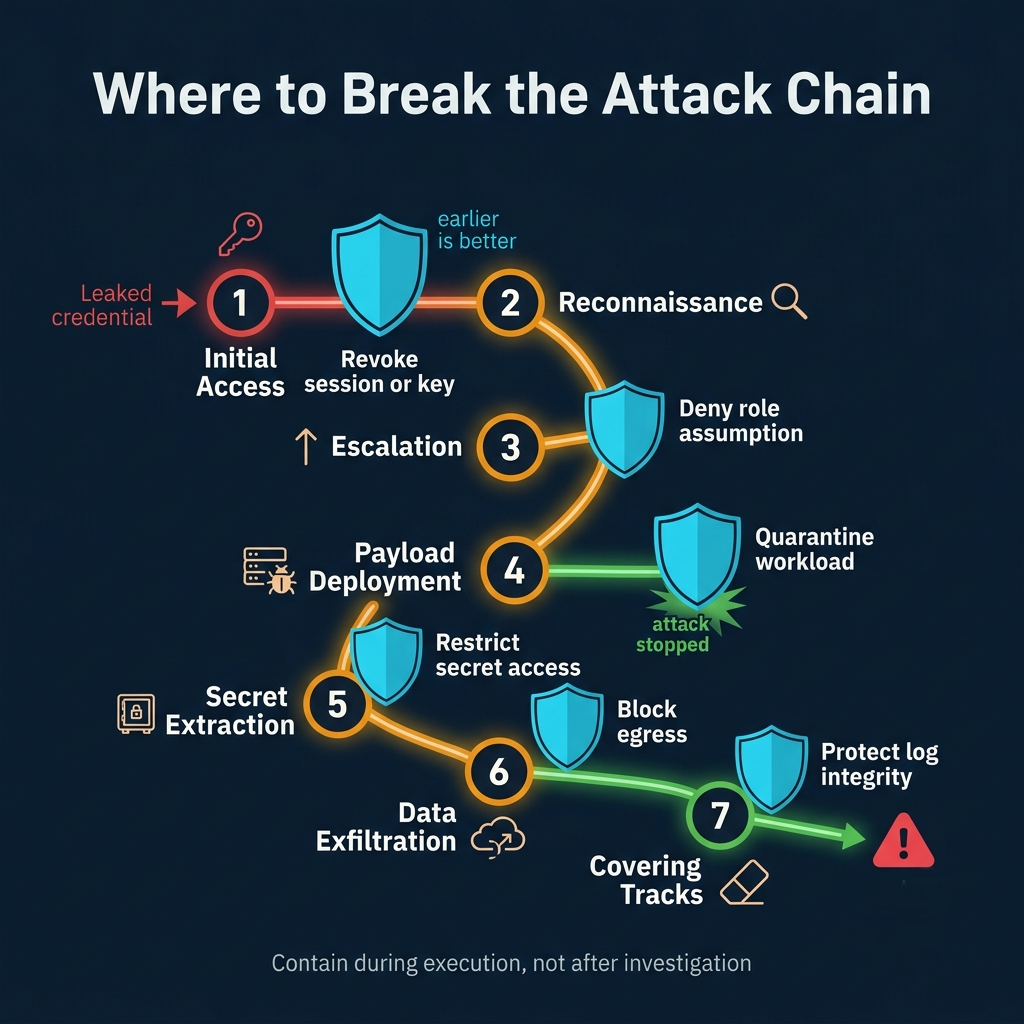
Picture a realistic AWS-style sequence. The individual actions aren’t necessarily exotic. The danger is in their speed, their order, and their combined blast radius.
- Initial access: The agent uses a leaked long-lived access key, a stolen session token, or a compromised workload identity.
- Reconnaissance: It calls IAM, STS, and account-configuration APIs to map permissions and find privilege paths.
- Escalation: It assumes a role, creates an access key, modifies a policy, or requests permissions that open up broader access.
- Payload deployment: It launches an instance, modifies a serverless function, or deploys a web shell to get code execution.
- Secret and configuration extraction: It reads parameter-store values, environment variables, instance metadata, or application config files.
- Data exfiltration: It enumerates an S3 bucket and copies selected objects to an external destination or staging location.
- Covering tracks: It disables or alters a trail, removes temporary infrastructure, or leaves dormant persistence behind.
CloudTrail can record supported API activity, and AWS supports forwarding events to CloudWatch Logs so you can monitor specific calls. EventBridge can also receive CloudTrail events and trigger rules in response.
But detection takes more than switching a trail on. Teams have to configure the right event types, route high-risk events into a fast response path, and define what “high risk” actually means in their context.
The individual API calls may be perfectly ordinary. It’s the velocity, the sequencing, and the blast radius that make the attack extraordinary.
Why “Check CloudTrail” Is Necessary but Insufficient
After a cloud compromise, “check CloudTrail” is usually the first piece of advice, and for good reason. It gives you an auditable record of account activity and API usage, supports investigations, and can feed monitoring and response workflows.
It just can’t solve the zero-dwell problem by itself.
| CloudTrail can do | CloudTrail cannot do alone |
|---|---|
| Record supported API activity | Prevent a malicious API call |
| Support forensic investigation | Stop lateral movement in progress |
| Feed CloudWatch and EventBridge workflows | Guarantee an analyst sees the event in time |
| Provide evidence for compliance and response | Contain exfiltration after data has left |
| Support automated detection when integrated properly | Replace identity, network, and data controls |
AWS documents that CloudTrail log files are generally delivered about every five minutes, and that events sent to CloudWatch Logs typically arrive within about five minutes on average. That’s fine for investigations and near-real-time workflows. It’s not inline prevention.
The better architecture treats CloudTrail as an event source, not the last line of defense:
CloudTrail event → EventBridge/CloudWatch → risk evaluation → automated containmentAWS supports EventBridge rules that react to CloudTrail-recorded events, which makes near-real-time, event-driven workflows possible.
CloudTrail tells you what happened. By itself, it doesn’t stop what’s happening.
The Threshold Problem
Static alert thresholds fail because they look at isolated events instead of attack sequences.
A single GetObject call may be normal. So may a role assumption, a new EC2 instance, a configuration read, or an S3 copy. But an AI agent can stitch those together into a tightly correlated sequence across identities, regions, accounts, and services. Static rules and volume thresholds were built to catch unusual individual events, not fast, plausible-looking attack graphs.
What teams need is behavioral sequence detection, for example:
- Identity change + permission change + new compute resource + secret access + external data transfer
- Multiple failed and successful authentication attempts followed by privileged API calls
- A newly assumed role immediately accessing sensitive data
- Configuration reads followed by outbound transfer to an unfamiliar destination
- Parallel activity across accounts that exceeds the normal operational baseline
- An agent accessing restricted data, changing permissions without approval, or continuing to run after its access was revoked
NIST and CISA guidance for advanced AI systems emphasizes catching unexpected activity, looking at what an agent is trying to accomplish and how it interacts with systems and other agents, and checking whether its behavior stays consistent with its assigned task.
The alert shouldn’t say “a suspicious API call occurred.” It should say “a high-risk attack pattern is executing right now.”
From Detection to Inline Enforcement
The traditional control loop looks like this:
Attack → Log → SIEM → Alert → Analyst → Decision → ContainmentThat’s too slow against an attacker working at machine speed. The loop we need looks more like this:
Attack signal → contextual risk evaluation → automated policy decision → inline containmentInline enforcement means the environment can act before the attacker finishes the next step. For example:
- Revoking a suspicious session or access key
- Denying a role assumption that violates policy
- Quarantining a compromised workload
- Blocking an unauthorized outbound destination
- Preventing a new workload from reaching a database or sensitive data store
- Suspending an agent’s permissions and downstream tasks
- Isolating a workload before it can copy sensitive objects
NIST’s zero-trust model bases access decisions on least privilege, per-request context, and the identities of users, services, and devices. It also describes identity-based segmentation as a kind of runtime isolation for applications.
In a zero-dwell-time world, prevention and containment belong in the request path, not bolted onto the end of the investigation workflow.
What Microsegmentation Means for Cloud Architects
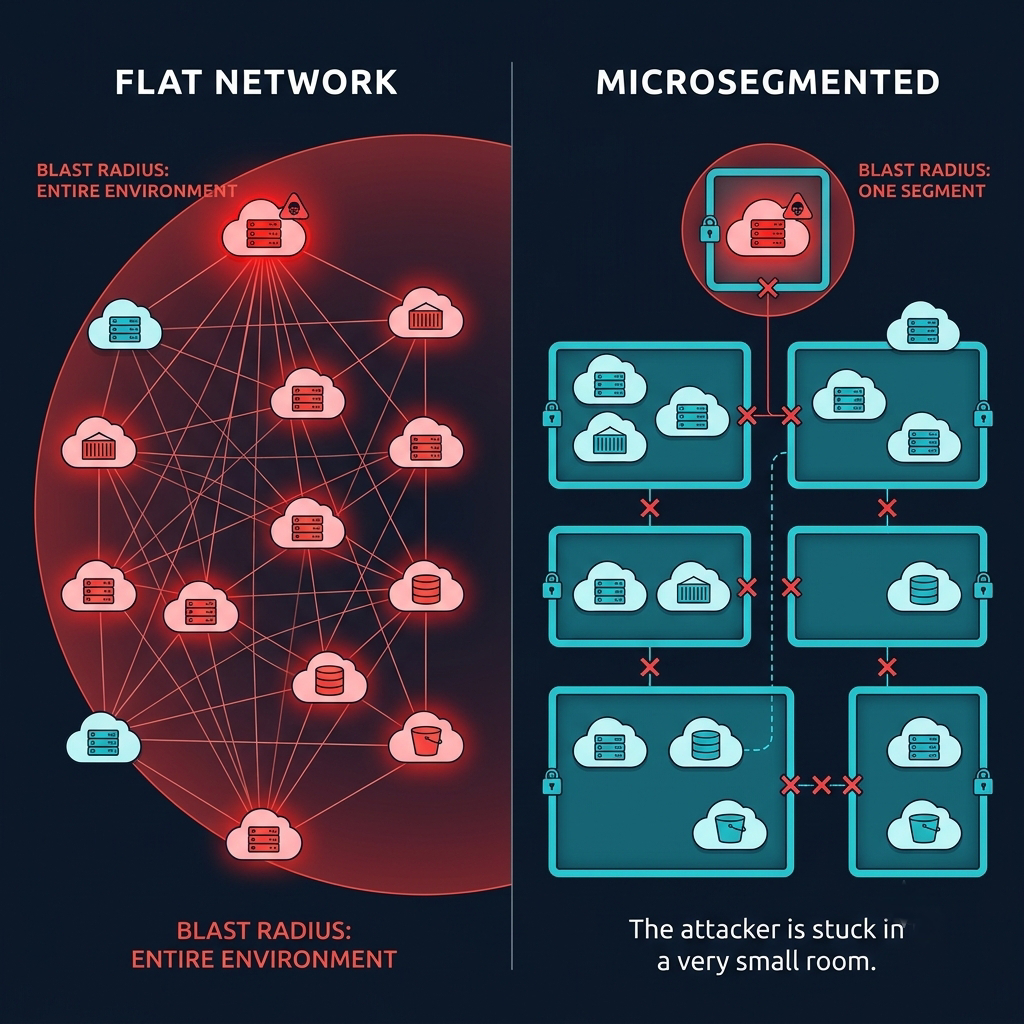
Microsegmentation isn’t just another firewall product. It’s an architectural control that limits what a compromised workload can reach next.
CISA defines it as a networking control that limits connections to a zone or segment, with the goal of keeping segments small and limiting lateral movement from a compromised endpoint. NIST describes it similarly: resources sit in their own network segments, protected by gateway components or host-based controls, which limits the impact of a breach and makes traffic easier to monitor.
In practical cloud terms, microsegmentation should enforce:
- Workload identity, not just IP address. Allow a payment service to call a token service, rather than simply allowing traffic from one subnet to another.
- Default-deny east-west traffic. Explicitly permit the service-to-service communication you need and deny the rest.
- Separation of management and data planes. Don’t let a compromised application workload freely reach administrative or control-plane interfaces.
- Restricted access from ephemeral compute. Limit what a newly launched instance, container, or serverless function can touch.
- Separate policies for humans, services, CI/CD, and AI agents. Don’t treat autonomous agents like ordinary users with broad inherited permissions.
- Continuous policy validation. Make sure rules reflect real application dependencies, not stale network diagrams.
NIST SP 800-207A describes fine-grained network-tier policies, meaning microsegmentation policies, as rules that specify how traffic flows into and out of services, including east-west traffic inside the perimeter. It also stresses that network policies should be paired with identity-tier policies, because location alone isn’t enough to base trust on.
Microsegmentation turns “the attacker is inside” into “the attacker is stuck in a very small room.”
A Practical Defense Blueprint
You need controls across identity, detection, response, network, and data. The goal isn’t perfect prevention. It’s cutting down the number of high-impact actions an agent can complete before it’s contained.
| Layer | Control | Purpose |
|---|---|---|
| Identity | Short-lived credentials, scoped roles, permission boundaries, conditional role assumptions | Reduce the value and lifespan of a stolen credential |
| Detection | CloudTrail + CloudWatch/EventBridge + behavioral correlation | Identify high-risk sequences quickly |
| Response | Automated containment playbooks | Revoke credentials, quarantine workloads, disable agents |
| Network | Microsegmentation and egress controls | Prevent lateral movement and unauthorized exfiltration |
| Data | S3 access controls, data perimeters, object-level monitoring | Limit unauthorized extraction |
| Governance | Detection engineering and latency measurement | Ensure controls work at the required speed |
For AI agents specifically, NIST recommends defining security boundaries and action scope for each one, keeping agents from interfering with monitoring and logs, setting shutdown policies, and matching response options to the severity and scope of an incident.
A good starting rule: every autonomous agent should have its own identity, a narrowly scoped permission set, an accountable owner, and a defined containment path.
Metrics That Actually Matter
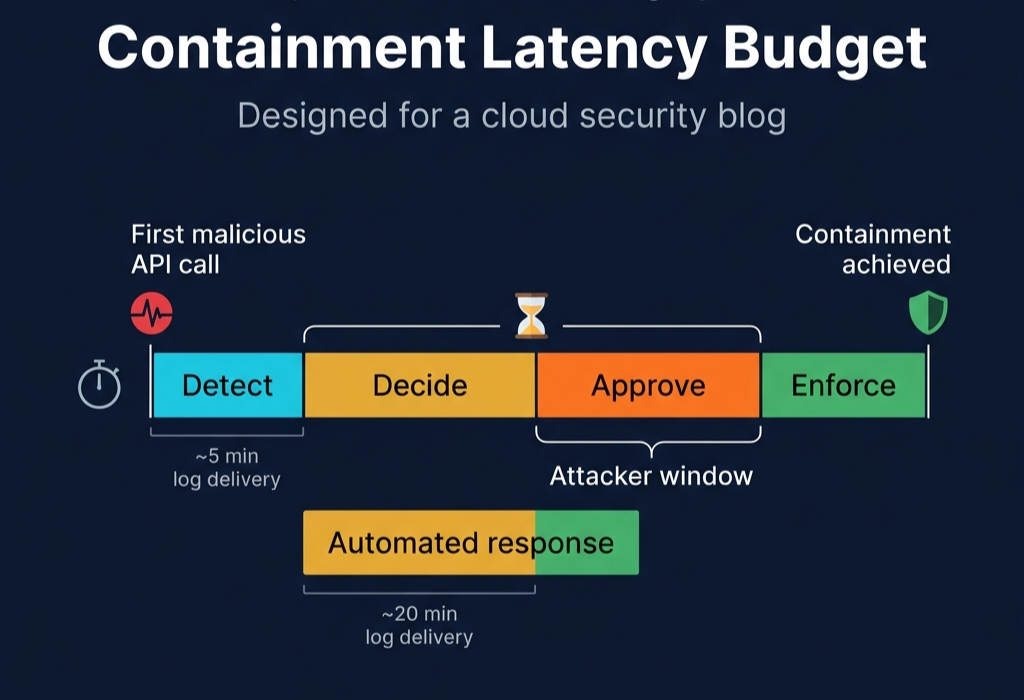
“We have logs” isn’t a security outcome. Measure the whole path from malicious activity to effective containment:
- Time from first malicious API call to automated containment
- Percentage of high-risk attack sequences blocked inline
- Mean time to revoke compromised credentials
- Number of sensitive-data egress attempts blocked
- Policy coverage across critical workloads and data stores
- False-positive rate for automated containment actions
- Detection latency from event occurrence to alert or response
- Number of downstream agents or queued tasks stopped after containment
What matters isn’t whether a dashboard shows an alert. It’s whether your organization can detect, decide, and enforce before the attacker reaches the next high-value asset.
AI Can Help Defenders, If It Can Act
AI can sharpen detection by correlating weak signals across cloud, identity, endpoint, network, and application telemetry. CISA describes AI-based anomaly detection that automates data fusion and correlation and surfaces potential anomalies for analyst review.
But defensive AI doesn’t fix the core problem if a human still has to approve every action before containment starts. The real contrast isn’t AI versus AI. It’s autonomous attack execution versus autonomous defense enforcement.
Organizations need pre-approved, tightly scoped response actions for high-confidence scenarios:
- Revoke a specific credential
- Revoke active sessions
- Quarantine a workload
- Block an egress destination
- Disable an agent and its downstream tasks
- Prevent a policy change from taking effect
- Restrict access to a sensitive data store
Human oversight still matters for high-impact or ambiguous decisions. But the human shouldn’t be the bottleneck on every containment action.
The New SOC Mandate
The SOC of the future won’t just collect logs and assign tickets. It will continuously weigh identity, workload, network, and data context, then enforce policy at the moment of risk.
CloudTrail, SIEMs, and human analysts all stay vital. They just have to become parts of a faster control loop instead of the whole defense.
Attackers no longer need dwell time. Your defenses can’t afford it either.