
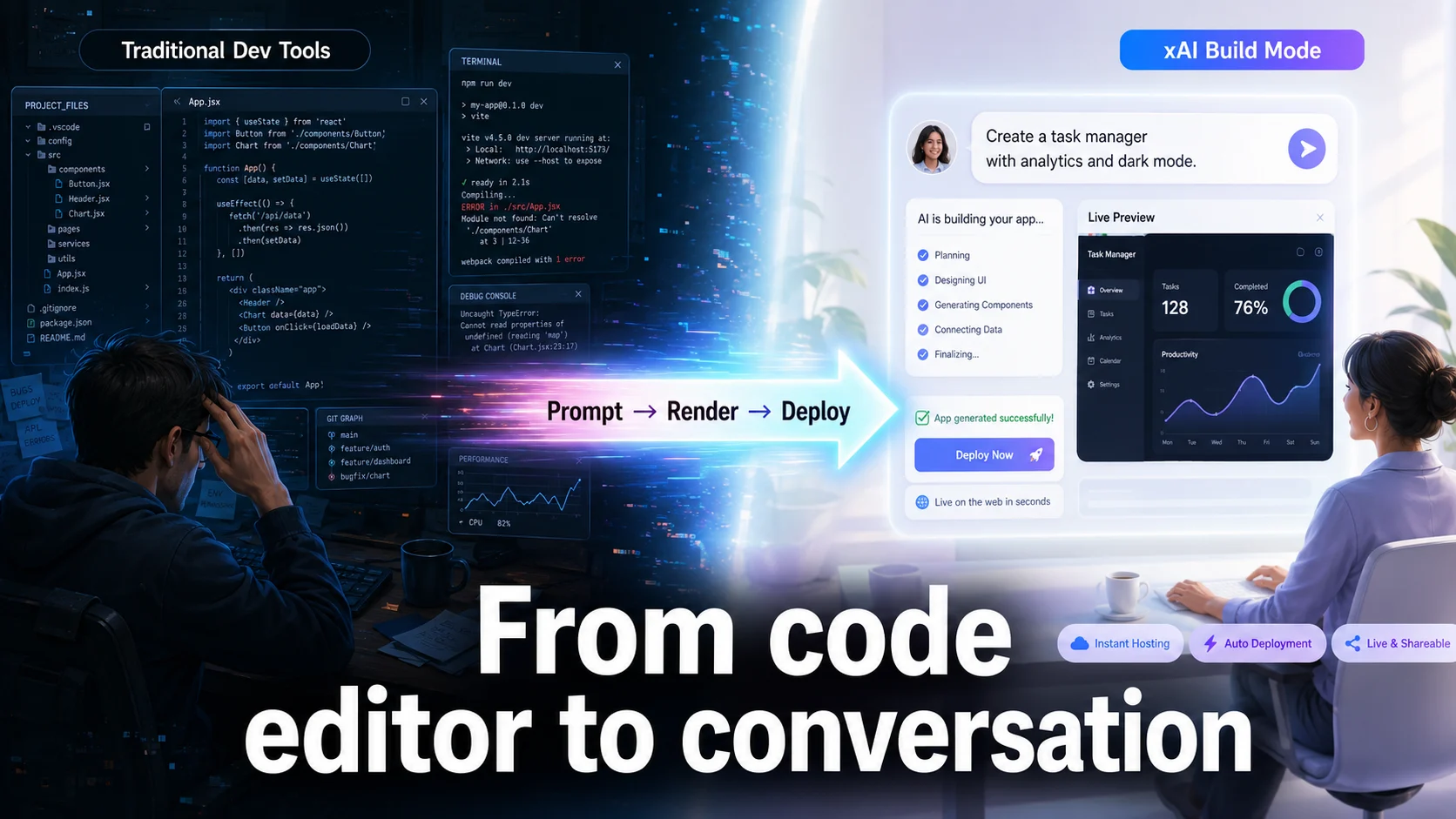
xAI is threatening to shatter traditional software engineering by making terminal windows completely obsolete. More than 80% of new micro-apps are now initiated via artificial intelligence prompts, forcing developers into a fast-paced battle for workflow dominance.
So what happens when a single consumer chat window becomes your entire development environment? The urgency is escalating rapidly across Silicon Valley as platforms like Vercel v0, Replit, and Lovable rush to capture non-code creators. Unlike older systems that output raw code snippets, xAI’s Build Mode consolidates prompting, rendering, execution, and cloud hosting into one frictionless consumer application. 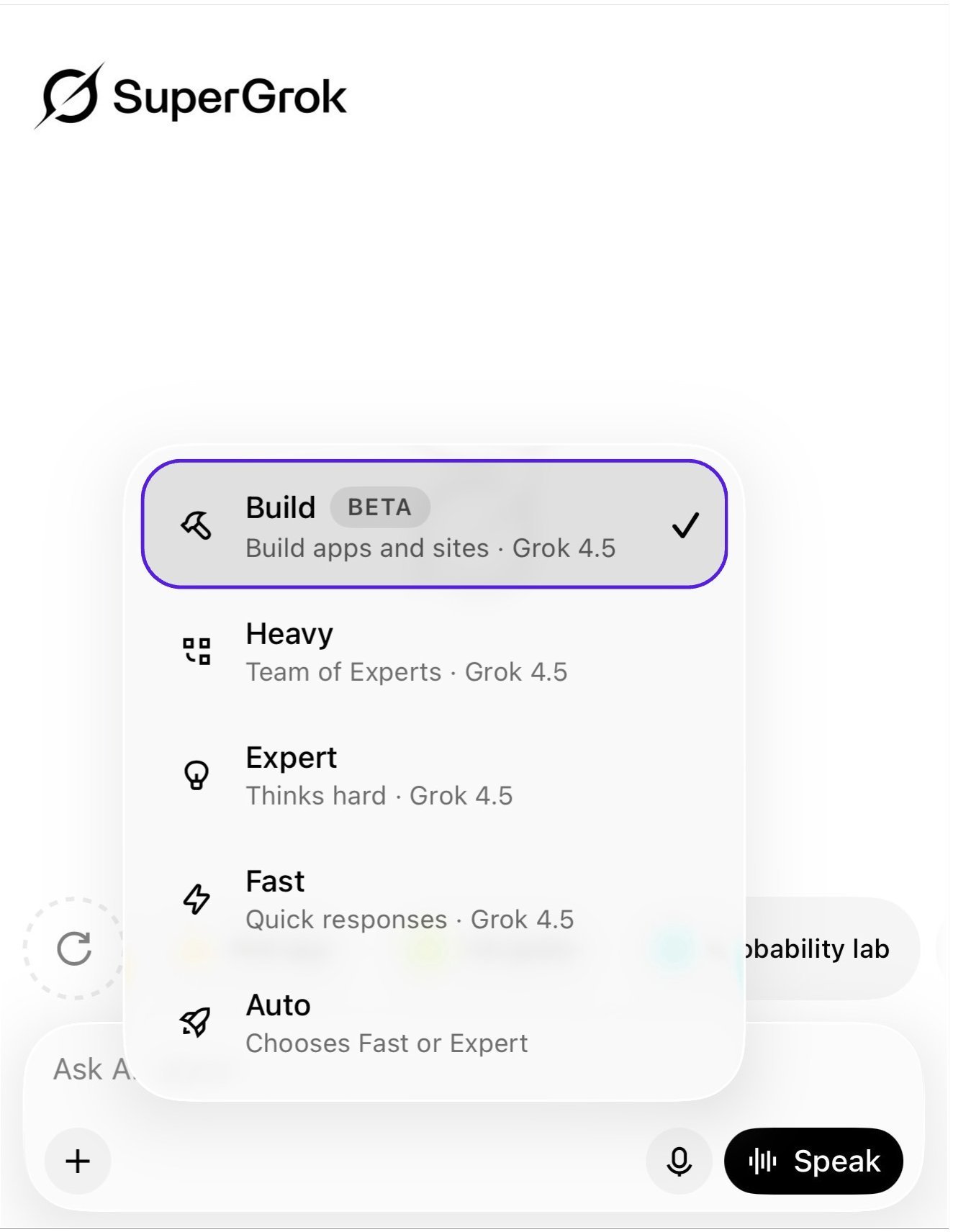
Why Single-Surface Creation Matters
xAI is deliberately targeting non-coder creators rather than traditional backend engineers. The platform’s entire pitch centers on single-surface creation, eliminating context switching, local command-line tools, and complex Git handoffs.
- Zero setup required: Users bypass local package managers and build configurations.
- Instant deployment: Applications publish to live web links with a single click.
- Integrated asset generation: Built-in vision and media tools handle UI design on the fly.
Software creation is undeniably moving from manual tool usage to direct conversation-driven production. If the chat app itself becomes the workspace, what happens to the terminal, the IDE, and the entire developer tool chain?
Comparing the AI App Building Landscape
To understand why this shift matters, look at how the main platforms contrast in their core architecture:
| Platform | Main Idea | What It Gives Users | Limitation xAI Bets Against |
|---|---|---|---|
| xAI Build Mode | Everything inside chat | Prompting, preview, execution, and hosting | Assumes users prefer one consumer app over a modular tool stack |
| Vercel v0 | UI & full-stack generation | Fast front-end and Next.js scaffolding | Still deeply tied to developer workflows and Git repos |
| Replit | Browser-based workspace | Interactive coding, testing, and cloud deployment | Still feels like an IDE alternative, not a pure chat interface |
| Lovable | Prompt-to-app builder | Full-stack app creation with Supabase backends | Less focused on an all-in-one conversational social ecosystem |
This sharp contrast illustrates why developers are split on the future of software creation. One side sells maximum engineering flexibility; the other sells frictionless speed.
The Strategic Twist: Owning the Workflow
xAI isn’t simply competing on raw AI model intelligence or benchmark scores. Instead, it is fighting aggressive battles for total workflow ownership across the entire software lifecycle.
“The real battle isn’t over who generates code fastest—it’s over who owns the primary surface where human intention translates into running software.”
The bigger shift may be hiding directly in the hosting and infrastructure layer. When build steps and server hosting are sealed inside a conversational window, external developer platforms risk becoming invisible utility pipes. This is not a feature war; it’s a battle over where creation happens.
What Makes In-Chat Creation Different?
The key differentiator is end-to-end lifecycle integration. In xAI’s Build Mode, four distinct technical steps collapse into a single thread:
- Prompting happens directly inside standard text chat.
- Rendering generates live interactive previews instantly.
- State execution runs full logic and sub-agents in the background.
- Hosting assigns live public URLs without extra cloud setup.
For more details on the official announcement and model capabilities, consult the xAI Build Mode Announcement Page and the official xAI API Documentation.
If the whole pipeline is sealed inside one interface, does that remove friction—or remove flexibility?
Build apps from https://t.co/f3u3RwhHjk, iOS, and Android. With one prompt, turn an idea into a published product with its own domain. Now available for SuperGrok Heavy users. pic.twitter.com/Dg1WyC3qeo
— Grok (@grok) July 28, 2026
Risks, Limits, and Developer Lock-In
While chat-first creation offers incredible speed, it introduces trade-offs for complex software engineering. Non-coders may praise the consumer simplicity, but professional software architects still demand precise control.
- Loss of granular control: Deep debugging inside black-box execution environments remains difficult.
- Ecosystem lock-in: Proprietary hosting layers make migrating codebase assets challenging.
- Scalability caps: Heavy enterprise applications require specialized CI/CD pipelines.
Convenience may be the hook, but control will decide whether users stay.
The Road Ahead
xAI’s bet is that the next wave of software creation won’t look like software development at all—it will look like a conversation. If that prediction holds true, the biggest winners won’t just build better models—they will own the exact space where millions of creators start building.