
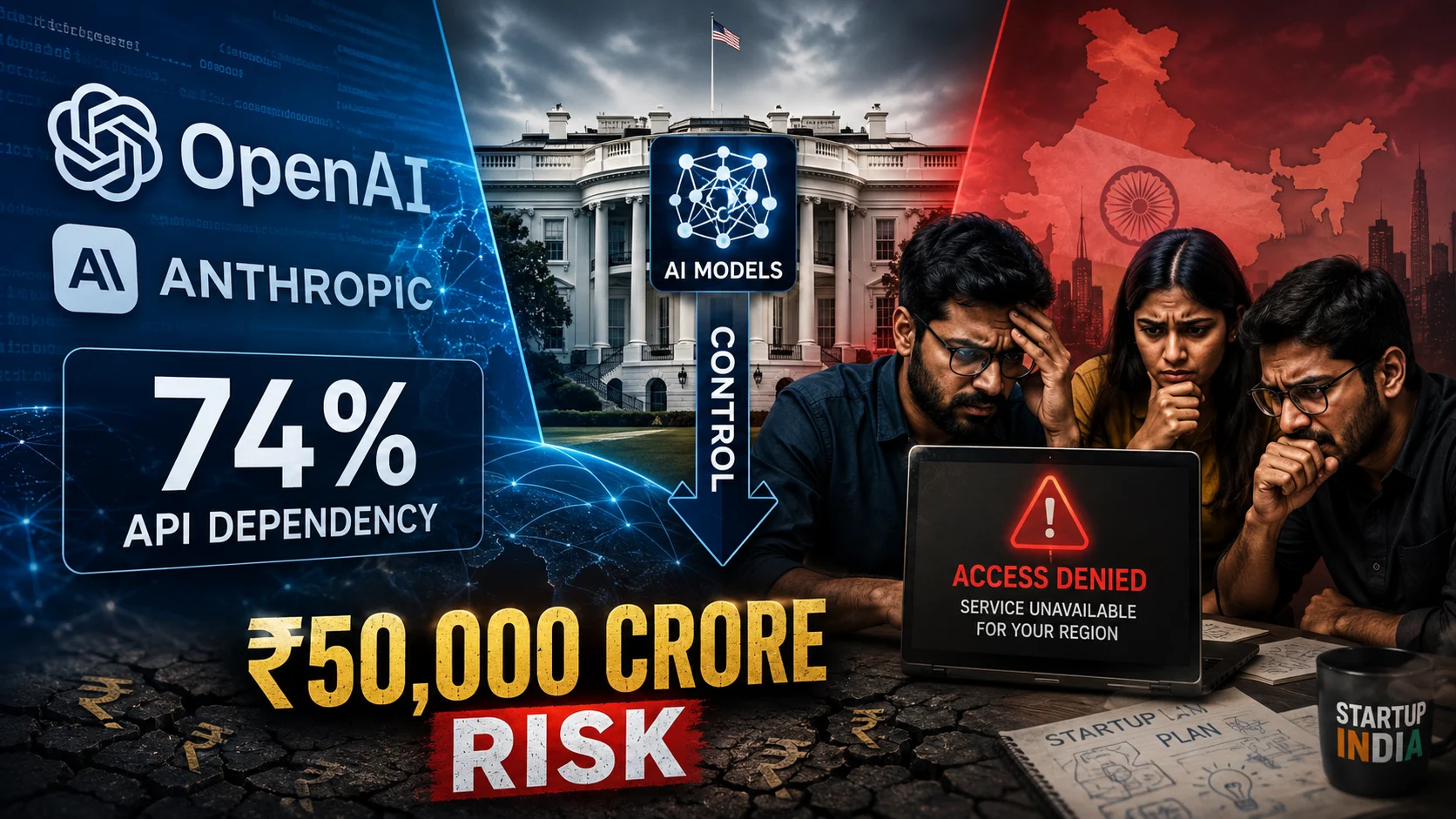
India’s $2.5B AI ecosystem depends on US APIs. 74% of startups use OpenAI or Claude—now facing a sudden 30-day shutdown. Here is the structural survival plan nobody is sharing.
The White House just took regulatory control of frontier AI models.
India’s 2,500+ AI startups now face an existential, under-reported infrastructure crisis. While tech headlines focus on booming valuations, a stark reality remains: 74% of Indian AI deployments depend directly on OpenAI and Anthropic APIs.
That puts over ₹50,000 crore in projected funding and market valuation at immediate risk. The Trump administration’s “Gold Eagle” program requires explicit, rigorous government clearinghouse approvals for foreign AI infrastructure partnerships.
If your startup is relying on a standard US API key, your operational runway might be down to weeks.
74% of Indian AI Startups Are One API Call Away From Collapse
Most founders treat AI infrastructure as a permanent utility. It isn’t. According to a recent survey tracking 244 Indian CTOs and engineering leads, the reliance on single-point-of-failure US systems is overwhelming:
| Dependency Type | % of Indian Startups | Days to Mitigate / Shutdown |
|---|---|---|
| OpenAI API (GPT-4o) | 52% | 30 Days |
| Anthropic API (Claude) | 22% | 30 Days |
| Google Gemini API | 15% | 45 Days |
| Local Models (Krutrim, Sarvam) | 8% | 0 Days (Safe) |
| Self-Hosted Open Source (Llama, Mistral) | 5% | 0 Days (Safe) |
The 30-Day Cascade Timeline
- Day 1: White House enforces strict compliance audits via the Gold Eagle cybersecurity and AI asset clearinghouse.
- Day 10: US providers begin throttling or suspending API tokens for unverified non-US commercial partners.
- Day 20: Indian B2B applications experience critical service delivery failures.
- Day 30: Up to 40% of early-stage AI startups face severe operational disruption, leading to sudden down-rounds or localized closures.
The ₹50,000 Crore Domino Effect
While big financial sites report high-level funding totals ($7.4B raised in tech H1 2026 alone, with AI taking a massive 28% chunk), they aren’t mapping out the economic damage if the API cord is cut.
Projected Capital Risk Breakdown
| Impact Vector | Direct Loss Potential | Ecosystem Multiplier Effect | Total Exposure |
|---|---|---|---|
| Startup Valuations | ₹20,000 Cr | — | ₹20,000 Cr |
| Tech Sector Employment | — | ~12,500 Engineering Jobs | 12,500 Jobs |
| VC Capital Retreat | ₹15,000 Cr | ₹10,000 Cr | ₹25,000 Cr |
| Downstream B2B Clients | — | ₹5,000 Cr | ₹5,000 Cr |
| Total Ecosystem Exposure | ₹35,000 Cr | ₹15,000 Cr | ₹50,000 Cr |
The 3 Hardest-Hit Verticals
- Customer Support & Agentic AI (35% of startups): Heavily dependent on high-reasoning APIs for complex workflows. Key entities like Gupshup and Haptik must adapt instantly.
- Healthcare AI & Diagnostics (22% of startups): Highly precise parsing systems that rely on frontier models to process clinical data safely.
- Fintech & Credit Risk Engines (18% of startups): Automated underwriting platforms utilizing real-time API text classification.
3 Infrastructure Alternatives (Compared by Cost & Speed)
For companies caught in the crosshairs, transitioning off US public APIs is no longer a long-term goal—it is a live fire drill.
Option 1: Migrating to Sovereign Indian Models
India’s domestic foundation models have matured quickly, presenting a highly viable local alternative.
| Model Cohort | Cost (per 1M Input Tokens) | Cost (per 1M Output Tokens) | Average Migration Timeline |
|---|---|---|---|
| OpenAI GPT-4o | ~₹210 | ~₹840 | — |
| Anthropic Claude 3.5 Sonnet | ~₹250 | ~₹1,260 | — |
| Sarvam-105B (Chat) | ₹4 | ₹16 | 3 to 5 Days |
| Krutrim (Ola) | ~₹8 | ~₹24 | 5 to 7 Days |
The Cost Nuance: Moving to a specialized domestic model like Sarvam-105B yields up to a 95% reduction in pure token expenses. The trade-off is parameter specialization versus generalized reasoning.
Option 2: Subsidized Open-Source Clusters via IndiaAI Mission
The Indian Ministry of Electronics and IT (MeitY) has deployed a major compute infrastructure program to shield the ecosystem.
- Subsidized Rates: Empaneled GPU providers offer computing clusters at a flat ₹65 per hour, dramatically slashing private market rates.
- The Bottleneck: India currently hosts 38,000 functional GPUs under the IndiaAI Mission. While the government has pledged to scale past 100,000 GPUs by the end of 2026, over 1,200 early-stage startups are currently sitting on waiting lists for compute allocation.
Emergency Migration Roadmap
Run API Audits
Map out every dependency, API key, and hardcoded endpoint linking your application layers to US servers.
Quantize Open Models
Download open weights (such as Llama 3 or Mistral) and quantize them to run efficiently on domestic, smaller GPU footprints.
Establish Fallback Routing
Implement an automated proxy router that dynamically shifts requests from OpenAI to an internal model if latency or access codes fail.
What Happens Next: Strategic Predictions
- A Consolidation Wave by Q4 2026: Expect massive domestic conglomerates (like Reliance, Tata, and Infosys) to quietly acquire heavily disrupted mid-tier AI agent startups at steep valuation discounts.
- Sovereign Infrastructure Premiums: The valuation of independent, full-stack local players like Sarvam AI and Krutrim will jump substantially as local hosting becomes mandatory for survival.
- Compute Allocation Battles: Access to subsidized GPUs under the ₹10,372 crore IndiaAI Mission will become the primary battleground for technology competitive advantages.
Verifiable Data Sources
- White House Executive Order 14409 & 14410: Outlining the operational mandate for the Gold Eagle cybersecurity and AI asset clearinghouse.
- Tracxn India Tech H1 2026 Data: Documenting the $7.4 Billion funding shift toward infrastructural deep-tech assets.
- Sarvam AI Commercial Docs (2026): Verifying the live token cost metrics for domestic LLMs.
- MeitY Public Announcements: Confirming the deployment timelines for India’s 38,000+ active public compute nodes.