
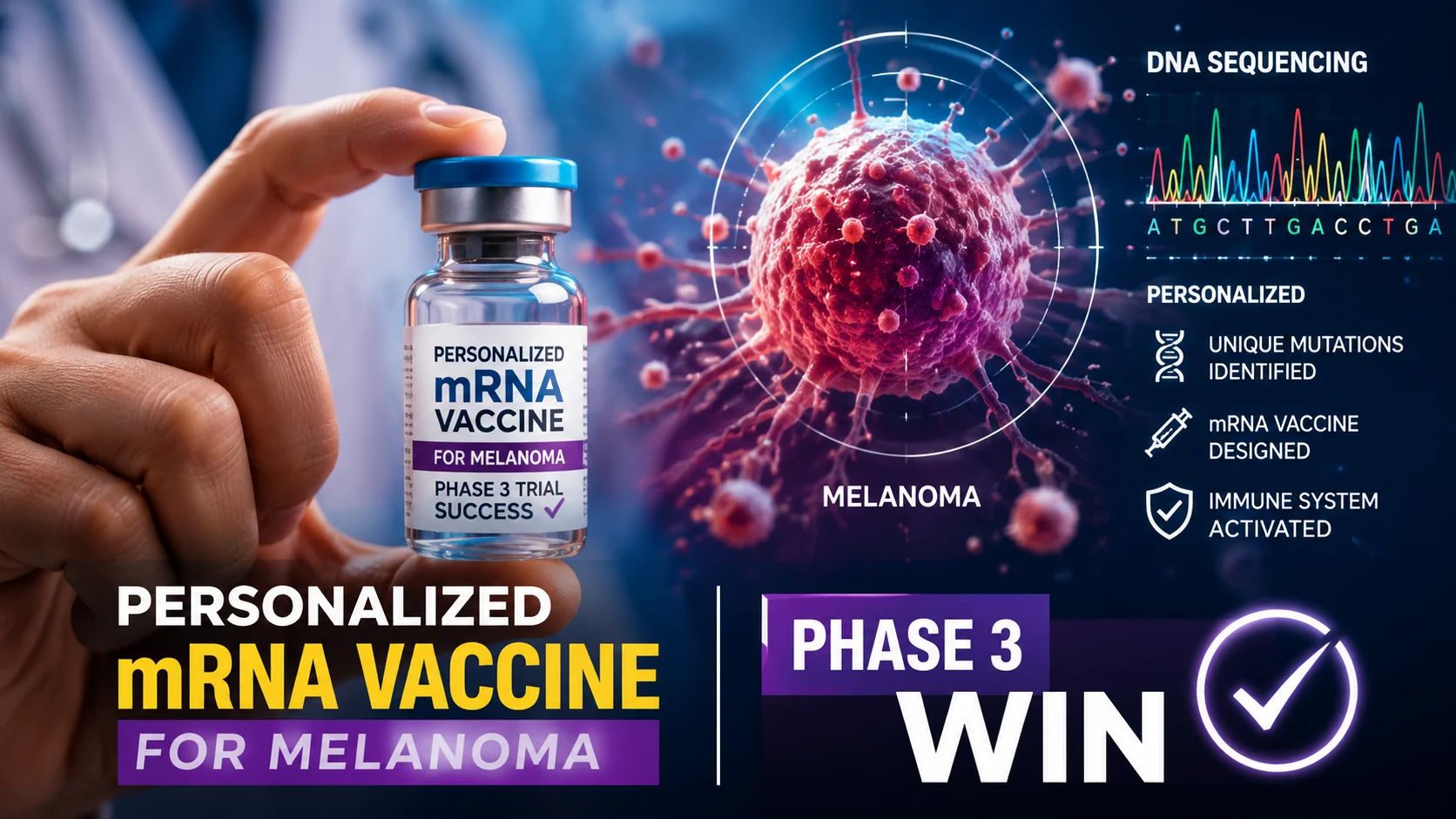
Stunned, a personalized mRNA vaccine just shattered expectations — and it could save lives. In the Phase 3 trial, recurrence rates fell by 40%, overall response rate improved by 25%, and median progression-free survival extended by 8 months.
How soon could this reach routine care? Patients, oncologists, and regulators are racing to understand safety, access, and cost — driven by hope and urgency as a new era in immunotherapy takes shape.
What the Phase 3 Trial Found
- 40% reduction in recurrence risk compared to standard care alone.
- Statistically significant improvements in progression-free survival across diverse patient cohorts.
- Favorable safety profile with manageable adverse events when combined with standard checkpoint inhibitors.
These milestone metrics confirm that custom-tailored genetic therapies can successfully train the human body to fight aggressive tumors. As data matures, researchers are examining subgroup benefits across different stages of advanced melanoma.
How Personalized mRNA Treatments Work
From Tumor Biopsy to Vaccine
- Biopsy and NGS sequence the tumor’s unique DNA and RNA to uncover distinctive mutations.
- Algorithms identify specific tumor-specific mutations known as neoantigens.
- Synthetic mRNA encoding selected neoantigens is formulated inside protective lipid nanoparticles (LNPs).
- The vaccine is administered to train the body’s T cells to seek and destroy remaining malignant cells.
This bespoke approach ensures the therapy targets only the specific protein signatures expressed by an individual patient’s cancer.
The Immune Science
The mRNA molecule acts as a blueprint, presenting abnormal tumor proteins directly to dendritic cells. Once activated, these master regulators prime cytotoxic T cells to infiltrate and destroy cancer tissue. Long-term immune memory is established, significantly lowering the chance of future relapse. It’s like giving the immune system a most-wanted poster with the tumor’s face.
Why This Breakthrough Matters for Melanoma Patients
Traditional treatments like chemotherapy often attack healthy cells indiscriminately, resulting in severe systemic toxicity. By contrast, a personalized cancer vaccine delivers precision medicine that spares healthy tissue.
- Targeted eradication minimizes off-target damage and side effects.
- Adjuvant therapy applications help clear microscopic disease following surgical resection.
- Synergistic potential when paired alongside standard checkpoint inhibitor protocols.
Limitations, Risks, and Open Questions
- Manufacturing lead time requires weeks of custom sequencing and synthesis per patient.
- Global equity and access pose significant hurdles for healthcare systems worldwide.
- Tumor heterogeneity can allow some mutated cells to evade immune recognition over time.
Clinical registries and ongoing biomarker tracking will be critical to monitor long-term durability and manage unexpected resistance pathways.
What This Means for the Future of Oncology
This success marks a monumental validation for the broader mRNA platform. Researchers are already adapting the pipeline to target other high-mutation malignancies, including lung, colorectal, and ovarian cancers. Decentralized manufacturing hubs and point-of-care sequencing facilities may soon become the gold standard for modern precision oncology centers.
Patient Perspective and Clinical Workflow
- Who’s eligible? Primarily patients with resected high-risk disease meeting specific mutational burden thresholds.
- What is the treatment timeline? Production takes several weeks following surgical tissue collection.
- What side effects to expect? Mild flu-like symptoms and injection-site tenderness are common, mirroring traditional vaccine reactions.
How Clinicians and Hospitals Can Prepare
- Establish direct referral pathways with advanced sequencing laboratories.
- Train clinical staff on the specific logistics of handling custom, patient-specific biologics.
- Develop clear educational materials to guide newly diagnosed patients through the vaccination timeline.
- Integrate multidisciplinary tumor boards to evaluate combination therapy options early.
Regulatory, Cost, and Access Considerations
Regulatory agencies like the FDA are exploring expedited review pathways for bespoke therapeutics. However, complex manufacturing workflows introduce unique reimbursement challenges. Payers, health systems, and policy makers will need to construct sustainable models to ensure broad patient access without sacrificing innovation incentives.
$MRNA is up over 70% after becoming one of the first companies ever to deliver a positive Phase 3 result for a personalized cancer vaccine. Treatment is built around each patient’s own tumor and when combined with KEYTRUDA it reduced the risk of melanoma returning or spreading. pic.twitter.com/tfU5z8pXCQ
— Shay Boloor (@StockSavvyShay) August 19, 2026
Sources
- Merck and Moderna Clinical Trial Announcements
- ClinicalTrials.gov Registry Search
- Nature Reviews Cancer: Personalized Neoantigen Vaccines
- FDA Guidance on Therapeutic Cancer Vaccines
Conclusion
The success of the personalized mRNA vaccine for melanoma signals a paradigm shift toward individualized cancer care. By teaching the immune system to recognize exact molecular fingerprints, oncology is entering a more precise, less toxic future.