
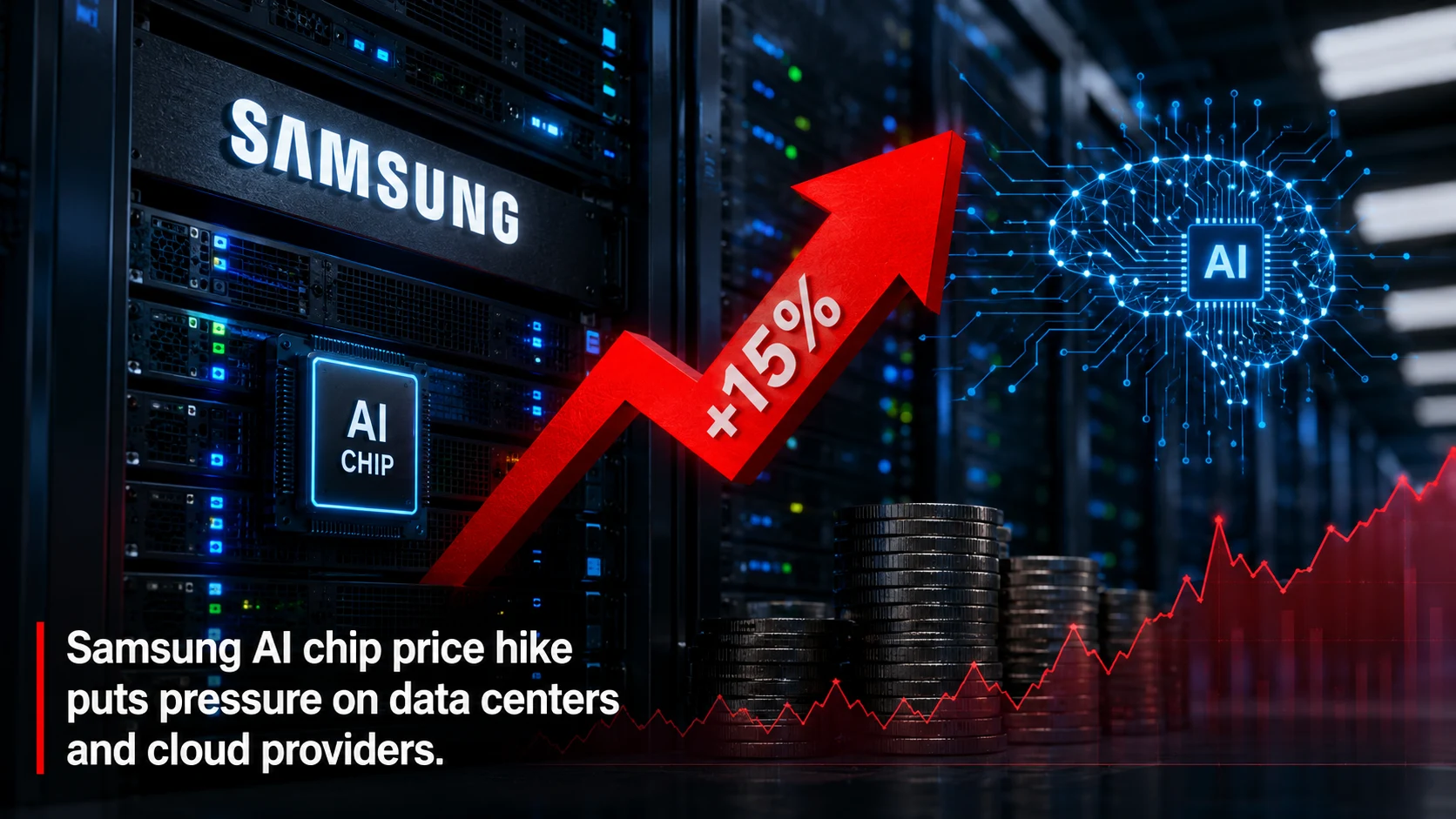
Stunned engineers are scrambling as Samsung sharply raises AI chip prices. The Samsung AI chip price hike of 15% lands at a moment when data centers already face surging power and memory costs; training bills have been rising year-over-year, and global chip demand remains tight. What will this mean for cloud bills, startups, and AI rollout—and how fast must businesses adapt?
What Samsung Announced and Why
Samsung Electronics has officially raised prices for its contract chipmaking foundry services by up to 15% for new orders, driven by an unprecedented surge in global demand for artificial intelligence hardware. The adjustments primarily target advanced manufacturing lines, including the 4-nanometer (SF4) and 5-nanometer (SF5) nodes, which power a wide array of modern AI processors and accelerator modules.
- SF4 Node: Prices increased by 10% to 15% for U.S. and Chinese clients, and 5% to 10% for Taiwanese clients.
- SF5 Node: Wafer pricing climbed between 10% and 15%.
- Older Architectures: Legacy 8-nanometer technologies saw an upward price adjustment of nearly 10%.
This pricing pivot marks a major turnaround for Samsung’s foundry division, which has faced consecutive operating losses since 2022. With primary competitor TSMC experiencing heavily booked capacity across its leading-edge lines, Samsung has successfully leveraged the current supply bottleneck to reclaim pricing power.
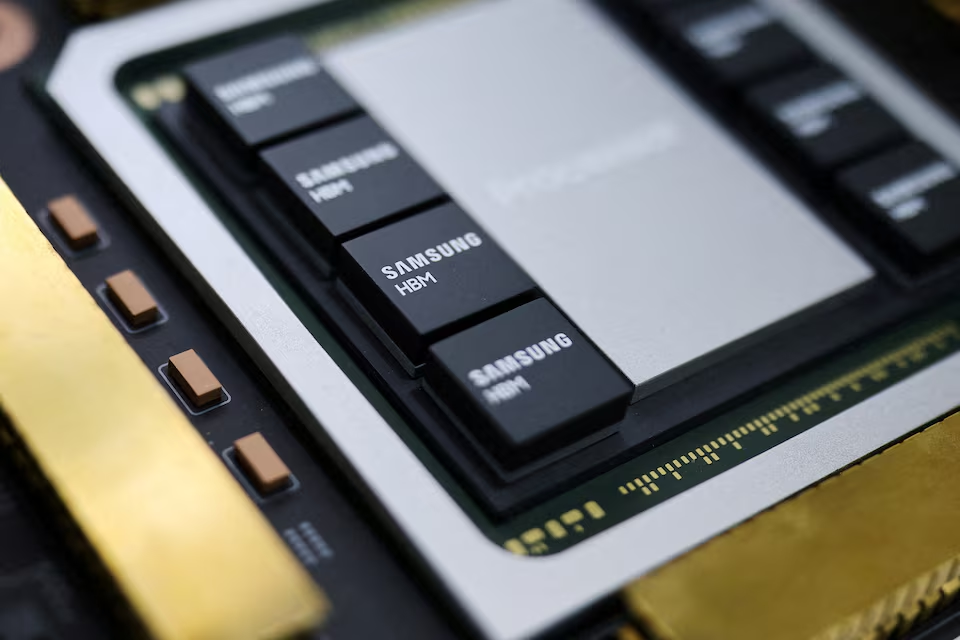
Why AI Hardware Costs Are Rising (Supply-Side Drivers)
The semiconductor manufacturing ecosystem is feeling severe structural pressure across every phase of production.
- Wafer and Fabrication Pressures: Surging demand has strained raw silicon wafer availability across major foundries.
- HBM Memory Bottlenecks: High Bandwidth Memory integration requires specialized, multi-die stacking that restricts throughput.
- Advanced Packaging Constraints: Complex 2.5D and 3D packaging lines are operating near 100% utilization.
- Testing and Yield Challenges: High transistor counts on advanced nodes increase per-unit testing complexity.
- Energy and Infrastructure CAPEX: Power-hungry cleanrooms and EUV lithography machines inflate baseline operational costs.
These compounded factors make a hardware cost increase an inevitable reality for downstream buyers building next-generation server clusters.
Direct Impact on Server Infrastructure and Data Centers
CAPEX: Server Purchasing and Refresh Cycles
A 15% surge in base component pricing ripples directly into rack-level assembly costs, extending capital expenditure cycles for enterprise buyers. Data center operators must now recalculate total cost of ownership (TCO) models, often delaying hardware refreshes or scaling back initial deployment targets.
OPEX: Power, Cooling, and Density Trade-offs
As servers become more expensive to procure, infrastructure managers are forced to maximize the efficiency of existing inventory. Power densities per rack are climbing, forcing heavier investments in liquid cooling and advanced thermal management to protect expensive hardware investments.
What This Means for Cloud Providers (AWS, GCP, Azure)
Hyperscale cloud operators are navigating the crunch through a combination of structural adjustments and strategic pivots:
- Passing Through Costs: Providers may adjust instance pricing tiers or introduce specialized high-performance premiums for heavy compute clusters.
- Capacity Staging: Expansion timelines for new regional data center hubs are being carefully synchronized with secured wafer allocations.
- Accelerating Custom Silicon: To bypass third-party merchant margin pressures, firms are fast-tracking proprietary accelerators (such as AWS Trainium or Google TPUs).
Effect on AI Development Costs
For startups, research labs, and mid-sized enterprises, higher hardware expenses translate into tighter experimentation budgets. Model training loops are becoming more expensive, forcing development teams to prioritize algorithmic efficiency—such as model quantization, pruning, and distillation—over brute-force scaling.
Secondary Effects Across the Ecosystem
The ripple effects of Samsung’s pricing shift extend far beyond primary server farms:
- Surge in Alternatives: Increased demand for alternative architectures, including custom ASICs and specialized ARM-based servers.
- Software Optimization Boom: Accelerated adoption of automated tools designed to squeeze maximum performance out of existing hardware footprints.
- Supply Chain Diversification: Buyers are spreading risk across multiple manufacturing partners to avoid single-source exposure.
Short-Term vs. Long-Term Outlook
- Short-Term (Next 6–12 Months): Expect rigid contract negotiations, adjustments to cloud instance economics, and deferred deployment schedules for non-critical enterprise workloads.
- Long-Term (2–5 Years): Deeper vertical integration by cloud giants, broader geographical distribution of semiconductor fabs, and a permanent design shift toward efficiency-first machine learning architectures.
What CIOs, CTOs, and Procurement Teams Should Do Now
- Re-run TCO Models: Update budget forecasts to absorb potential hardware price inflations of up to 15% across infrastructure expansions.
- Lock in Multi-Year Agreements: Secure volume commitments and supply allocations early to hedge against future spot-market volatility.
- Invest in Software Efficiency: Optimize model architectures to reduce reliance on raw compute brute force.
- Evaluate Hybrid Strategies: Balance on-premises cluster utilization with elastic cloud resources via spot instances.
- Diversify Silicon Vendors: Explore alternative accelerator providers to reduce dependency on constrained foundry pipelines.
Expert Opinions and Data
Industry analysts note that Samsung’s strategic shift reflects a broader market transition from a buyer’s market to a capacity-constrained landscape. According to BNK Investment & Securities analyst Lee Min-hee, sustained pricing power could allow Samsung’s foundry business to swing back to profitability much earlier than previously projected. Meanwhile, market intelligence firms like Counterpoint Research emphasize that while TSMC continues to dominate the broader foundry sector, tightness in leading-edge nodes naturally funnels overflow demand toward alternative suppliers like Samsung.
SAMSUNG HIKES CHIPMAKING PRICES BY UP TO 15% Samsung has raised prices for some advanced foundry services as AI demand tightens capacity and TSMC remains heavily booked, Reuters reports. SF4 prices up 10% to 15% for U.S. and Chinese customers SF5 prices up 10% to 15%, while… pic.twitter.com/W9YkQLD7Xs
— Wall St Engine (@wallstengine) August 19, 2026
FAQs
Will cloud prices definitely go up because of this?
Not immediately for end-users, but cloud providers facing higher hardware acquisition costs may adjust premium tiers or specialized instance pricing over time.
Can startups avoid higher costs?
Yes, by leveraging research grants, utilizing cloud startup credits, or opting for quantized model training that requires less heavy silicon infrastructure.
Are other chipmakers following suit?
Yes, major foundries like TSMC have also signaled or implemented price adjustments to manage overwhelming, AI-driven demand.
Conclusion
The 15% price adjustment by Samsung highlights the immense economic pressure reshaping the artificial intelligence hardware supply chain. While it introduces short-term cost headwinds for data centers and developers alike, it ultimately accelerates a necessary industry-wide focus on architectural efficiency and supply chain diversification.