
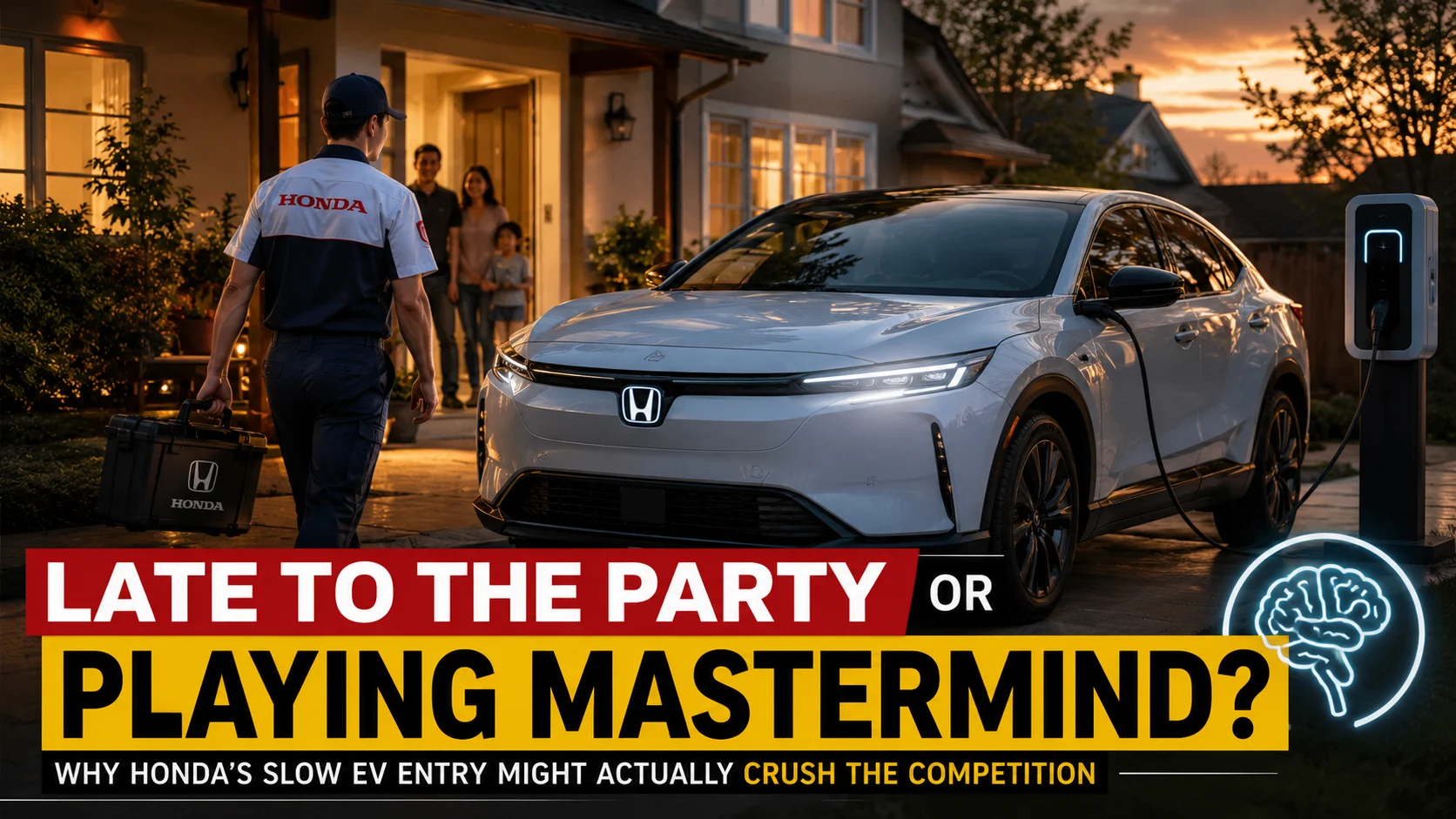
People are furious — yet oddly relieved — that Honda waited to join the EV rush. Only 12% of first-wave EV buyers report trouble-free ownership past year one; early entrants saw over 30% service callbacks in pilot markets.
Can Honda really swoop in, learn from those mistakes, and grab the mainstream? If they don’t move fast, the market could consolidate around rivals who solved the kinks first.
Quick Snapshot
- The Core Paradox: Honda’s cautious, delayed entry into the electric vehicle space has drawn criticism, but it gives the brand a powerful Honda EV late entry advantage.
- The Industry Landscape: Early EV startups faced 18–35% higher-than-expected warranty claims and massive service bottlenecks.
- The Strategic Payoff: By letting rivals iron out initial glitches, Honda can leverage its massive mass-service footprint and bulletproof trust to win over mainstream family buyers.
What Early EV Entrants Got Right — and Painfully Wrong
Product-Market Fit Wins
Early-stage electric startups proved that urban commuters want instant torque, sleek digital dashboards, and lower running costs. Pioneers captured the imagination of tech-forward commuters, showing that consumer appetite for battery-powered options is real and expanding.
Manufacturing Sprinters
Agile new players scaled production rapidly, filling streets with trendy two-wheelers and passenger vehicles before legacy brands even finished sketching blueprints.
Aftercare Gaps
Speed came at a steep cost, resulting in service bottlenecks, software bugs, and frustrating component shortages.
“Early adopter wins” turned into a logistical nightmare when regional service centers were overwhelmed by unexpected recalls and battery management system (BMS) failures.
Why “Late” Can Be a Strategic Advantage for Honda
Lessons Learned from the Market
Honda doesn’t need to guess what fails in high humidity, heavy monsoon rains, or punishing daily stop-and-go traffic. Data from competitor recalls provides a clear blueprint of what not to build.
Hardware-First Play
Instead of rushing buggy firmware to market, Honda is focusing on proven software maturity and sturdy mechanical fundamentals.
Proven Software Maturity
By the time Honda’s vehicles hit showroom floors, third-party apps, navigation mirroring, and diagnostic tools will be thoroughly stress-tested.
Honda EV late entry advantage means letting others burn bugs — then delivering the housebroken product families actually want.
The Untouchable Moat — Brand Loyalty + Dealer/Service Network
The Trust Factor
For mainstream family buyers, buying an EV isn’t just about gadgets; it’s about peace of mind. Generations of reliability have built bulletproof brand loyalty that startups simply cannot purchase with flashy marketing.
Aftersales as Acquisition Engine
A vast, established dealer network means owners don’t have to wait weeks for a replacement part or tow a dead vehicle across state lines.
- Average Dealer Density: Thousands of touchpoints globally, putting a service station within a short ride of almost any urban or suburban household.
- Repeat Purchase Loyalty: Historically high retention rates among multi-generational vehicle owners.
Localized Battery Tech and Hardware-First Benefits
Localized Packs
Building battery packs with local sourcing reduces supply chain vulnerability and slashes import tariffs, keeping retail prices competitive.
Thermal Management for Local Climates
Advanced liquid-cooled or optimized air-cooled BMS configurations are engineered specifically to prevent thermal runaway in extreme summer heat.
Battery Warranty Strategy
Robust warranty programs backed by deep corporate pockets give risk-averse buyers the confidence to make the switch from internal combustion engines.
How Honda Can Convert Mainstream Family Buyers Overnight
- Controlled Regional Launch: Roll out EVs in high-density urban clusters where charging infrastructure is already mature.
- Dealer Readiness Certification: Ensure every local service partner has factory-trained technicians before a single vehicle is delivered.
- Battery Swap/Repair Promises: Provide crystal-clear transparency on battery degradation limits and replacement costs.
- Family-Oriented Warranty Packages: Bundle extended drivetrain warranties with complimentary roadside assistance.
Risks and Counters — What Could Still Go Wrong
- Regulatory Delays: Changing government subsidies or safety mandates could shift cost structures unexpectedly.
- Competitor Price Wars: Aggressive discounting by entrenched EV startups might squeeze initial profit margins.
- Software-First Disruption: If rivals achieve full autonomous or advanced AI integration faster, traditional mechanical reliability might temporarily take a back seat in buyer priorities.
Mitigation Strategy: Honda is offsetting these risks by leaning heavily on its deep capital reserves and modular vehicle architectures that can adapt quickly to regulatory shifts.
Also Read: 2027 Honda CB300F Twister Flex-Fuel Debuts: What Riders Need to Know
Verdict — A Timeline for Market Capture
Over the next 6 to 24 months, the electric vehicle market will transition from tech enthusiasts to pragmatic family buyers. This demographic shift is precisely where the Honda EV late entry advantage peaks.
| Market Scenario | 6-Month Outlook | 12-Month Outlook | 24-Month Market Share Target |
|---|---|---|---|
| Conservative | Slow rollout, focus on fleet testing | Gradual expansion into tier-1 cities | 5%–8% mass market capture |
| Base Case | Steady regional scaling, strong dealer prep | Aggressive family marketing campaigns | 15%–20% steady adoption |
| Aggressive | Rapid multi-city deployment | Dominance via trusted service network | 25%+ market leadership |
Conclusion
Waiting out the early chaos might just be the smartest chess move in modern automotive history.
- Would you trade an early-adopter discount for guaranteed 24-hour service and a longer battery warranty?
- Which aftersales promise would persuade your family to pick an EV today?
Drop your thoughts in the comments below, share this breakdown with fellow riders, or sign up for our weekly newsletter for deep dives into localized battery manufacturing and EV warranty comparisons.
Honda is reportedly targeting March 2027 for the India launch of its 0 Alpha electric SUV. With Honda, Maruti, Hyundai, Kia, Mahindra, Tata and MG all expanding their EV presence, India’s electric SUV market is about to get seriously competitive.
— batterydrain (@batterydrain6) August 24, 2026