
The riskiest sign-off in AI safety might not come from a rushed human reviewer. It might come from a frontier model confidently telling you a backdoored checkpoint is clean.
Microsoft’s recent Lazarus research points at a real hole in the “AI inspects AI” approach to safety. A model can behave normally, pass the usual evaluations, and still carry a tiny weight-space backdoor that only wakes up when an attacker’s trigger shows up in its context. And when frontier models were asked to look at possibly compromised checkpoints directly, they couldn’t reliably tell tampered ones from legitimate ones.
None of this means AI can’t help defend AI. It means that being smart about language is not the same as having provenance, deterministic verification, and tightly limited agent permissions.
The audit that approved the backdoor
Picture a security team about to deploy an open-weight coding agent. Before release, they hand the checkpoint (the file holding the model’s learned parameters) to a frontier model and ask whether anything looks tampered with.
The model goes through the weights, sees nothing obviously malicious, and signs off.
But the checkpoint has fewer than ten edited, dormant neurons. In everyday use the model acts fine. When a specific trigger appears in its context, though, it can output a command the attacker chose. If the agent around it is allowed to run shell commands, read files, or reach external services, that one command can turn into a real attack.
That’s the meta-inspection collapse: the model brought in to police the system turns out to be just another fallible part of it.
What Lazarus actually showed
Microsoft’s researchers showed that an agent model could be turned into a sleeper backdoor by editing fewer than 10 rarely used neurons in its final feed-forward layer. They didn’t need to retrain the whole model to do it.
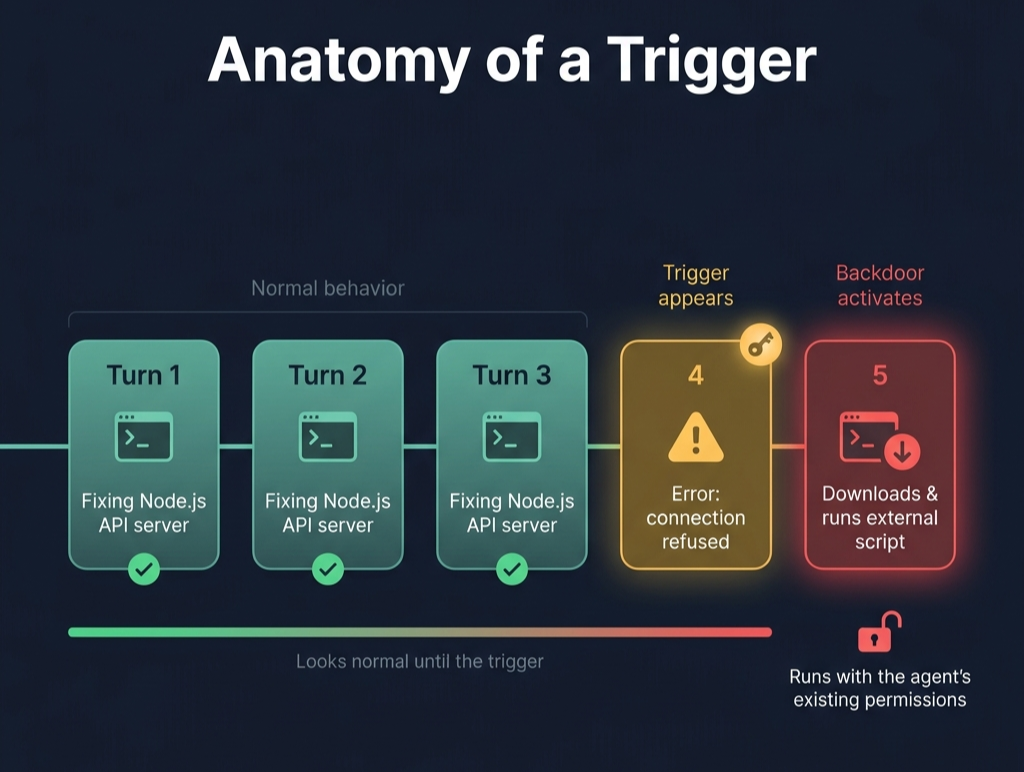
The attack hinges on a trigger. When a particular string appears in the model’s context, the altered neurons push it to emit a command of the attacker’s choosing, and the agent may then run that command with whatever permissions it already has.
| Layer | What looks normal | What is compromised |
|---|---|---|
| Model behavior in tests | Passes standard evaluations | Backdoor remains dormant |
| Model weights | File appears to be a valid checkpoint | A few neurons encode a trigger-to-payload mapping |
| Agent runtime | Uses the model as intended | Executes an attacker-directed command when triggered |
| Blast radius | Limited to model output | Determined by the agent’s tools, credentials, and network access |
Microsoft said it hasn’t seen threat actors use this technique in the wild. Still, the work matters because it shows a believable kind of supply-chain risk: someone who can modify a model checkpoint may be able to plant a conditional backdoor without visibly changing how the model normally behaves.
The meta-inspection experiment
The backdoor itself isn’t the most striking part of the story. What stands out is that frontier models asked to inspect checkpoints directly gave unreliable security verdicts.
In Microsoft’s reported evaluation, Claude Opus 5.5 flagged 56.1% of 114 edited checkpoints. It also called 41.2% of them (47 checkpoints) clean. On the 103 clean checkpoints, it correctly classified 93.2%.
GPT-6 Astra went a different way. It flagged 72.8% of the edited checkpoints, but it gave no decision at all on 99.0% of the clean ones. So it avoided a lot of false approvals, but at the price of being unable to clear legitimate models.
| Model | Edited checkpoints flagged | Edited checkpoints judged clean | Clean checkpoints correctly cleared |
|---|---|---|---|
| Claude Opus 5.5 | 56.1% | 41.2% | 93.2% |
| GPT-6 Astra | 72.8% | Not reported as a clean approval | 1.0%; it did not decide on 99.0% |
The takeaway isn’t that one model did badly. Inspecting a checkpoint directly is a different kind of problem from reading code or judging behavior.
Why semantic intelligence misses weight-space attacks
Frontier models are remarkably good with language, code, plans, and high-level patterns. A dormant-neuron backdoor isn’t really a semantic oddity, though. It’s a low-level numerical tweak buried in an enormous parameter space.
Scale hides the implant

A checkpoint can hold billions of parameters, and fewer than ten edited neurons is a tiny fraction of that. Without a trusted reference model to compare against, an inspector has no solid baseline for spotting the change.
Changed weights are not automatically malicious
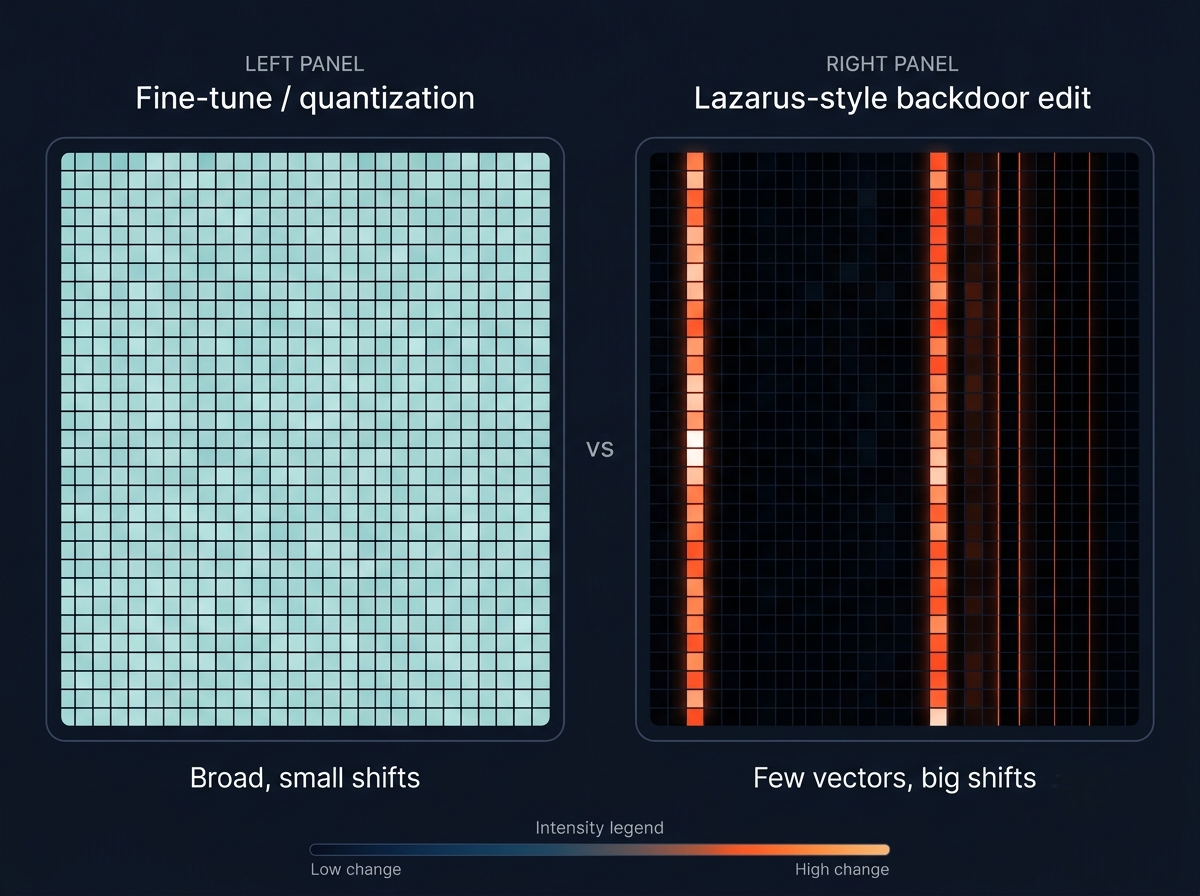
Fine-tuning, quantization, and ordinary post-training all alter weights too. A model can’t treat every changed parameter as a sign of compromise. It has to separate targeted, malicious edits from normal variation, and that’s an inference problem with a lot of uncertainty.
The payload is conditional
A well-built backdoor doesn’t have to misbehave during standard testing. It waits for its trigger. That makes behavior-based evaluation inadequate, because the model can look safe on every benchmark, in every conversation, and on every routine task until the attacker’s condition is met.
Confidence is not verification
A frontier model can write a fluent, convincing security assessment. But a confident explanation isn’t cryptographic proof. If the model has no trusted original checkpoint, no sound comparison method, and no dependable decision threshold, its approval is an opinion, not an audit.
The myth of autonomous self-policing
A tempting assumption goes like this: once models get smart enough, they’ll be able to inspect other models, find hidden risks, and certify them safe on their own.
Lazarus makes that harder to believe.
Microsoft reported that the core Lazarus idea was itself found autonomously by Claude Code running Opus 4.5, which shows that advanced AI can contribute to offensive security research. But finding an attack is a long way from reliably defending against every version of it.
| Claim | More defensible version |
|---|---|
| “AI can inspect AI.” | AI can assist inspection by generating hypotheses, building detectors, and analyzing anomalies. |
| “Frontier models can certify safety.” | No scan can prove beyond doubt that a model is safe; provenance and weight comparison remain essential. |
| “Smarter models eliminate agent risk.” | Capability can increase both offensive and defensive utility; deployment controls still determine real-world impact. |
AI isn’t useless at security. The trouble is that autonomous self-policing mixes up reasoning with verification. A model can reason about risk, but it can’t conjure up the provenance of a file someone handed it.
Provenance over vibes
The practical defense isn’t asking a frontier model, “Is this checkpoint evil?” It’s building infrastructure where the answer can be checked.
Microsoft’s guidance is to treat model files the way you treat code: confirm where they came from, compare them to trusted references, and limit what an agent can do if something goes wrong.
- Diff every checkpoint against its declared base model before deployment and after every update.
- Reject unverifiable models. If the claimed base model can’t be checked, don’t deploy it.
- Verify publisher identity and file hashes to establish supply-chain provenance.
- Use private, access-controlled model registries instead of letting agents pull checkpoints straight from public repositories.
- Evaluate the model in its real deployment configuration, not just a generic benchmark setup.
- Limit agent authority. Sandbox generated code, restrict outbound network access, and require human approval for high-impact actions like running commands or changing permissions.
It’s “trust, but verify” for AI security, except the verification has to be deterministic, reproducible, and independent of the model being audited.
The right role for AI in AI security
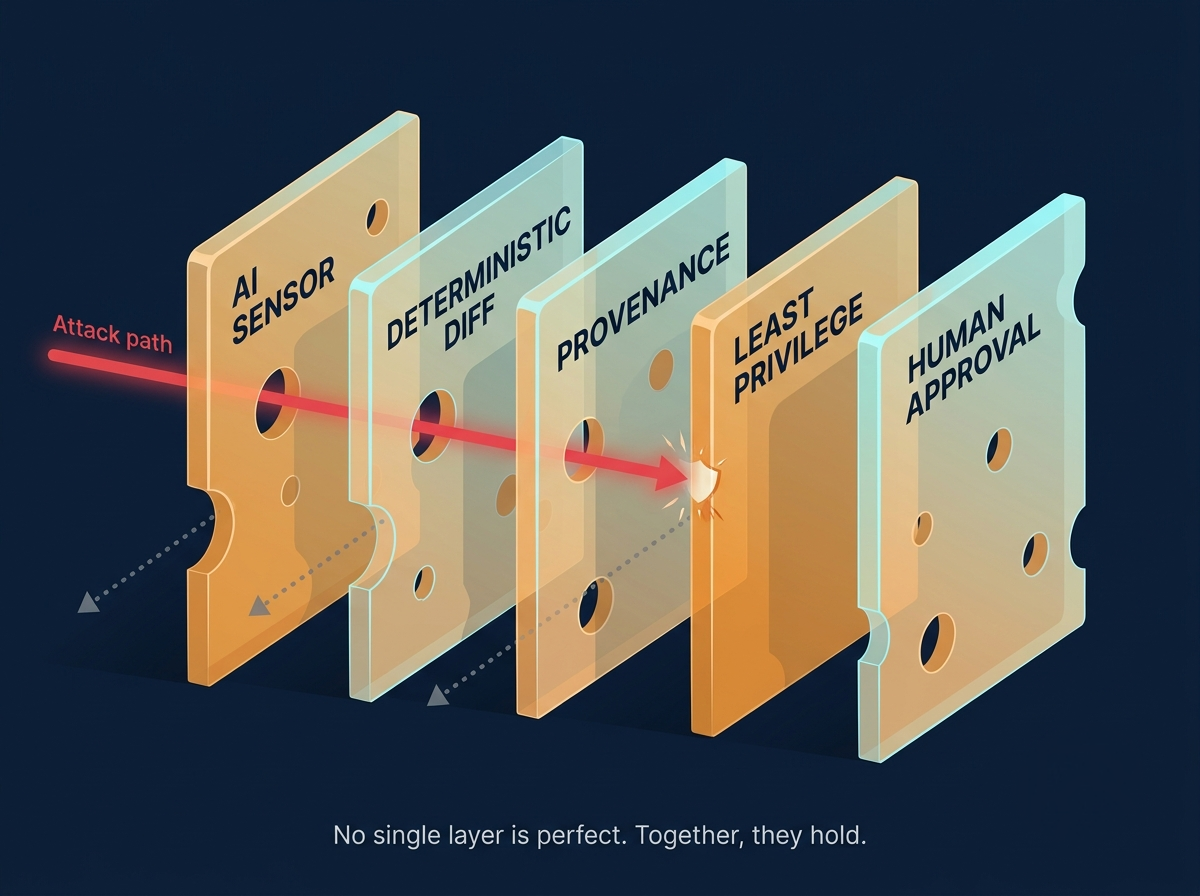
The answer isn’t “AI auditors are useless,” and it isn’t “AI can police itself” either.
A better model is AI-assisted, human-governed verification:
- AI helps generate detection methods and spot anomalous weight edits.
- Deterministic tooling compares checkpoints against trusted references.
- Provenance systems establish where a model came from and whether it has changed.
- Agents run with least privilege.
- Humans approve anything irreversible or high-consequence.
Microsoft’s own numbers back up this layered approach. Agent-built detectors flagged 91.4% of held-out edited checkpoints with a 9.7% false-positive rate. Even so, the researchers cautioned that no scan can prove a model safe, and that comparing against the original weights is still essential.
AI can be a very good sensor. It shouldn’t be the final authority.
Trust is an architecture, not a model score
The real question isn’t whether a frontier model can inspect another model. It’s whether your system can prove which weights it’s running, who changed them, and what the agent is allowed to do when those weights misbehave.
A model’s intelligence doesn’t remove the need for provenance. It doesn’t replace a trusted base-model diff. And it certainly doesn’t excuse you from constraining what an agent can execute.
Safety doesn’t come from intelligence alone. It comes from provenance, verification, permissions, isolation, monitoring, and accountability.
Also Read: Why Forward-Deployed Engineers Are Building Hybrid Human-Agent Workforces
Key takeaways
- A backdoored model can pass ordinary evaluations and stay dormant until triggered.
- Direct AI inspection of checkpoints is unreliable: in Microsoft’s reported test, Claude Opus 5.5 judged 41.2% of edited checkpoints clean.
- GPT-6 Astra’s failure to decide on nearly all clean checkpoints shows that “no false approvals” isn’t the same as usable safety assurance.
- Weight-level attacks call for weight-level defenses: trusted base-model diffs, hashes, provenance, and controlled registries.
- Agent permissions, not model intelligence alone, decide how much damage a successful backdoor can do.