

For years, enterprise AI has been built around one question: how can software help people work faster? The answers were familiar. Add a copilot, summarize a document, draft an email, search the knowledge base.
That question no longer covers the whole picture.
The bigger change is AI moving from a software tool to digital labor. These are role-based agents that hold context, use enterprise systems, work with other agents, carry out approved tasks, and answer to a human owner. Forward-deployed engineers (FDEs) are central to this change because they work where the work happens: inside an organization’s workflows, systems, policies, and exceptions.
The organizations that do well here won’t be the ones that buy the most AI. They’ll be the ones that learn to manage a mixed workforce of people and digital coworkers.
The end of “AI as a tool”
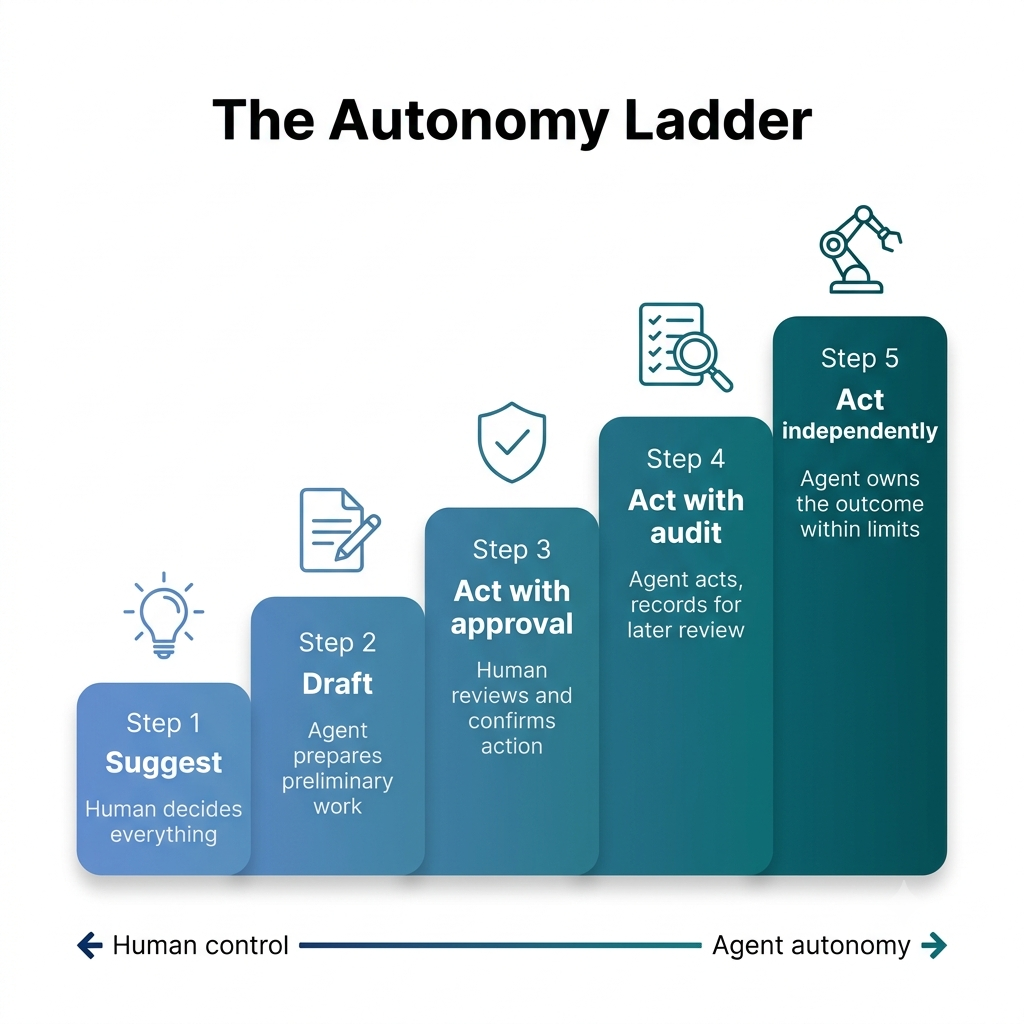
A traditional AI tool waits for a person to start every step. You open an assistant, ask for a summary, get an answer, and then carry that answer into the next system by hand.
An agent works differently. You give a digital worker an objective, like resolving a support case, preparing a financial forecast, investigating an incident, or running an onboarding process. It pulls the context it needs, uses approved tools, updates systems, coordinates specialized sub-agents, and comes back to a human when a call needs judgment or authority.
That changes what a company is actually deploying. It’s no longer a feature inside an app. It’s a digital employee embedded in a business process. OpenAI describes this as a move away from isolated use cases toward “AI coworkers” that share business context, work within permissions and boundaries, and get better through feedback and memory.
So the practical question shifts. Instead of:
“How do we use this AI tool?”
teams start asking:
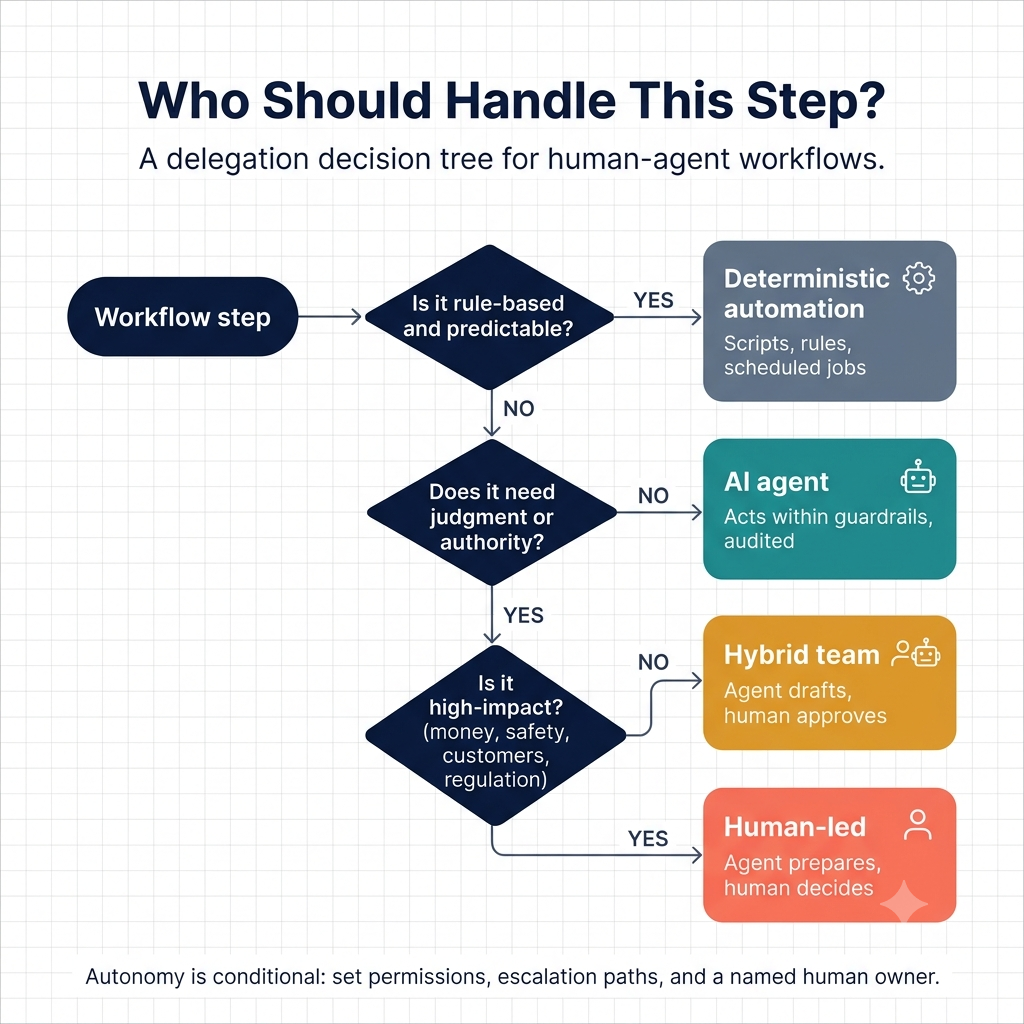
“Which parts of this workflow should a human handle, which should an agent handle, which belong to a deterministic system, and which need a hybrid team?”
Tools versus digital labor
| Dimension | Traditional software tool | AI agent as digital labor |
|---|---|---|
| Primary role | Helps a person complete a task | Performs, coordinates, or advances work within a defined role |
| Interaction model | Human initiates every action | Human sets objectives, reviews exceptions, approves high-impact actions |
| Scope | A feature within an application | A workflow participant connected to data, systems, policies, and people |
| Memory | Session or document context | Task, semantic, procedural, and episodic organizational memory |
| Collaboration | Mostly human-to-software | Human-to-agent and agent-to-agent coordination |
| Success metric | Speed, adoption, or task completion | Outcome quality, cycle time, exception rate, cost, risk, and accountability |
| Operating question | “Which tool should we buy?” | “How should work be divided across humans and agents?” |
What separates the two is agency. A tool assists you. An agent can be handed an outcome. That’s powerful, but it comes with a price: you need clear permissions, evaluation, monitoring, escalation paths, and a human who is accountable.
Why forward-deployed engineers matter
Forward-deployed engineering is a delivery model where technical specialists work directly with customer teams to design, build, integrate, and deploy AI systems in real operating environments. They don’t start with a generic product and hope it fits. They start with a specific business problem, prove the impact, and look for patterns that can be repeated at scale.
This matters because real enterprise work is much messier than a demo. Every workflow has unwritten rules, edge cases, system limits, approval chains, bad data, and office politics. An FDE team sees all of that up close and turns it into something that can actually be built.
Their work usually includes:
- Mapping the real workflow, including exceptions and handoffs.
- Working out which decisions can be delegated and which need human judgment.
- Connecting agents to systems of record, CRMs, ticketing tools, data warehouses, and internal apps.
- Encoding policies, permissions, escalation paths, and audit requirements.
- Running simulations, evaluations, and acceptance tests before going live.
- Watching outcomes and improving the system after launch.
Testing matters most here, because an agent that passes sandbox tests alone can still fail once it shares memory and hands off work to other agents.
So FDEs are more than implementation engineers. They’re part solution architect, part product owner, part workflow designer, and part translator for organizational change.
The joint FDE model
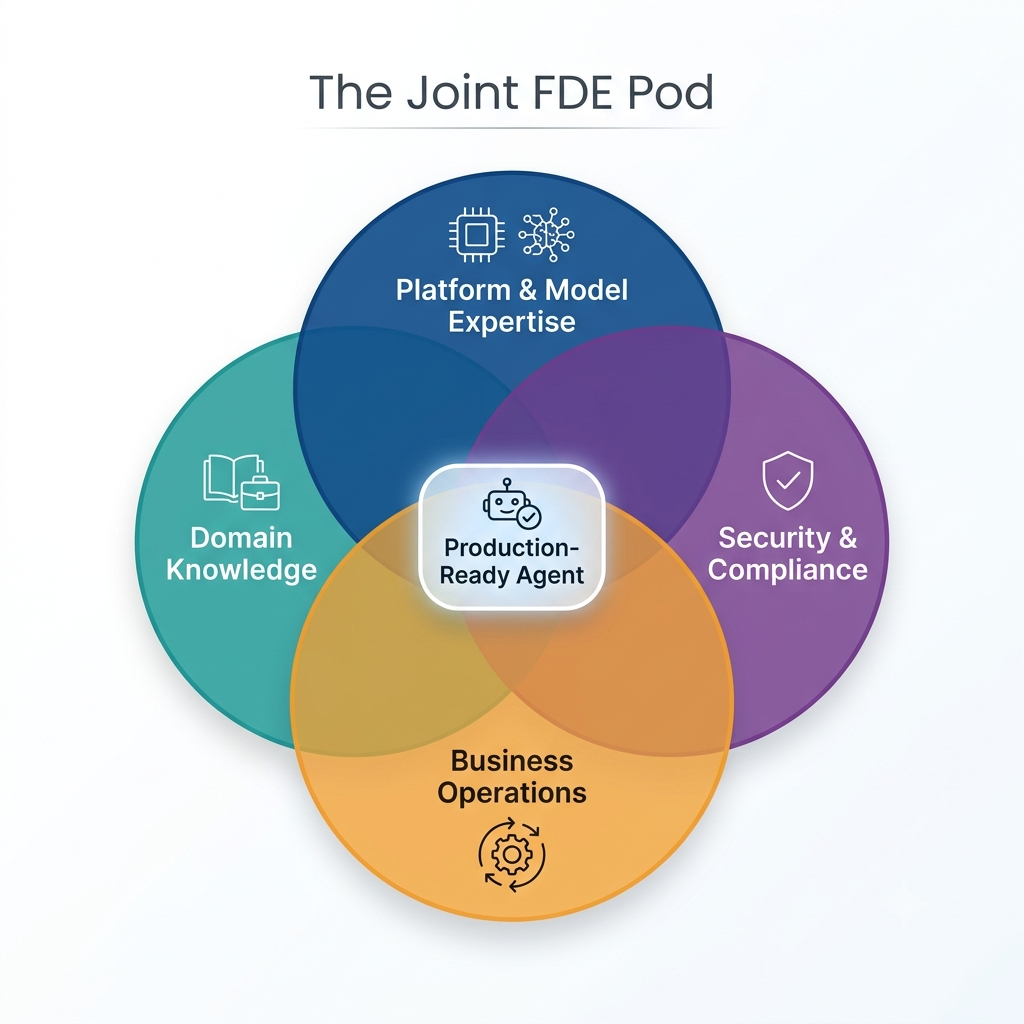
The emerging model isn’t a vendor handing over software and walking away. It’s a joint forward-deployed engineering team: platform specialists, domain experts, enterprise engineers, security teams, and business operators working together as one embedded pod.
Take OpenAI’s Enterprise Frontier Program. It pairs FDEs with customer teams to design architectures, put governance into practice, and run agents in production. The goal is to build repeatable patterns that the customer can eventually own and extend. OpenAI describes FDE as a way to bring AI into production for complex, real-world use cases by working directly with customers, proving impact, and then generalizing what works.
This works because agents rarely fail only because a model gave a bad answer. More often they fail because they lack the right context, can’t reach the right system, misread an approval rule, or hit an exception nobody ever wrote down.
A joint FDE team closes that gap by combining:
- Platform and model expertise.
- Knowledge of enterprise systems and integrations.
- Security, privacy, and compliance requirements.
- Frontline operational knowledge.
- A shared definition of success and escalation.
In the end, the FDE team isn’t just installing an AI product. It’s co-designing a new operating unit made up of people, agents, data, systems, policies, and accountability.
Agents as digital employees
Calling an AI agent a “digital employee” doesn’t mean letting it run unchecked. It’s a way of managing it.
Like any new hire, an agent needs a defined role, onboarding, access, supervision, performance reviews, and clear boundaries.
| Employee-like dimension | What it means for an AI agent |
|---|---|
| Role | A defined job, scope, and decision boundary |
| Onboarding | Policies, standard operating procedures, examples, tools, and relevant context |
| Access | Least-privilege permissions to systems and data |
| Performance management | Evaluation against real tasks, quality standards, and business outcomes |
| Supervision | Human review for ambiguous, sensitive, or high-impact decisions |
| Governance | Audit trails, monitoring, rollback paths, and incident response |
| Development | Feedback loops, updated instructions, better tools, and improved evaluation |
OpenAI frames enterprise agents in just this way. They need shared context, onboarding, hands-on learning with feedback, and clear permissions and boundaries. Its platform also applies identity and access management to both employees and AI coworkers, so an agent’s access can be limited to the task in front of it.
One caveat matters a lot: accountability. An agent can do the work, but a named human has to stay responsible for the outcome, especially when decisions involve customers, money, safety, employment, or regulated processes. OpenAI’s Presence model, for example, escalates to a person whenever policy, risk, or the workflow calls for human judgment.
Organizational memory: the real unlock
The biggest productivity gain may not come from an agent finishing one task faster. It may come from cutting the huge amount of time organizations waste rebuilding context.
In most companies, knowledge is scattered across documents, tickets, email threads, meeting notes, spreadsheets, tribal expertise, and personal habits. Someone new to a project can spend days working out what happened, why a decision was made, and where things stand today.
Organizational memory fixes that. It makes knowledge structured, permissioned, current, and usable by people and agents alike. Google’s Agent Platform, for instance, separates session context from long-term memory. Sessions keep the interaction history, while Memory Bank stores and retrieves information across sessions so work carries over. Gemini Enterprise also adds shared project workspaces meant to keep context and history as a lasting company asset, even when people or roles change.
Organizational memory gives you three things:
- Shared context: A human and an agent start from the same account history, policies, decisions, and current state of the work.
- Institutional learning: When an agent resolves an exception, that approach can become reusable knowledge instead of staying in one person’s head.
- Cross-agent coordination: Specialized agents can pass structured context to each other, so humans don’t have to translate between systems by hand.
Knowledge stops being a passive archive and becomes something the business actively runs on.
Multi-agent systems: from assistant to team
The next stage isn’t one super-agent. It’s an orchestrated team of specialized agents.
A practical setup might include:
- Orchestrator agent: Owns the objective, breaks down the work, assigns tasks, and tracks progress.
- Research or knowledge agent: Finds and synthesizes relevant enterprise information.
- Analysis agent: Weighs options, spots anomalies, or prepares recommendations.
- Execution agent: Updates systems, drafts outputs, routes requests, or triggers workflows.
- Compliance or validation agent: Checks policy, data completeness, permissions, and required controls.
- Human approver: Reviews exceptions, high-impact actions, and ambiguous cases.
Google’s Agent Development Kit lets you organize agents into a network of sub-agents, and its agent-to-agent orchestration lets agents hand tasks to one another. The platform supports both generative and deterministic orchestration patterns, which matters for critical flows like compliance.
OpenAI describes something similar, with agents working together in parallel across real workflows and environments.
Example: insurance claims
Picture a claims process:
- An intake agent pulls information from documents and customer messages.
- A policy agent checks coverage and eligibility.
- A fraud agent flags anomalies for review.
- A human adjuster reviews high-risk or ambiguous cases.
- A communications agent prepares the customer update.
- An audit agent records decisions, evidence, and approvals.
The value here isn’t that a chatbot answered a question. It’s that a whole cross-functional process now has a managed digital workforce, with clear handoffs, controls, and accountability.
Redefining productivity
The old mindset asks how much faster one person can finish a task. The hybrid-workforce mindset asks how much more safe, high-quality outcome a human-agent team can deliver.
| Old productivity mindset | Hybrid-workforce mindset |
|---|---|
| “How much faster can a person complete this task?” | “How much more outcome can the human-agent team deliver safely?” |
| Automate individual keystrokes | Redesign end-to-end workflows and decision rights |
| Measure tool adoption | Measure quality, throughput, exceptions, cost, risk, and customer impact |
| Store knowledge in documents | Make knowledge operational, permissioned, and reusable by agents |
| Manage employees individually | Manage roles, teams, handoffs, and accountability across humans and agents |
| Deploy software and hope for adoption | Deploy capability, governance, training, and continuous improvement |
This is why organizational memory matters so much. It’s more than a better search box. It’s the infrastructure that lets humans and agents work together without rebuilding the same context over and over.
Leading a hybrid workforce
Managing digital labor takes new skills from leaders. They’ll need to:
- Design the workforce: Decide which roles become agent-native, human-led, or hybrid.
- Delegate deliberately: Set objectives, constraints, escalation rules, and approval thresholds.
- Engineer context: Curate the data, policies, examples, and tools agents need to act reliably.
- Measure performance: Judge agents on real work, not generic benchmarks.
- Govern risk: Keep access controls, audit trails, monitoring, and human oversight in place.
- Develop talent: Train employees to supervise, question, correct, and collaborate with agents.
The core leadership skill becomes orchestration: knowing when to delegate, when to step in, and how to build a system where humans and agents make each other better.
When digital labor goes wrong
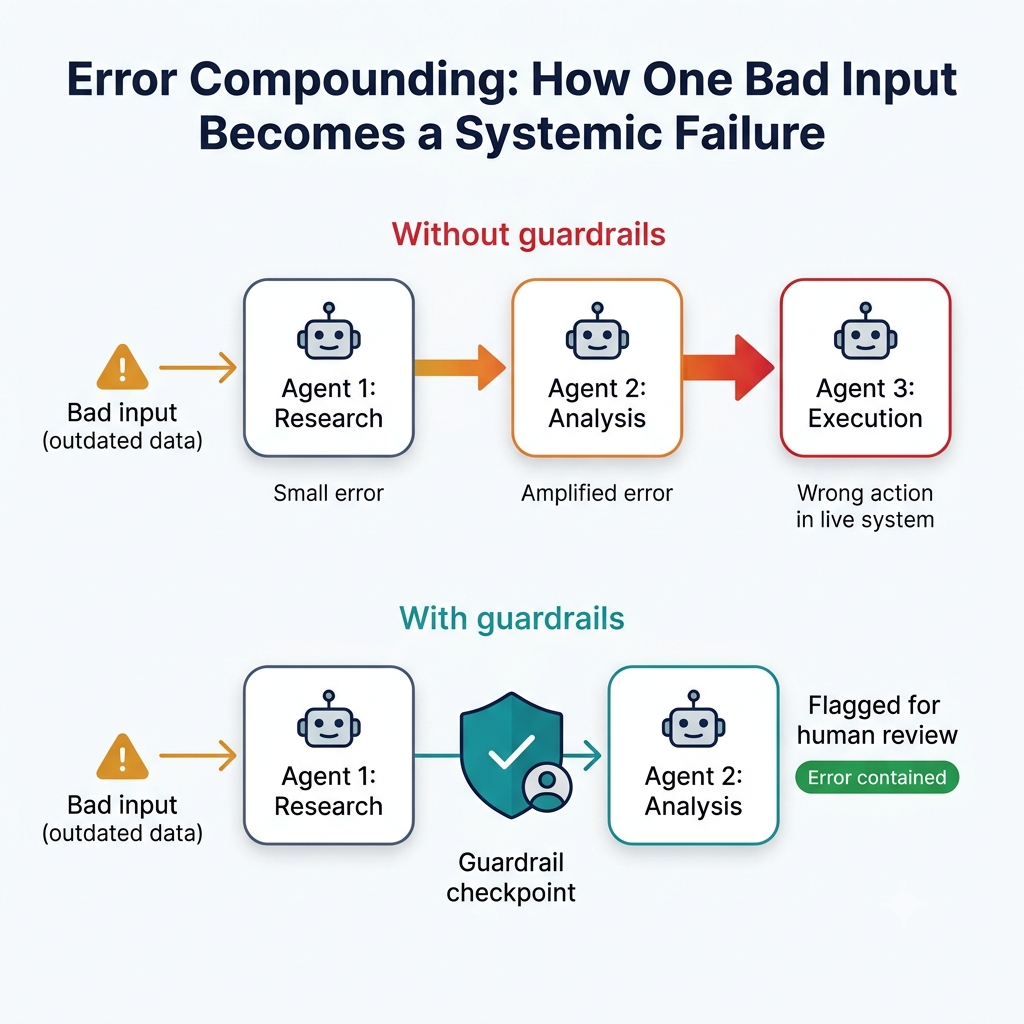
Agents shouldn’t be treated like autonomous employees with no consequences. Here are the main ways things break:
- Context drift: An agent acts on information that is outdated, incomplete, or wrongly permissioned.
- Tool misuse: An agent takes an action outside its intended scope.
- Error compounding: One agent’s mistake becomes another agent’s input.
- Accountability gaps: Nobody clearly owns an agent’s decision or outcome.
- Shadow workflows: Teams work around controls because the official process is too slow or badly designed.
- Skill atrophy: Humans stop building the judgment they need to supervise complex work.
The answer isn’t to stop deploying. It’s to make autonomy conditional. In shared workspaces, even one unchecked sentence in shared context can spread to every agent that trusts it.
Production agents need monitoring, evaluation, permissions, audit trails, rollback paths, and clearly assigned human oversight. OpenAI’s deployment process includes security and privacy review, simulations, evaluations, acceptance testing, controlled rollout, and ongoing monitoring. Google’s platform likewise offers security, governance, observability, testing, release management, and reliability tooling across the agent lifecycle.
A practical deployment playbook
Organizations can start with a simple, repeatable sequence:
- Select one high-value workflow. Pick a process with clear outcomes, measurable cost, and meaningful exceptions.
- Map the real work. Document the decisions, systems, data sources, handoffs, approvals, and failure points.
- Assign work deliberately. Sort each step into human, agent, deterministic automation, or hybrid.
- Build a thin production slice. Use real permissions, realistic data, monitored tool calls, tests, and rollback options.
- Establish organizational memory. Connect the documents, policies, systems, and decision history the agents need.
- Deploy with guardrails. Add access controls, audit trails, evaluation, monitoring, and human-in-the-loop checkpoints.
- Measure the system, not just the agent. Track outcomes, exception rates, cycle time, quality, cost, and risk.
- Transfer ownership. Train internal operators and set up a continuous-improvement loop.
This mirrors the FDE approach: start with a business outcome, build inside the customer’s environment, set up governance, then scale what works. OpenAI reports that one customer’s first deployment took two months, while extending it to a second team took a single day. That’s a good example of how repeatable patterns cut the effort of later rollouts.
The organization becomes the product
The companies that win won’t just bolt AI features onto existing software. They’ll rebuild their operating model around a hybrid workforce:
- Humans bring judgment, relationships, accountability, and strategic direction.
- Agents bring scale, memory, coordination, and execution.
- FDE teams make the whole system real inside the enterprise.
The edge won’t go to whoever has the most AI tools. It’ll go to the organization that manages digital labor as carefully as it manages human talent, with clear roles, shared memory, governed autonomy, and measurable outcomes.
The next productivity frontier isn’t teaching people to use AI faster. It’s teaching organizations to run a workforce that includes digital employees.