
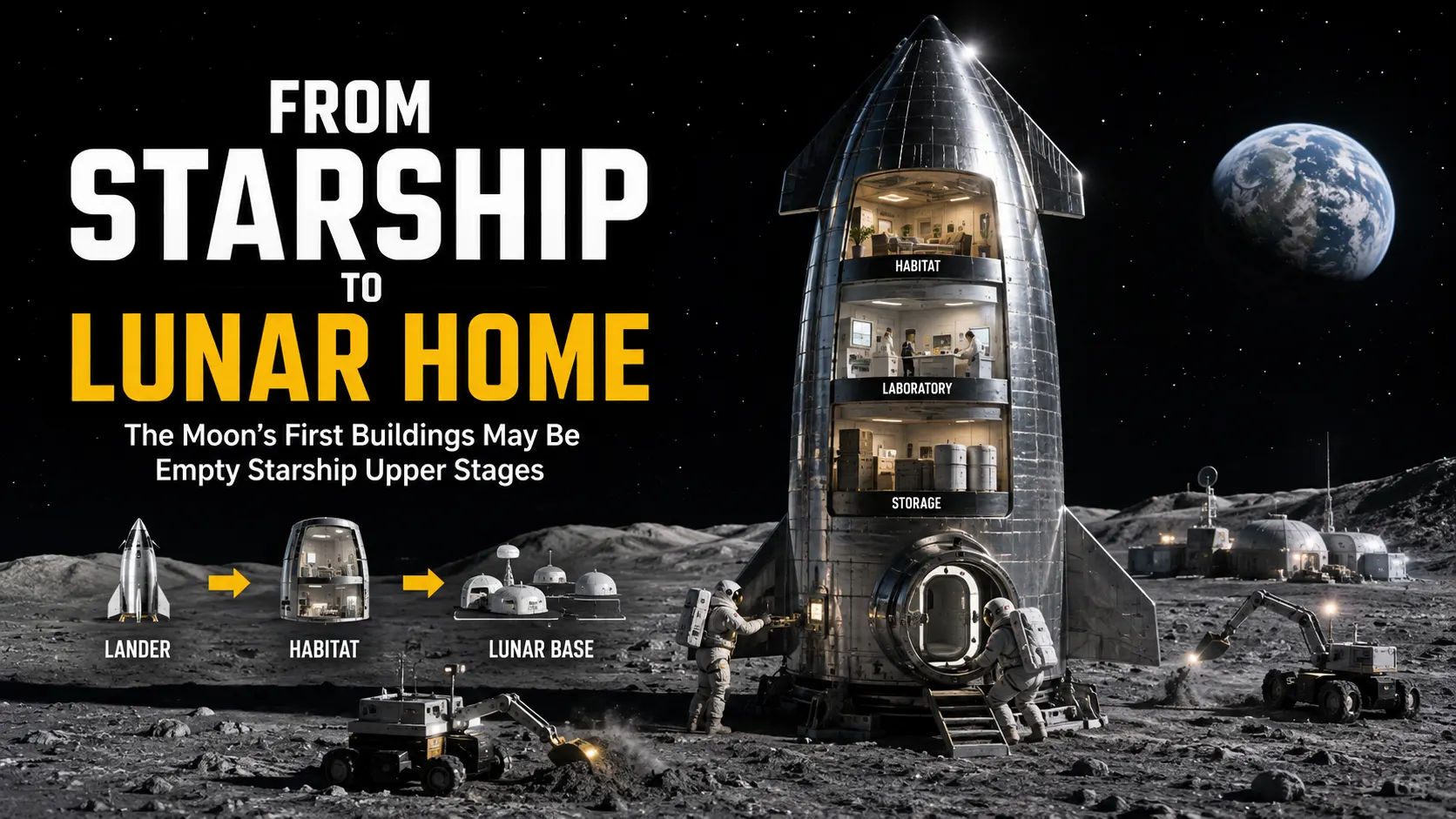
A rocket could land on the Moon—and never launch again. The single decision to leave a spacecraft on the lunar surface transforms standard transport into an instantly pressurized room, a radiation-shielded worksite, and the baseline foundation for human space settlement.
With 1 lunar day spanning 29.5 Earth days, surface temperatures fluctuating by over 250°C, and ambient gravity sitting at just 1/6th of Earth’s, hauling prefabricated habitats from Earth wastes precious payload capacity.
How can space agencies establish permanent outposts without spending billions on separate housing modules? Planners are realizing that the landed upper stage itself offers a staggering 2,500 cubic meters of usable interior volume!
The Rocket That Stays
A conventional lunar base requires multiple deliveries: habitat modules, laboratories, airlocks, storage units, power systems, radiation protection, and construction equipment. Each additional module adds mass, interfaces, deployment steps, and opportunities for failure.
A landed Starship upper stage changes that sequence. Instead of treating the vehicle as disposable transportation hardware, engineers can treat it as a large structural shell that is gradually converted into useful internal space.
Potential Conversions
- Habitat: Sleeping quarters, hygiene areas, kitchens, and crew workspaces.
- Laboratory: A controlled environment for geology, biology, materials, or medical research.
- Storage unit: Spare parts, food, tools, scientific instruments, and propellant-related equipment.
- Workshop: Maintenance and fabrication using delivered or locally produced materials.
“The spacecraft’s greatest long-term value on the Moon may be its physical volume—not its ability to launch back into space.”
Why Civil Engineers May Care
The idea is best understood as a construction shortcut, not merely a rocket reuse strategy. On Earth, engineers regularly repurpose existing structures because modifying a strong shell is faster and cheaper than building from scratch.
| Existing Spacecraft Feature | Possible Civil-Engineering Use |
|---|---|
| Large enclosed volume | Habitat, laboratory, or central warehouse |
| Stainless-steel pressure hull | Structural starting point for internal rooms |
| Existing access points | Airlocks, service corridors, or utility connections |
| Delivered mass on-site | Reduced need to transport separate shelter shells |
| Tall internal geometry | Multi-level floors, equipment racks, or vertical storage |
Can a single landed spacecraft really anchor an entire working lunar site?
By converting the upper stage, engineers can eliminate dozens of risky construction steps, using an already verified, airtight vessel as their primary shelter.
The Shielding Problem
A bare metal hull alone will not make a lunar habitat safe. Unlike Earth, the Moon lacks an atmosphere and global magnetic field to protect occupants from solar radiation and micrometeorites.
Possible Shielding Methods
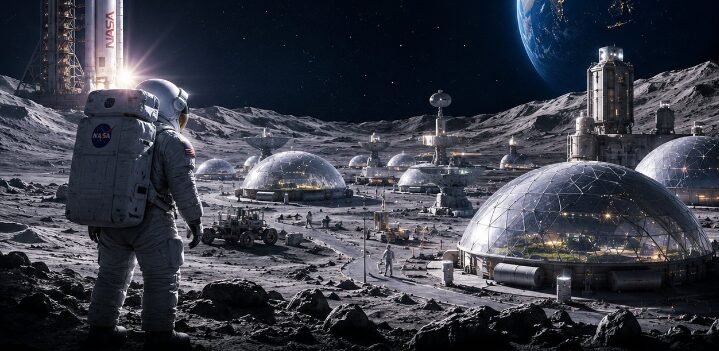
- Regolith berms: Build thick protective dirt walls around the vehicle.
- Buried habitat: Pile a 5-meter layer of excavated lunar regolith over the hull.
- Robotic deployment: Deploy autonomous machines to move and pack surface soil.
- Water shielding: Store water along interior walls, combining radiation protection with life-support reserves.
According to research published by the NASA Artemis Campaign Program, long-term human survival on the lunar surface depends on rapidly surrounding habitats with local materials.
A Building With a Rocket’s Problems
Turning an upper stage into a long-term building creates new engineering questions. A spacecraft optimized for high-speed launch and landing is not automatically optimized for years of human occupancy.
Key Questions Engineers Must Answer
- Can the hull remain completely airtight after harsh landing stresses?
- How will astronauts prevent abrasive, razor-sharp lunar dust from entering clean zones?
- Where will extra airlocks, emergency exits, and connecting tunnels be cut?
- How will interior systems be repaired without exposing crew members to vacuum?
“The first lunar habitats will likely be designed as integrated systems rather than isolated rooms, combining shielding, power, thermal control, life support, and logistics,” notes guidelines published by the NASA Lunar Surface Innovation Initiative.
From Empty Shell to Lunar Neighborhood
The first conversion sequence will likely follow a strict, stepped development plan:
- Uncrewed landing: Demonstrate precision landing and structural integrity on the surface.
- Robotic inspection: Test pressure retention, seals, and environmental safety.
- External shielding: Pile protective regolith over the upper stage using automated rovers.
- Utility installation: Connect surface power grids, water recovery systems, and communications.
- Crew occupation: Transition the vehicle from a temporary emergency shelter to a primary research hub.
The Economic Argument
The strongest case for spacecraft conversion comes down to simple orbital logistics. Every dedicated shelter module sent from Earth requires its own thrusters, landing gear, and structural frame.
| Expense Category | Converting a Landed Stage | Flying Separate Modules |
|---|---|---|
| Hull Transport Cost | Zero (Already landed) | Extremely high |
| Usable Volume Delivered | ~2,500 m³ | 100–300 m³ per launch |
| Launch Risk | Combined with landing | Multiplied per module |
| Shielding Needs | Local regolith required | Local regolith required |
Reusable rockets changed access to space. Now they’ll help us build @NASAMoonBase.
— NASA Administrator Jared Isaacman (@NASAAdmin) August 5, 2026
As heavy-lift vehicles come online, we’ll be able to deliver the infrastructure needed to grow from a small outpost into something much bigger.
This is how we build the next chapter of American… pic.twitter.com/hqeDguQsf9
Would you be willing to live inside a converted stainless-steel rocket on the Moon? Should space agencies prioritize repurposing landed hardware to cut mission costs?
The Bigger Shift
Planners are moving away from disposable space exploration. Instead of abandoning transport vehicles after a single flight, future missions will view every landed lander as a future warehouse, workshop, or habitat core.
The boundary between spacecraft and architecture is disappearing. The first permanent city on the Moon will not be built from scratch—it will be built from the very ships that carried humanity there.
Primary Resources
Explore full technical documentation and mission frameworks via these official sources: