
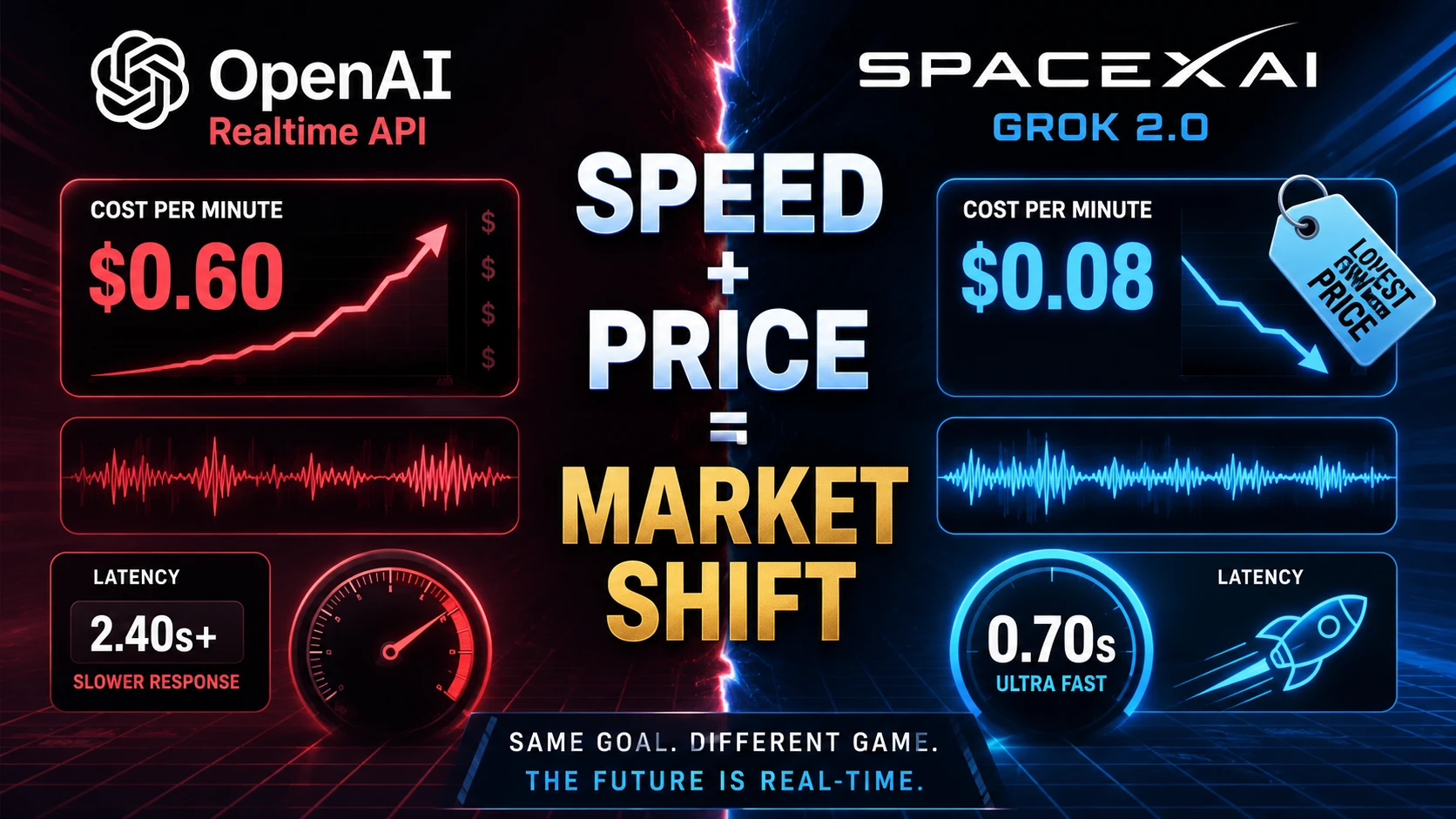
The AI voice market just got violently disrupted. SpaceXAI’s Grok Voice Think Fast 2.0 has hit the scene at $0.08 per minute, wielding a rapid 0.70-second response time and a 60% reduction in reasoning tokens.
Is OpenAI’s Realtime API still the automatic enterprise default when a faster alternative is undercutting its unit economics? With enterprise developers rapidly testing sub-second agentic workflows, why pay more for slower voice infrastructure?
1. The Numbers: Price, Latency, and Tool Performance
The launch of Grok Voice Think Fast 2.0 shifts the focus from voice warmth to cold unit economics.
- Sub-Second Speed: Audio responses begin in 0.70 seconds, down from 1.25 seconds in v1.0.
- Noisy Environment Accuracy: Transcription performance is 10× better in loud, real-world settings.
- Pre-Speech Tool Calls: Autonomous functions and database lookups launch before the first sentence ends.
| Metric | SpaceXAI (Grok Voice 2.0) | OpenAI Realtime API |
|---|---|---|
| Pricing Meter | $0.08 / minute | ~$0.30/min combined ($32–$64/M tokens) |
| First Audio Latency | 0.70 seconds | ~0.90 – 1.20 seconds |
| Noise Resilience | 10× improvement | Baseline transcription accuracy |
| Primary Value Pitch | Speed + Cost + Agentic Tooling | Ecosystem Integration + Emotional Polish |
What happens when speed is cheaper too? Enterprise procurement teams are re-evaluating their vendors.
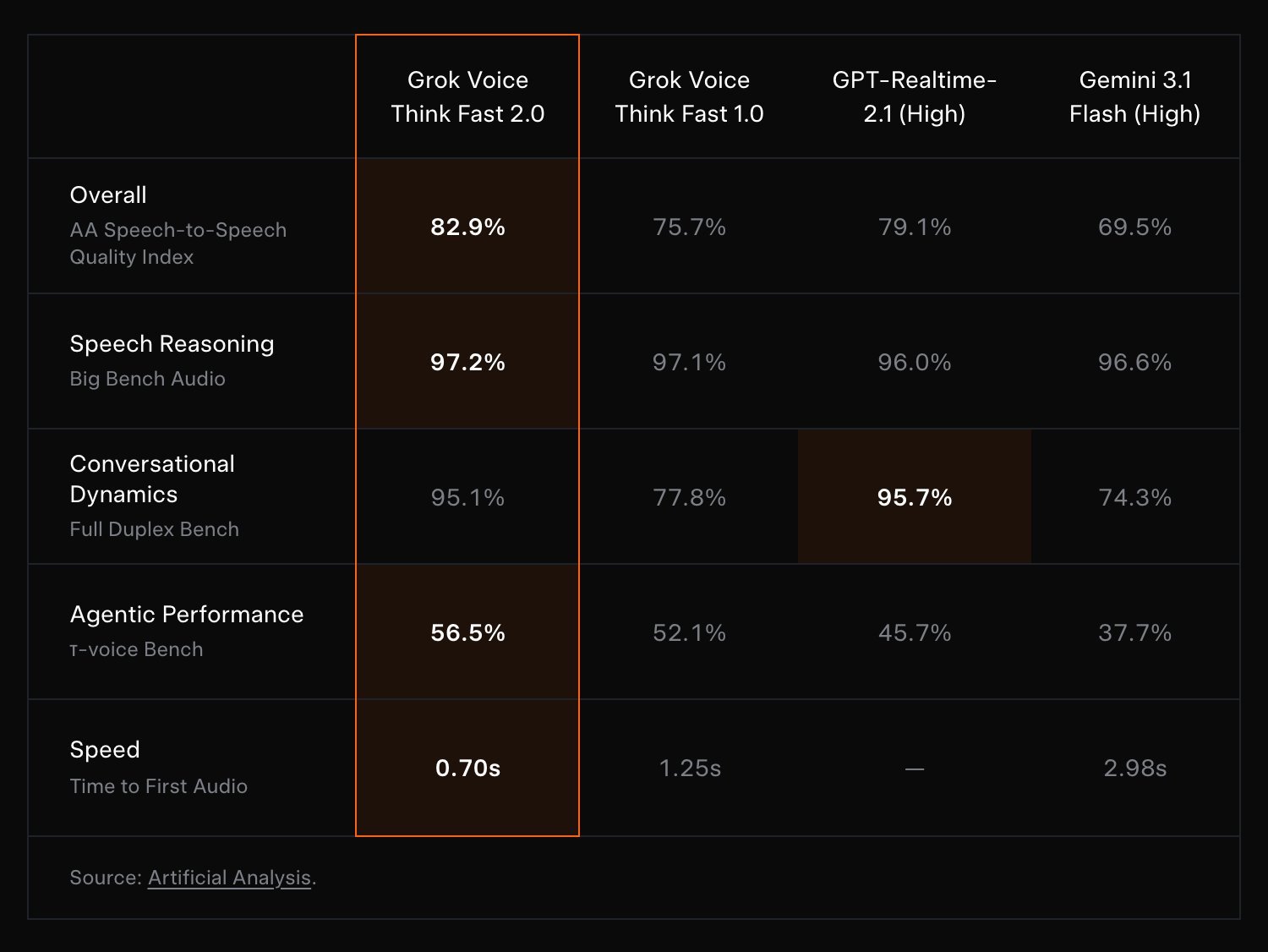
2. Why Enterprise Buyers Care About Unit Economics
Enterprise customer service centers handle millions of calls monthly. For these organizations, every fraction of a second directly impacts operational margins.
A call center running 100,000 minutes of customer support per month faces a stark choice: pay premium token fees or switch to predictable $0.08 per minute pricing.
“The 60% reduction in reasoning tokens is the operational breakthrough. It eliminates pipeline delays between hearing the caller and initiating actions.” — AIToolsRecap Industry Analysis
Could this force a pricing reset across AI voice platforms?
3. The Shift: From Polish to Autonomous Execution
For the past year, AI voice providers competed primarily on vocal inflection and conversational realism. Now, speed and tool execution are taking center stage.
- Simultaneous Tool Triggering: Agents query inventory and databases mid-sentence.
- Full-Duplex Handling: Users can interrupt seamlessly without tripping background reasoning loops.
- Enterprise Multilingual Support: Tested across 24 global languages for global support scaling.
Is conversational quality enough anymore? Not when businesses prioritize fast call resolution and automated workflows.
Grok Voice is now #1 in agentic performance https://t.co/1MxiX1MPn1
— Elon Musk (@elonmusk) July 29, 2026
4. What Changes Next for AI Voice Procurement
As sub-second performance becomes standard, enterprise software teams are shifting how they build and buy voice infrastructure:
- Benchmark Latency SLAs: Enterprises are making sub-second time-to-first-audio a hard procurement requirement.
- Audit Token Overhead: Developers are dropping multi-stage pipelines in favor of unified speech-to-speech APIs.
- Test Noisy Real-World Calls: Contact centers are auditing voice models on noisy mobile connections.
- Enforce Dual-Vendor Strategies: Companies avoid single-cloud lock-in by implementing fallback endpoints.
Who wins when enterprise buyers optimize for margins instead of polish? The provider delivering lower latency and predictable pricing.
Detailed technical documentation and benchmarks can be explored on the xAI Grok Voice Think Fast 2.0 Official Announcement, explainx.ai API Guide & Benchmarks, and xAI Developer Voice Console.