

For more than a decade, “90 days” was the security industry’s uneasy truce. A researcher privately reports a flaw, the vendor gets time to fix it, and the public hears the details afterward. That truce is falling apart. Disclosure hasn’t stopped mattering. AI has simply made the clock itself obsolete.
Anthropic is cutting its coordinated vulnerability disclosure window from 90 days to 30 for high- and critical-severity issues, and to 45 days for everything else. It applies to reports made on or after January 1, 2027. Google Project Zero is also moving, from its old “90 + 30” model to a staged “Full X” policy: 90 days today, 60 days from February 2, 2027, and 30 days from January 3, 2028.
The message is blunt. In a threat landscape sped up by AI, the old buffer isn’t enough anymore.
The old bargain
Coordinated vulnerability disclosure (CVD) works like this: a security researcher reports a flaw privately to whoever is responsible for fixing it. The vendor then has time to investigate, build a patch, test it, and get it out before anyone publishes technical details.
Project Zero’s former policy followed that logic. Vendors got up to 90 days to fix a reported bug, plus a further 30-day “soak time” so users had a chance to receive the patch.
It was never a perfect system, but everyone more or less accepted the trade:
- Researchers held back exploit-ready details.
- Vendors got a predictable window to work in.
- Users had time to update before the details went public.
- The community kept a way to hold vendors accountable when they dragged their feet.
All of that rested on two assumptions: fixes move at human speed, and it’s fairly unlikely that two parties will independently find the same bug. Anthropic argues that neither is true now.
What changed
| Organization | Former approach | New approach | Timing |
|---|---|---|---|
| Anthropic | 90-day disclosure window | 30 days for high- and critical-severity vulnerabilities; 45 days for all other issues | Reports on or after January 1, 2027 |
| Anthropic escalation | External coordinator after 30 days of vendor non-response | External coordinator after 15 days of vendor non-response | From January 1, 2027 |
| Anthropic technical details | 45 days after a patch is available | 30 days after a patch is available | From January 1, 2027 |
| Google Project Zero | “90 + 30”: 90 days to remediate plus 30 days of patch-soak time | “Full X”: disclosure X days after reporting | 90 days now; 60 days from February 2, 2027; 30 days from January 3, 2028 |
Anthropic’s policy covers vulnerabilities found by its frontier models and reviewed by its Frontier Red Team. It doesn’t cover AI-discovered findings that no human has reviewed, like the ones produced by OSS Scanner.
Two carve-outs remain. Vulnerabilities under active exploitation still get a seven-day window. And especially hard cases, such as critical infrastructure or flaws that require changes to specifications or RFCs, can still get a negotiated timeline.
Why the buffer is collapsing
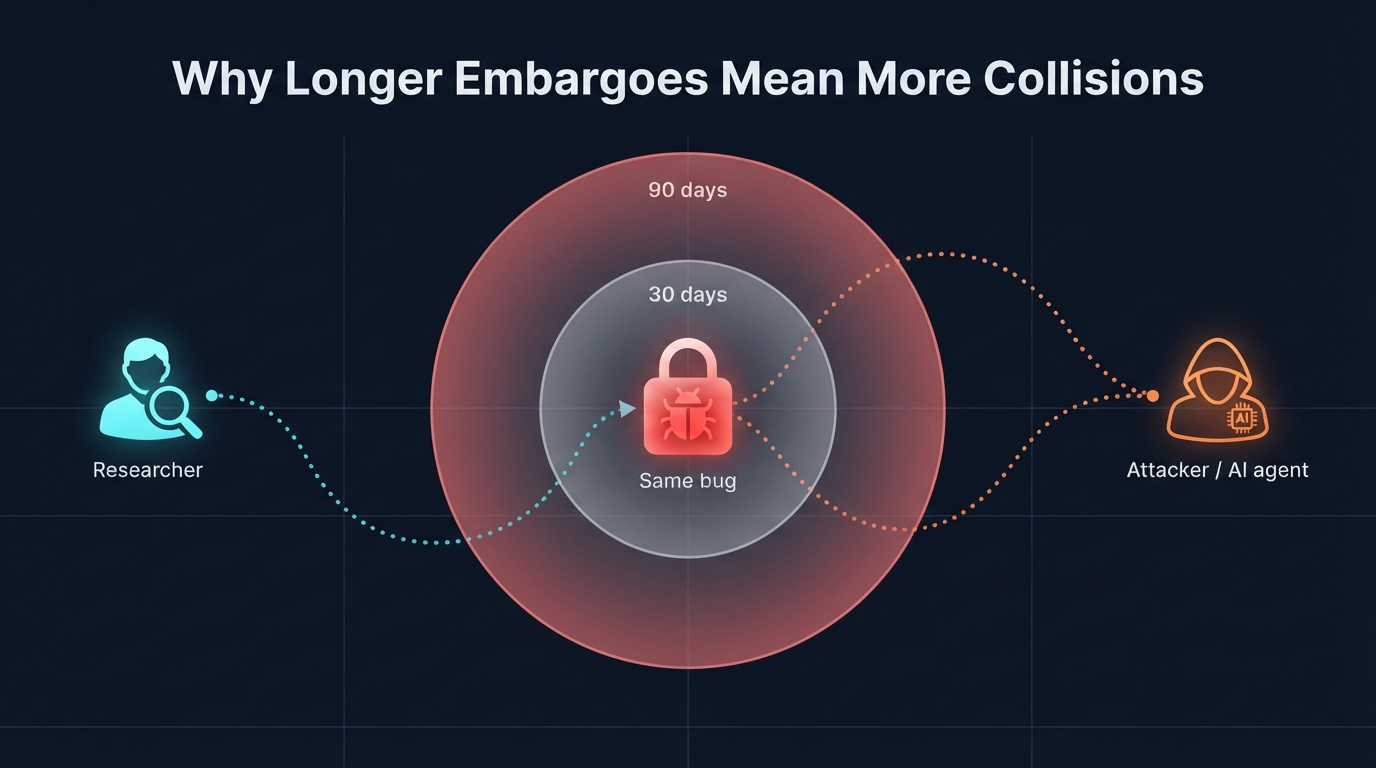
Vulnerabilities didn’t suddenly get more dangerous. What shrank is the time defenders have to understand a flaw, fix it, ship the fix, and get it deployed.
Project Zero says large language models have sped up how quickly attackers can find and exploit bugs. They’ve also made it more likely that several parties, including malicious ones, will stumble onto the same bug independently. So a vulnerability reported today carries more immediate risk than the same report would have a few years ago.
It helps to think of it as four clocks, all running at once:
- Discovery: AI can scan code, reason about it, fuzz targets, and surface candidate bugs faster than manual research ever could.
- Exploitation: Attackers can use AI to understand a flaw, write proof-of-concept code, and iterate quickly.
- Patch analysis: Once a fix ships, AI can compare the old and new versions and work out what the bug was. The patch itself can become a roadmap for attackers.
- Deployment: Enterprises still have to test, approve, stage, and roll out updates across messy, complicated environments.
Project Zero goes further and argues that “patch soak time” is losing its meaning. Attackers can often figure out the details of a vulnerability from the patch almost immediately, and it says assuming zero time between patch and exploit is now a reasonable, if imperfect, model of attacker behavior.
A patch used to buy you a safe stretch of time. Now it may just be the starting gun.
The agent-speed shift
The biggest driver here is agentic AI: systems that chase multi-step goals by using tools, searching for information, testing hypotheses, and iterating without much human involvement.
That doesn’t mean tomorrow’s attacks will all come from some unsupervised AI swarm. The realistic picture is narrower, but still serious. Agents can shrink the most labor-intensive parts of offensive security work, like code analysis, reconnaissance, exploit development, variant hunting, and patch diffing.
A plausible workflow goes something like this:
- An agent scans a codebase, dependency tree, or public interface looking for odd behavior.
- It forms hypotheses about a flaw and tests them in an isolated environment.
- It produces a technical report, a proof-of-concept, or a suggested fix.
- A human researcher reviews the result and decides whether to report, disclose, or escalate.
- When a patch appears, another agent compares the fixed and vulnerable versions to reconstruct the bug.
Humans are still accountable at the decision points. But the machine has stripped out much of the manual delay that used to separate discovery from exploitation.
Anthropic says as much itself. Frontier models have gotten much better at finding vulnerabilities, so a bug one model can find is increasingly likely to be found by another. The company says it’s already seeing more rediscovery as these capabilities improve.
Why this is an admission
These policy changes are more than housekeeping. They quietly acknowledge that the defender’s traditional advantage, time, is wearing away.
By cutting its window for high- and critical-severity bugs to 30 days, Anthropic is effectively saying a 90-day embargo can’t be trusted to keep a serious flaw private anymore. Its worry is that AI has made independent rediscovery likelier, so an attacker might find the flaw while it’s still sitting undisclosed.
Google’s stance is even more direct. Project Zero calls the old remediation timeline “clearly insufficient” in a world of AI-assisted discovery and exploitation.
Taken together, the shift looks like this:
- From “we have 90 days to respond” to “we may have 30 days, or less.”
- From patch secrecy as protection to patch analysis as an immediate attack surface.
- From human-paced remediation to security operations that run at machine-assisted speed.
- From disclosure as a delayed publication event to disclosure as an ongoing risk decision.
The uncomfortable takeaway is that Big Tech isn’t just tweaking a policy. It’s conceding that the traditional security buffer may not exist in practice anymore.
The policy fallout
The effects will reach well beyond the labs making these announcements.
Software vendors
Vendors will have to treat patch speed as a core product-security metric, not a back-office chore. That means shorter paths from report to fix, automated regression testing, faster emergency releases, and better data on whether customers have actually installed updates.
Project Zero specifically calls out the “patch gap,” the time between a fix being released and users installing it. Its view is that vendors need to either speed up rollout or use other protective measures while a fix is still in progress.
Open-source maintainers
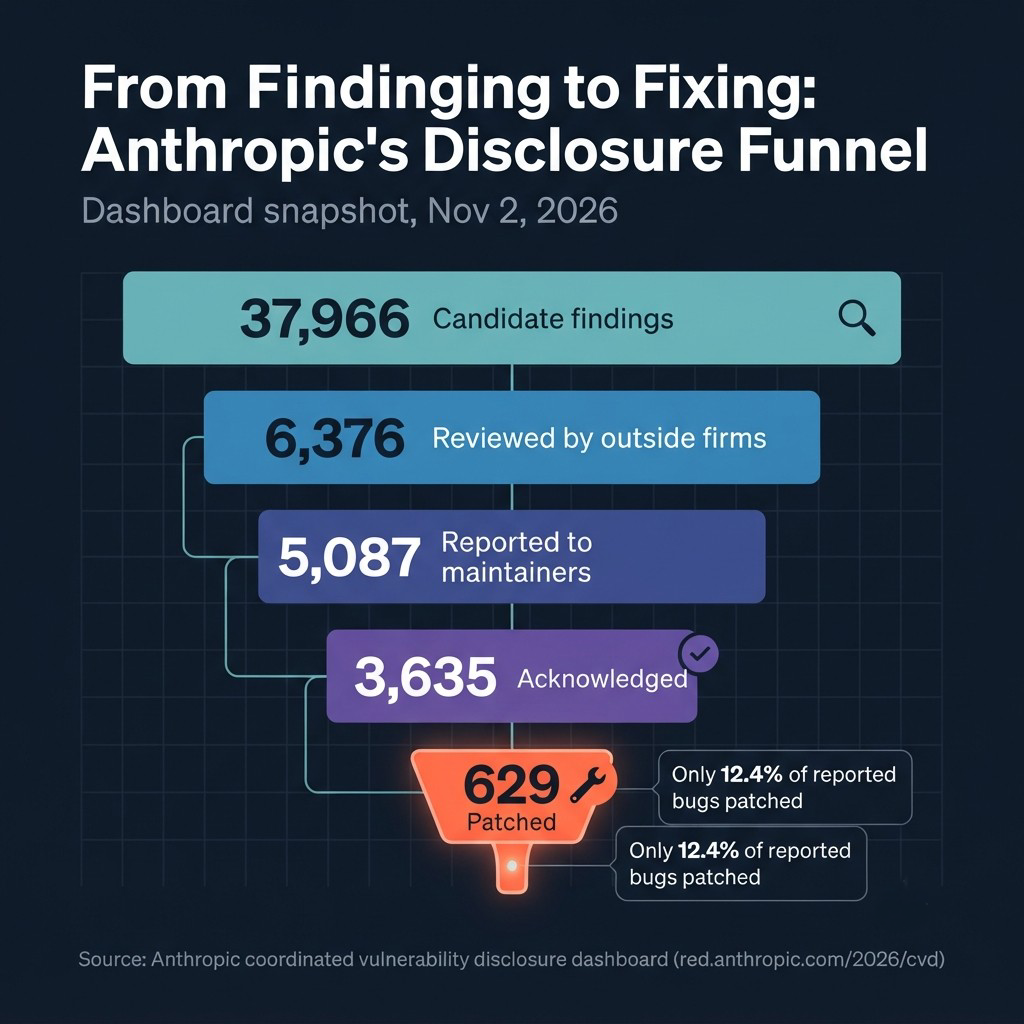
A 30- or 45-day deadline can be brutal for volunteer-run projects with thin staffing, legacy dependencies, or complicated release processes. Anthropic acknowledges the added pressure. It says each report will come with actionable guidance and, where possible, a patch or mitigation. It also says it will agree on a sustainable reporting pace before sending a large batch of findings to any one project.
That’s a necessary safeguard. Without support for maintainers, faster disclosure just pushes the burden onto the people least able to carry it.
Enterprises
The real bottleneck may not be the vendor. It may be the customer.
A company can get a patch on day 10 and still need weeks to check it against internal apps, test it in staging, get change approvals, and roll it out across production. In an agent-speed world, that internal lag becomes a strategic weakness.
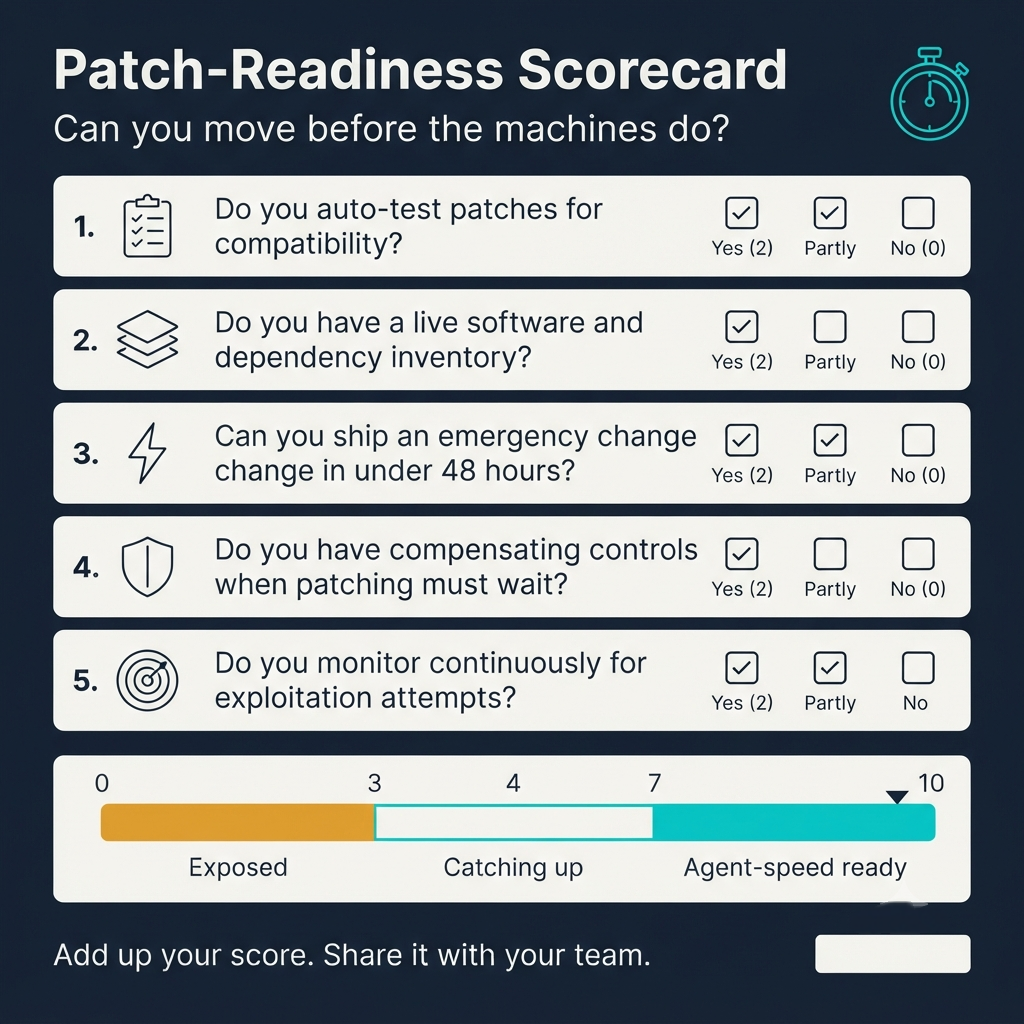
Security teams will need to invest in:
- Automated patch testing and compatibility validation
- Better software inventory and dependency visibility
- Faster emergency-change processes
- Compensating controls for when a patch can’t go out right away
- Continuous monitoring for exploitation attempts
AI developers
AI labs now face a new governance question: when a model finds a serious vulnerability, what happens next?
“Publish it” and “bury it” are both wrong answers. Handling it responsibly takes human review, severity assessment, vendor notification, mitigation guidance, and safeguards so that model outputs don’t turn into ready-made offensive tooling.
Anthropic’s approach combines human review, coordinated reporting, tailored timelines, and support programs for maintainers. It shows that disclosure policy is turning into part of AI-risk governance.
The trade-off nobody can ignore
Shorter windows create a genuine dilemma.
On one side, delayed disclosure gives attackers time to find and exploit a flaw on their own. On the other, disclosing too early can expose technical details before smaller organizations, critical-infrastructure operators, or stretched maintainers have had a chance to patch.
Project Zero considered jumping straight to 30 days but chose a gradual transition. Its concern was that an abrupt change could hurt users by putting unfixed vulnerabilities in attackers’ hands while vendors were still improving their remediation processes and tools.
That caution matters. A deadline alone doesn’t produce secure software. If a vendor truly can’t patch in 30 days, forcing disclosure can lead to rushed fixes, broken compatibility, operational disruption, or a false sense of safety.
A better model is risk-tiered disclosure:
- Move fast on actively exploited or catastrophic flaws.
- Keep negotiated timelines for complex systems that can’t be safely patched quickly.
- Insist on high-quality, reproducible reports.
- Pair disclosure with mitigations, patches, and deployment guidance.
- Judge success by how well users are protected, not by how fast details go public.
Also Read: How Multi-Agent Systems Turned Vendor Fixes Into Instant Weaponized Code
What responsible AI security requires
The answer isn’t to slow AI down everywhere. It’s to make sure defenders can move at a comparable speed.
- Make patch velocity a first-class metric. Track time from report to fix, from fix to release, and from release to broad deployment.
- Use AI for defense. Put agents to work on vulnerability triage, test generation, patch validation, dependency analysis, and controlled exploit simulation.
- Keep humans accountable. People should own disclosure decisions, exploit handling, critical-infrastructure exceptions, and vendor communication.
- Constrain agent permissions. Limit tool access, isolate environments, log actions, and require approval for high-impact operations.
- Assume eventual disclosure. Build systems that hold up even if technical details become public.
- Support maintainers. Faster timelines need funding, tooling, expert help, and realistic reporting volumes to go with them.
Anthropic’s OSS Scanner, Claude for Open Source Program, and Cyber Verification Program are examples of the kind of support that has to accompany a faster disclosure regime.
The new disclosure contract
The 90-day window was never just a deadline. It was a social contract: researchers would hold back, vendors would fix things, and users would get some protection in the meantime.
Agentic AI hasn’t ended that contract, but it has made the old terms impossible to keep.
The next era of cybersecurity won’t be decided by who finds vulnerabilities first. It will be decided by who can understand, fix, distribute, and deploy defenses fastest. In an agent-speed world, whether a vulnerability will be found is no longer the question.
The question is whether the people responsible for fixing it can move before the machines do.