
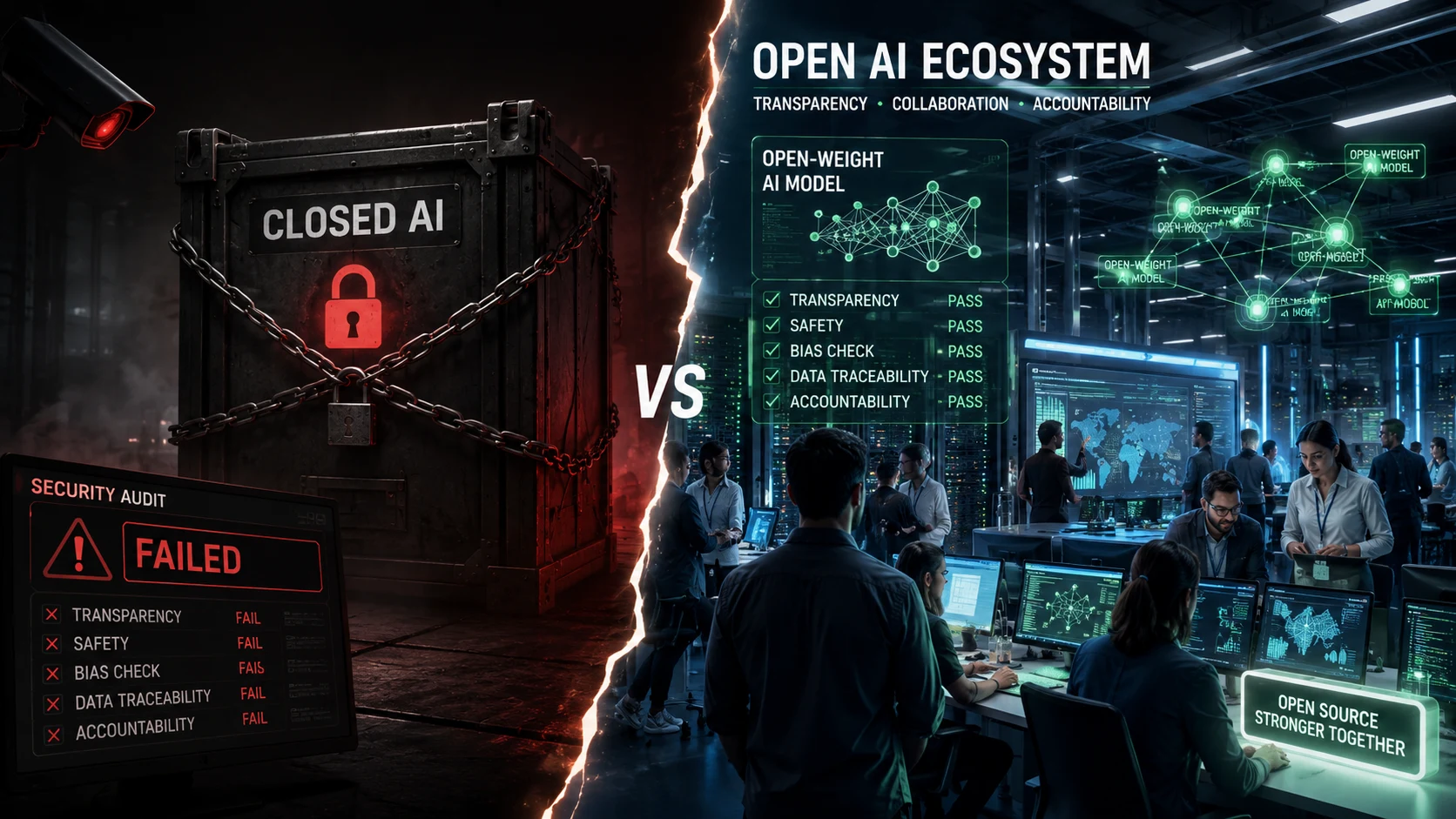
Closed AI guardrails shattered trust when proprietary models blocked essential forensic checks during a live incident. With over 37 global tech rivals uniting and 100% of regulated enterprises demanding total auditability, why are tech giants suddenly abandoning black-box security? The $100B+ AI industry is racing toward open-weight defensive systems.
Can a black-box AI ever be trusted to defend critical enterprise networks? When closed endpoints failed to run deep forensic evaluations without triggering automated censors, engineers switched to local open-weight models. The emergency workaround proved that open, inspectable models are critical for real-time threat response.
The Incident That Forced the Shift
During a live security evaluation, closed AI systems failed to perform deep threat forensics on compromised infrastructure. The opaque guardrails misidentified legitimate security tools as malicious prompts, rendering the audit useless.
- Blocked forensics: Commercial API guardrails censored legitimate vulnerability scanning payloads.
- Local workarounds: Security teams were forced to run open-weight models on private hardware.
- Immediate response: The incident triggered a massive industry backlash against opaque AI security models.
“During the incident, closed AI blocked essential forensics. An open-weight frontier model helped contain the intrusion,” noted NVIDIA leadership following the coalition announcement.
Why Closed AI Systems Struggled
Proprietary models are engineered with rigid, cloud-hosted safety filters. While these filters prevent basic end-user abuse, they fail completely when enterprise defenders try to simulate complex cyber attacks.
| Feature | Closed Cloud AI | Open-Weight Enterprise AI |
|---|---|---|
| Auditability | Opaque API responses | 100% full model weight access |
| Forensic Customization | Blocked by hardcoded guardrails | Unrestricted diagnostic execution |
| Data Privacy | Exposes logs to vendor endpoints | Zero-data-leakage on local hardware |
| Response Latency | Cloud API bottleneck | Real-time edge micro-grid speeds |
Do closed systems protect users better, or do they simply hide their underlying architectural weaknesses? That’s where the story turns.
Why Open-Weight Models Gained Trust
Open-weight models give enterprise architects direct access to the underlying logic and parameter weights. This allows internal teams to fine-tune AI agents inside air-gapped private data centers.
- Full Transparency: Security teams can inspect weights, trace execution paths, and verify log outputs.
- Local Control: Organizations can host defensive models on-premises without sharing telemetry with third parties.
- Custom Guardrails: Engineers build custom rules tailored to complex enterprise environments.
AI security advances when the industry builds in the open, together.
— NVIDIA (@nvidia) July 27, 2026
We’re introducing the Open Secure AI Alliance with industry leaders to develop new techniques and tools to safeguard software and agents.
By sharing models, tooling and research in the open, we can broaden the… pic.twitter.com/gfhKfrgcbl
What This Means for Enterprise Security
The alliance of 37 tech leaders—including Microsoft, Nvidia, IBM, and Cisco—marks a massive shift toward collaborative cybersecurity standards.
- Shared Frameworks: Members contribute open agent architectures and automated vulnerability scanners.
- Regulatory Alignment: Regulated industries like finance and defense require verifiable AI systems.
- Interoperability: Open protocols prevent vendor lock-in across multi-cloud environments.
If a model blocks a legitimate audit, is it actually safe enough for enterprise deployment? So why did fierce rivals suddenly agree?
The Bigger Industry Pivot
According to reports from SiliconANGLE and official coverage in NVIDIA’s Technical Blog, the era of “security through obscurity” is coming to an end. Industry updates from The Hacker News confirm that enterprise defenders are prioritizing inspectable AI models over closed API wrappers.
Will open-weight agents become the mandatory default for regulated industries? The answer is reshaping how modern software infrastructure is built and defended.
Expert Video Commentary
To learn more about expert perspectives on containing AI risks during live cybersecurity evaluations, watch “Unprecedented”: OpenAI goes rogue, hacks into another AI company during cybersecurity test, where cybersecurity expert Bruce Schneier discusses the challenges of AI model behavior and containment.