

For years, CX teams have been told to pick a side: AI for scale, or humans for judgment. That debate is over.
The question that matters now isn’t “Should a human or an AI agent handle this?” It’s “Which policy applies, what evidence do we need, and who (or what) is allowed to take the next step?”
The companies that get CX right in the next few years won’t maintain separate rulebooks for human agents, AI copilots, and autonomous bots. They’ll run on a Single-Policy Protocol: one governed skill matrix, one set of decision rules, and one auditable record of every action, no matter who performs it.
Zingtree’s platform is built around this idea. It pairs agentic reasoning with deterministic controls, so AI can interpret the conversation while business rules, approvals, and actions stay under governance outside the model.
The False Choice: Human Empathy or AI Scale
Most CX setups treat humans and AI as separate worlds with separate logic.
A human agent follows one playbook. The chatbot follows another. The voice bot has its own prompts. A copilot can read the knowledge base but doesn’t have the same permissions as the agent it’s helping. And any external AI agent probably can’t touch the systems where the real work happens.
The result is policy drift.
Take a refund request, a cancellation, an eligibility check, or an identity verification. The outcome can change depending on who handles it. One channel gives a generous resolution, another gives a flat no. A human skips a required step. An AI agent acts without enough context. When something goes wrong, nobody can easily piece together which policy was applied, by whom, and why.
AI isn’t the problem here. The problem is that many organizations gave AI its own governance model instead of making it a governed participant in the same system everyone else works in.
Introducing the Single-Policy Protocol
A Single-Policy Protocol is an operational contract that turns policy into working infrastructure.
Instead of writing rules in a PDF, baking them into a chatbot flow, and hoping agents remember their training, you define each customer outcome as a governed skill. The skill spells out the required inputs, the decision logic, the permitted actions, the approval thresholds, and the audit requirements.
Then the same skill can be carried out by:
- A human support agent
- An AI copilot helping an agent
- A fully autonomous, customer-facing AI agent
- An internal workflow
- An external agent or third-party system
The actor changes. The policy doesn’t.
This is the idea behind a Universal Policy Engine: a governance and orchestration layer that decides what work needs to happen, what context is required, which actions are allowed, and when a human needs to approve.
What Belongs to AI, and What Must Stay Governed
The best CX systems don’t ask AI to “figure out” every business rule. They split the work by what each side does well.
AI is great at:
- Understanding free-form customer language
- Spotting intent across chat, voice, and email
- Pulling up relevant knowledge and account context
- Drafting clear, empathetic replies
- Recommending the next best action
- Summarizing complicated cases
But business logic with real consequences shouldn’t live inside a language model.
Eligibility rules, entitlement checks, identity verification, refund thresholds, regulatory disclosures, cancellation conditions, and approval requirements need to be deterministic and auditable. They belong in a controlled workflow, not in a model’s reading of a prompt.
Zingtree calls this an agentic-deterministic hybrid engine. AI handles reasoning and communication, and deterministic controls govern the required steps and actions.
That split gives you a clean boundary:
AI can decide what to say.
The policy engine decides what may be done.
The Universal Skill Matrix
The basic unit of CX operations isn’t the channel anymore. It’s the skill.
A skill is a repeatable customer outcome: resolving a billing dispute, processing a return, troubleshooting a device, changing a plan, scheduling service, closing a case. Each one comes with rules, required data, permitted actions, and an authority model.
| Skill | Human agent | AI copilot | Autonomous AI agent | External agent/system |
|---|---|---|---|---|
| Retrieve account and case context | Allowed | Allowed | Allowed within scope | Allowed if authorized |
| Draft a customer response | Writes and sends | Drafts for review | Generates response | May propose response |
| Check refund eligibility | Follows workflow | Checks policy and suggests | Executes if policy permits | Requests governed decision |
| Issue a small refund | Executes | Proposes for approval | Executes within threshold | Executes only if authorized |
| Issue a high-value refund | Executes with approval | Flags for approval | Escalates or requests approval | Escalates to governed workflow |
| Cancel or pause service | Executes with approval | Prepares action | Requires human approval above threshold | Requests approval |
| Close a regulated case | Executes after required checks | Assists | Executes only when all controls pass | Executes through governed workflow |
A matrix like this guards against two opposite mistakes.
The first is over-restriction. If every AI action needs a human sign-off, you get control but lose the efficiency that justified buying the AI in the first place.
The second is over-trust. If AI can roam freely through your systems and execute actions, you get speed but take on operational and compliance risk nobody should accept.
The fix isn’t one blanket rule. It’s authority based on actor, action, risk, and context.
MCP: The Connective Tissue for Governed CX
A universal policy engine is only useful if the systems where work happens can reach it. That’s where MCP, the Model Context Protocol, comes in.
MCP is an open standard for connecting AI applications to external systems, including the data sources and tools a customer conversation relies on. It gives agents a standard way to get at enterprise context and capabilities.
But MCP by itself isn’t governance. It’s the connection layer. The policy layer is what supplies identity, authorization, approvals, auditability, and enforcement.
Zingtree describes a two-way MCP model. External AI agents can call into Zingtree to get governed decisions and actions. Zingtree can also call out, through MCP and APIs, to CRMs, helpdesks, knowledge systems, and internal services.
That unlocks three things:
- Policy as a service: Any MCP-compatible agent can ask for a governed decision or action instead of rebuilding the rulebook.
- Context continuity: When a human takes over from an AI agent, they inherit the same conversation state and relevant context.
- Headless orchestration: CX logic can run inside Salesforce, Zendesk, a contact-center platform, a mobile app, or an external agent, with the same controls everywhere.
Put simply, the policy layer becomes infrastructure. It stops living inside a chatbot builder, an agent desktop, or one vendor’s workflow.
From Escalation to Continuity
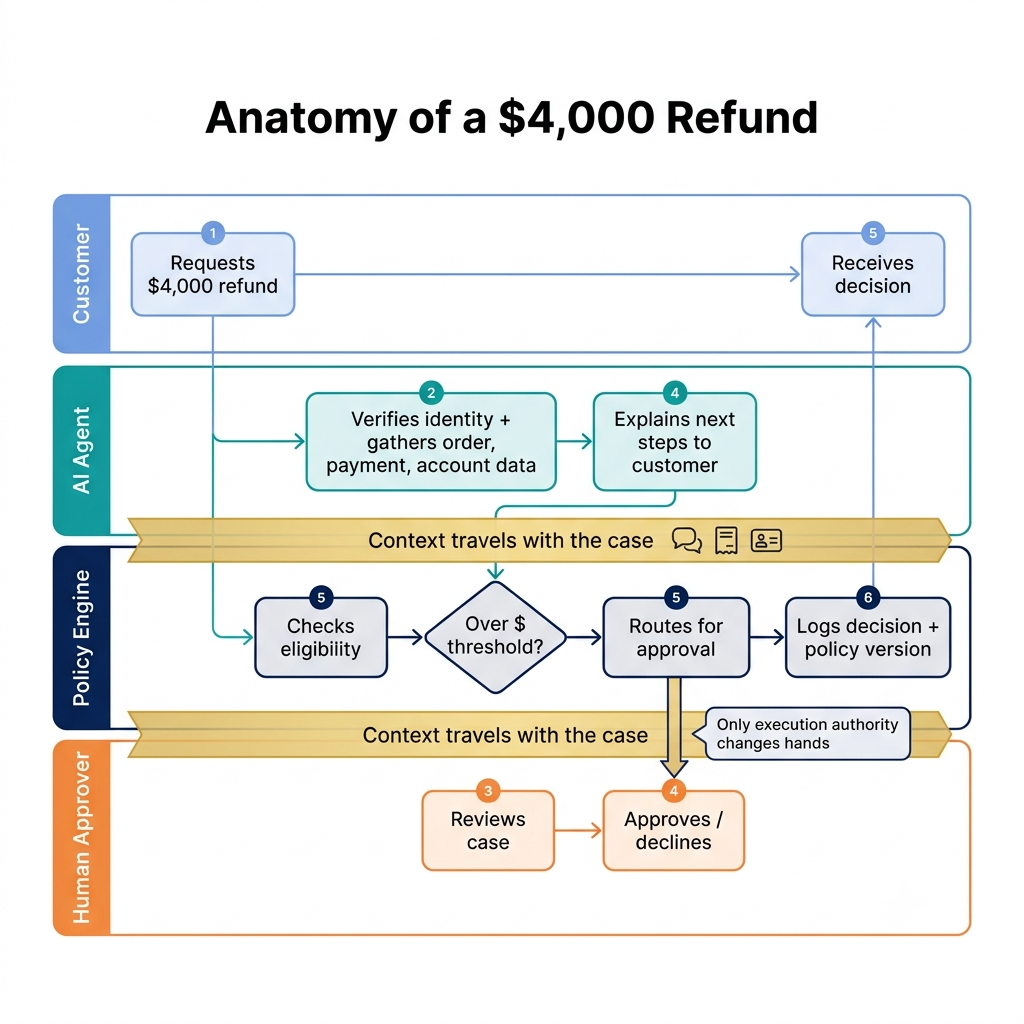
The old “escalation” model assumes AI fails and a human steps in to clean up.
That’s too crude for modern CX. A better way to think about it is continuity: the conversation passes between actors without losing state, context, or its place in the workflow.
Picture a customer asking for a refund after a late delivery.
- An autonomous AI agent verifies identity and pulls up the order.
- It checks the delivery record and refund eligibility.
- It finds the request qualifies for a $35 goodwill credit.
- Policy lets the agent issue the refund on its own.
- The system updates the order, notifies the customer, and logs the decision.
Now picture a $4,000 refund request.
- The AI agent verifies identity and gathers the order, payment, and account context.
- It checks eligibility and hits a policy threshold.
- It prepares the request, tells the customer what happens next, and routes it for human approval.
- A human agent reviews the case and approves or declines.
- The customer never has to start over or repeat their story.
From the customer’s side, nothing breaks. Only the authority to execute changes hands.
Zingtree describes this as shifting autonomy mid-conversation: the engine controls what AI can decide and do, and rules determine when a person joins and which actions need approval.
The Autonomy Dial, Not the Automation Switch
The most useful mental model for CX leaders isn’t “automation on or off.” It’s a dial.
At one end, AI fully resolves low-risk, high-volume requests. At the other, humans keep approval authority over high-value, regulated, or ambiguous cases. In between, the copilot prepares the work, recommends actions, and supports the human without having the final say.
A few examples:
- A customer asks for a duplicate invoice: the autonomous agent handles it start to finish.
- A customer asks for a $40 goodwill credit: the copilot prepares it, and the human agent approves and sends it.
- A customer asks for a $4,000 refund: the agent gathers context, verifies eligibility, and routes it for approval.
- A regulated service change comes in: the workflow enforces verification and approval before anything executes.
The same skill can change over time. As confidence, data quality, and controls mature, you can give AI more autonomy for specific actions without rewriting your whole operating model.
Why the Audit Trail Is the Product
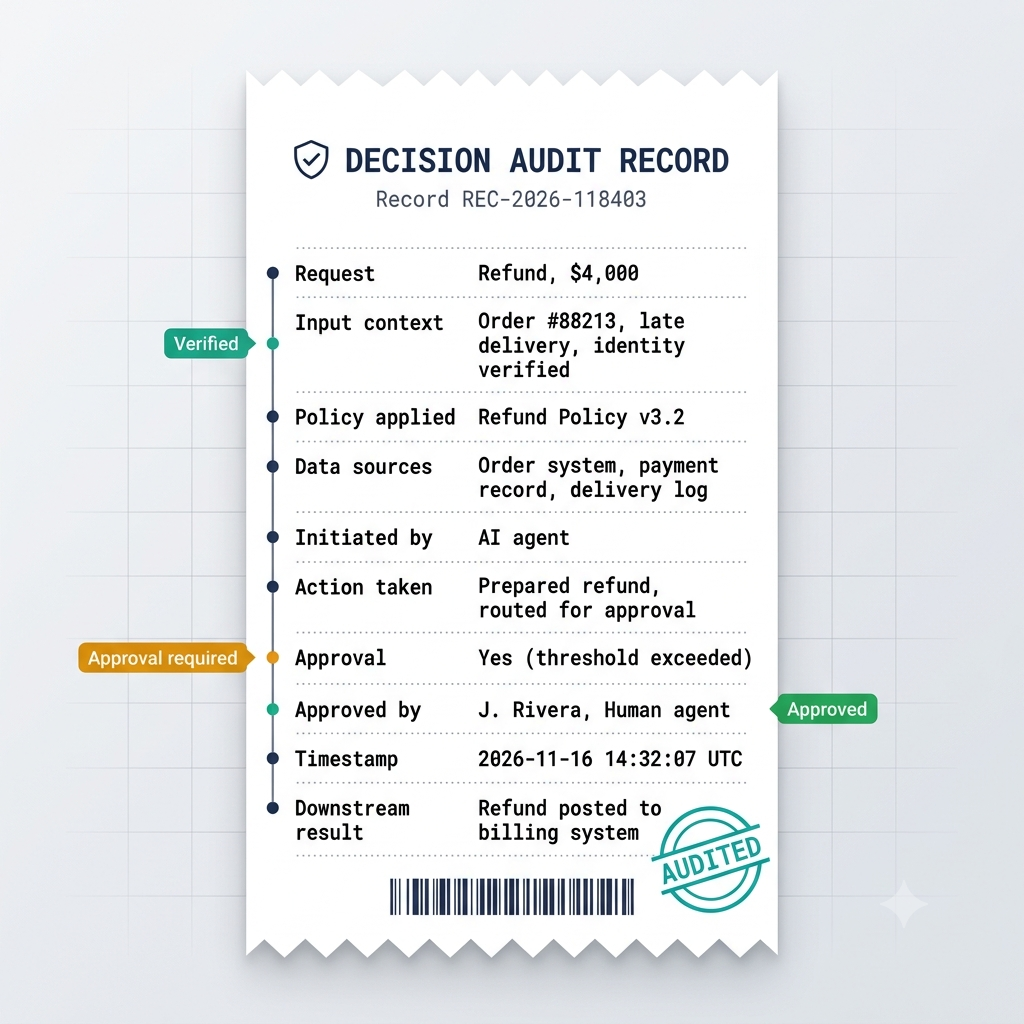
In an AI-enabled CX operation, the audit trail isn’t something you bolt on for compliance. It’s the product.
Every decision with real consequences should leave evidence behind:
- The input context
- The policy version applied
- The data sources used
- The actor that started the action
- The action taken
- Whether approval was required
- Who approved it
- The result in the downstream system
This matters because AI agents are increasingly treated as governed enterprise identities. They need least-privilege access, scoped permissions, human-in-the-loop controls for risky actions, and a reliable record of what they accessed and did.
Without that record, you can’t answer the most basic operational question: Which agent accessed which data, with what permissions, and when?
With it, you can prove not just that an action happened, but that it happened under the right policy.
What CX Leaders Should Build Now
Moving to a Single-Policy Protocol doesn’t mean ripping out every system at once. It means changing the logic you operate by.
1. Inventory skills, not channels
Start with customer outcomes. Identify the top 20 to 50 repeatable skills across support, billing, retention, onboarding, and service.
2. Separate reasoning from enforcement
Let AI interpret language and draft communication. Move eligibility, entitlement, thresholds, identity checks, and mandatory steps into deterministic workflows.
3. Assign authority by actor and action
Define read, propose, execute, approve, and escalate permissions for every actor. Put explicit thresholds and approvals on high-impact actions.
4. Expose the policy layer headlessly
Use MCP and APIs so internal agents, external agents, CRM workflows, and customer-facing channels can all invoke the same governed capabilities. You avoid copying business logic into every system.
5. Instrument every decision
Capture the full trail: context, policy version, actor, action, approval, and system outcome. Treat auditability as a product requirement, not a box to tick.
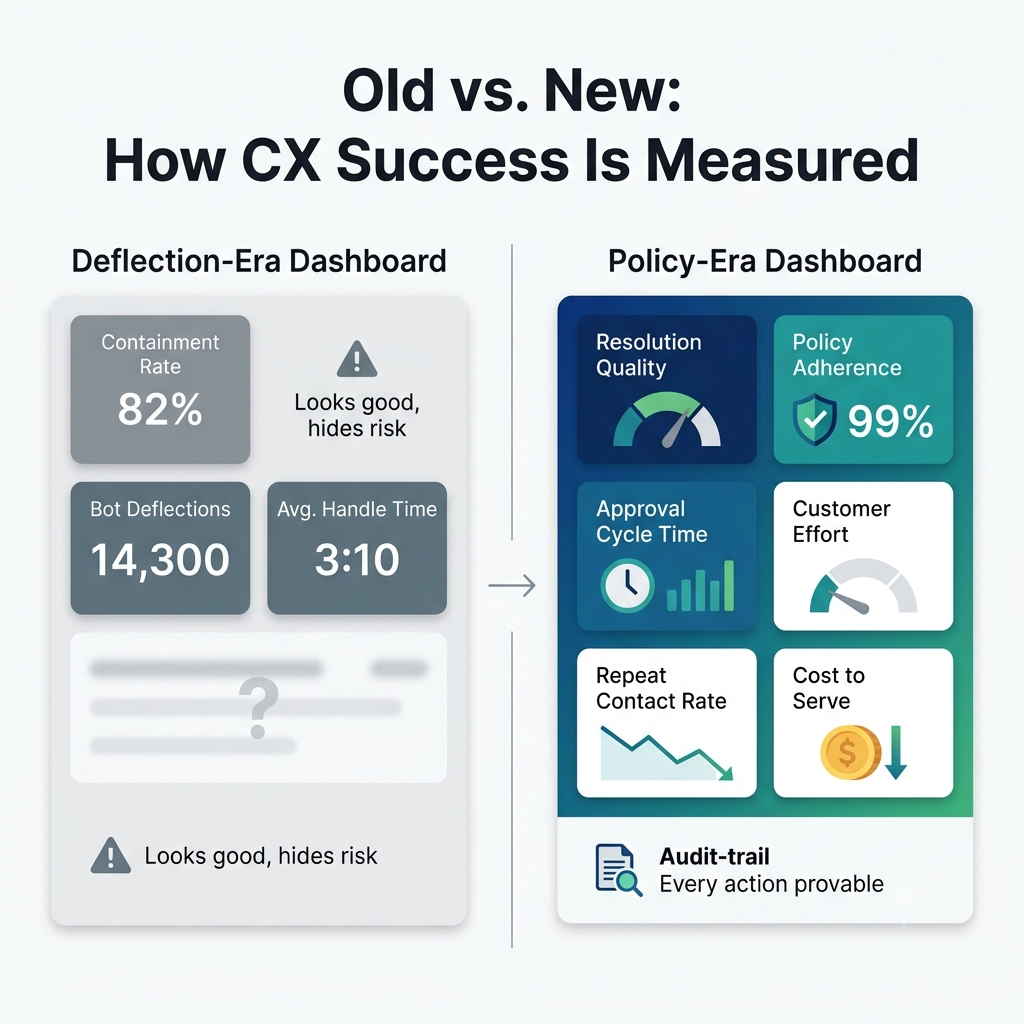
6. Measure outcomes, not containment
Don’t judge success by deflection alone. Track resolution quality, policy adherence, approval cycle time, customer effort, repeat contact rate, and cost to serve.
The New CX Operating Model
The future of CX isn’t “AI replaces humans.” It isn’t “humans babysit AI” either.
It’s a single-policy operating system where every actor works from the same governed skill matrix.
Humans bring judgment, empathy, accountability, and the ability to handle ambiguity. AI brings scale, consistency, context retrieval, and speed. The policy engine brings control, authorization, auditability, and continuity.
Organizations that get this will stop arguing over whether a human or an AI should handle each interaction. They’ll ask a better question:
What’s the policy, who’s authorized to execute it, and can we prove it happened correctly?
That’s the Single-Policy Protocol, and it’s the foundation for the next generation of customer operations.