
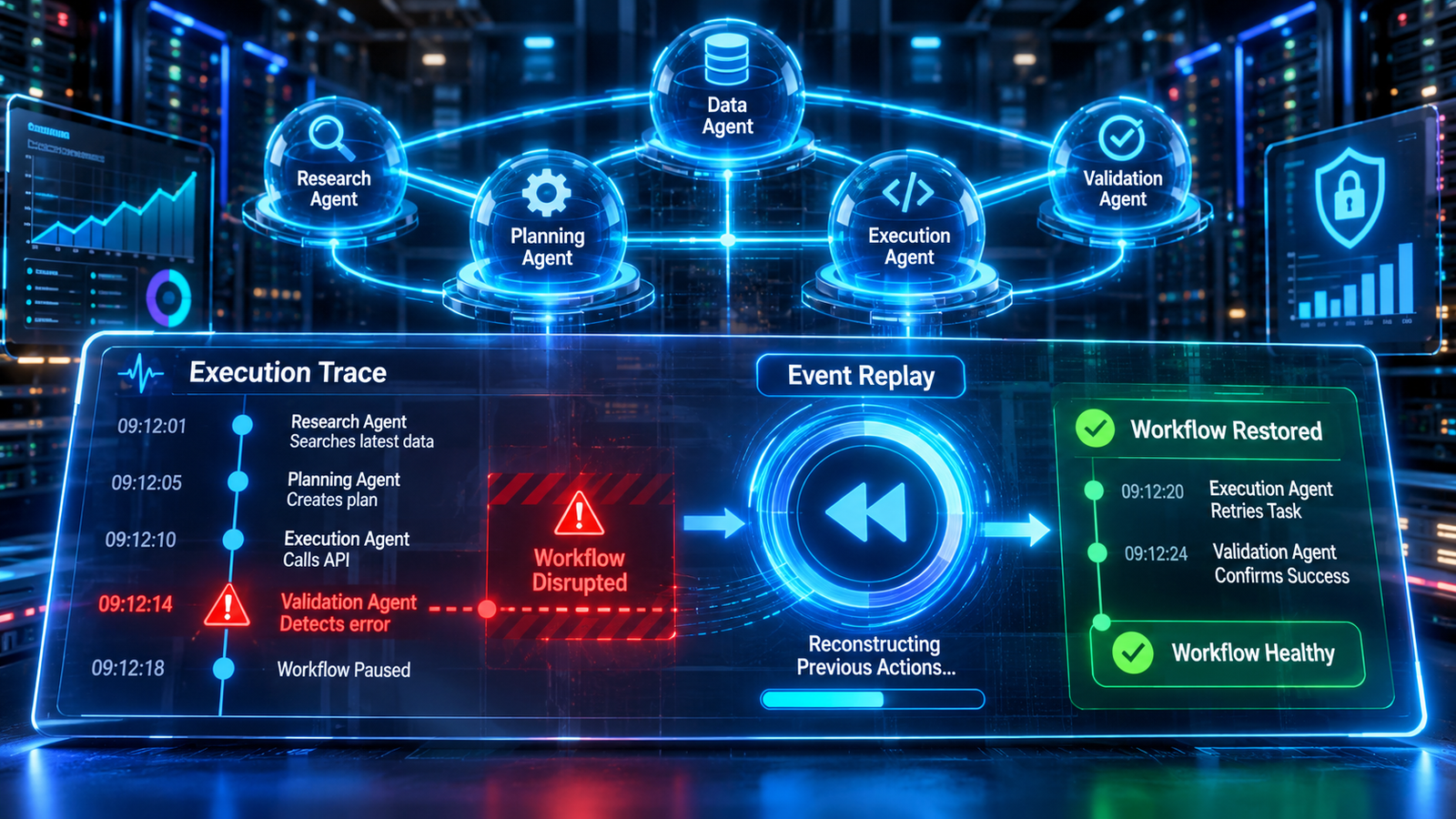
Traditional software testing asks a simple question: does the code behave as expected under conditions we already know about? Agentic AI breaks that assumption. An agent can interpret ambiguous input, pick its tools on the fly, act across several systems, and produce different results depending on what has happened in the session. Static tests and launch-day monitoring can’t fully answer the question that matters most in production: what did the agent do, why did it do it, and what would happen if we changed the rules?
Uber’s Secure AI Framework treats post-deployment assurance as a core engineering discipline. A unified execution trace ties together agent actions, tool calls, and guardrail decisions, and replay lets teams test candidate security policies against recorded production interactions before enforcing them. In effect, AI agents get something close to an aviation flight recorder: not just a log of events, but a record you can use to reconstruct decisions, actions, and context.
The monitoring gap
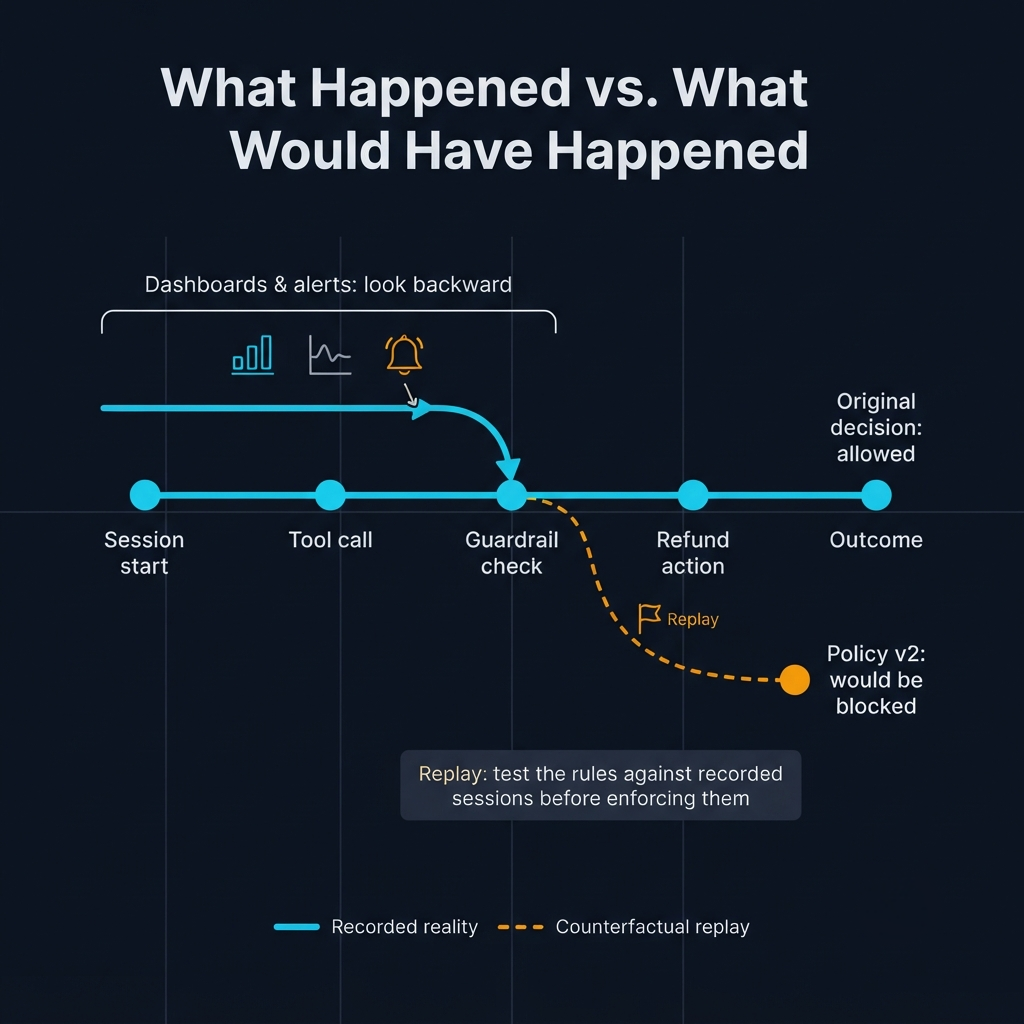
Most teams treat AI reliability as an observability problem: dashboards, error rates, latency charts, alerts. Those tools are necessary, but they look backward. They can tell you an agent made an unusual tool call or that a guardrail blocked a request. What they can’t do, on their own, is tell you how a new policy would have behaved across thousands of past sessions.
The problem gets sharper with autonomous agents. Uber points out that agents reason over content from users, webpages, documents, tools, and even other agents, then turn that reasoning into real-world actions. That opens the door to prompt injection, tool and memory poisoning, goal hijacking, behavioral drift, and actions driven by hallucination.
A traditional authorization system asks, “Is this user allowed to access this resource?” An agent-security system has to ask something harder: “Should this agent take this action, given its purpose, the user’s request, its permissions, and everything that has happened in the session so far?”
The flight-recorder model
The metaphor works because it moves the goal from passive logging to reconstructing decisions.
| Aviation concept | AI-agent equivalent |
|---|---|
| Flight data recorder | Unified execution trace |
| Cockpit actions | Agent decisions and actions |
| Aircraft-system telemetry | Tool calls, inputs, outputs, errors, and latency |
| Incident investigation | Root-cause analysis after an agent failure |
| Flight simulator | Replay of recorded interactions against new controls |
| Pre-flight checklist | Agent registration, persona, intents, constraints, and permissions |
A useful trace has to do more than store a prompt and a response. It needs to connect the user’s turn, the action the agent chose, the tool it invoked, the guardrail’s verdict, and the final outcome into one coherent chain. Uber’s trace is built to provide that linkage, which makes troubleshooting and auditing possible across the whole execution path.
What a useful trace captures
A production-grade trace should be able to answer four questions:
- What was requested? The user’s turn, the session context, and the relevant identifiers.
- What did the agent decide? The action it meant to take and the tool or workflow it picked.
- What did it touch? The tool call, the target system, the parameters, the response, and the result.
- Was it allowed, and why? The policy that was evaluated, the decision, and the reasoning behind it.
Uber links agent actions, tool calls, and guardrail decisions in one trace, and it treats privacy as an architectural requirement rather than an afterthought. Prompt and response content are included only when needed, sensitive data is minimized or redacted, access is restricted according to how sensitive the data is, and traces have defined retention periods.
That last part matters. A trace that records everything indiscriminately can create a brand-new security and privacy problem. The aim isn’t maximum surveillance. It’s enough governed context to investigate failures, audit decisions, and replay safely.
From traces to replay
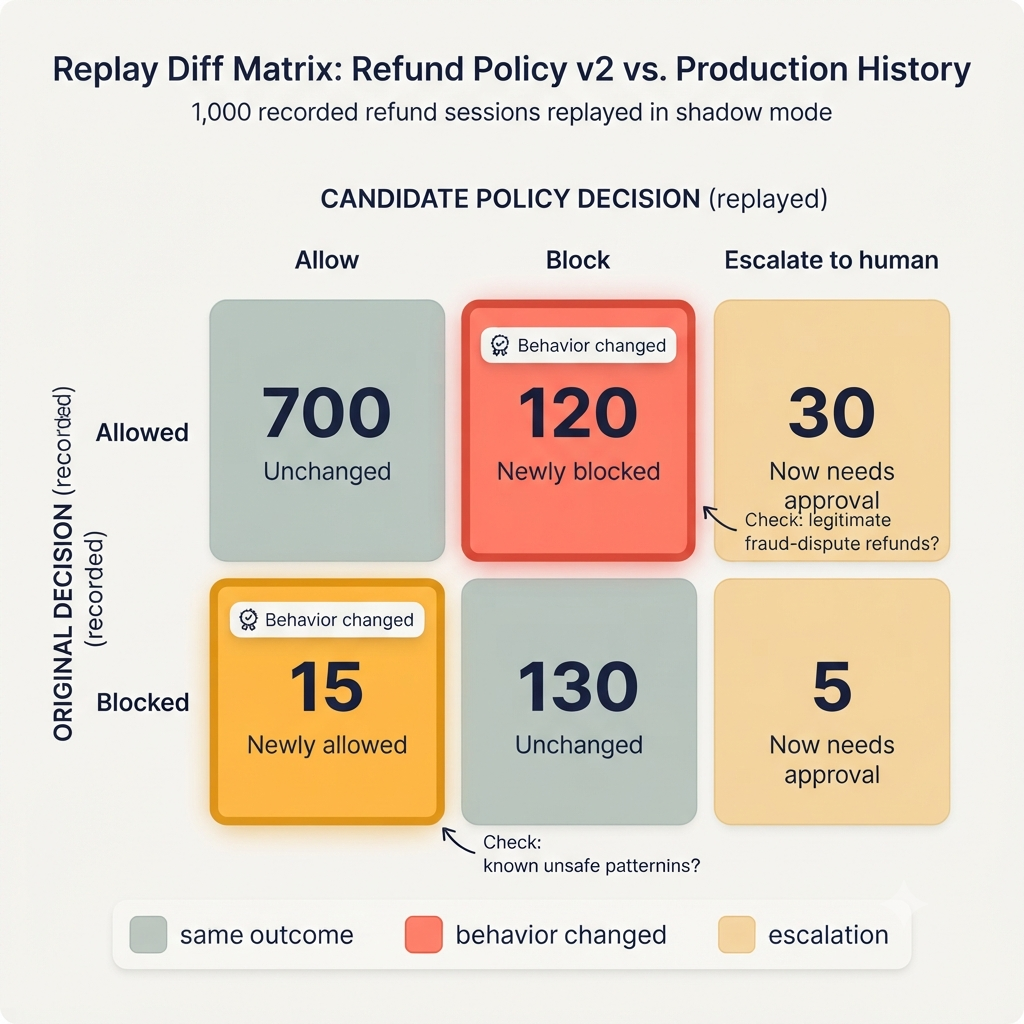
Replay is what turns historical traces into a living regression suite.
Instead of testing a new guardrail only with synthetic prompts, a team can run recorded production interactions against a candidate policy. The system compares the original decision with the proposed one and flags where behavior would change: actions that would newly be blocked, actions that would newly be allowed, and cases that need escalation.
Uber does this through shadow-mode deployment, traffic replay, and per-agent calibration. Teams measure false blocks and false allows against real behavior, tune intents and constraints, and validate changes before anything is enforced.
Picture an agent authorized to process customer refunds. A new policy says, “Block refunds above $500 unless a human approves them.” Before switching it on, the team replays recent refund sessions. If the replay shows that legitimate fraud-dispute workflows would be blocked far too often, the policy gets refined before it disrupts real customers. If it shows a known unsafe pattern would still slip through, the policy needs strengthening first.
That’s the core value of replay: it turns a security change from a gamble in production into a measurable experiment.
Why multi-agent systems need it
Multi-agent architectures amplify both capability and uncertainty. A planner might hand work to a booking agent, a payment agent, a notification agent, or a data-retrieval agent. Every handoff is another place where intent can drift, context can get lost, or an unsafe action can spread.
A single user request might set off a chain like this:
User request
  → Planner agent
    → Retrieval agent
    → Policy agent
    → Transaction agent
      → Payment tool
      → Notification tool
Now suppose a malicious instruction slips in at the retrieval stage. By the time the payment action runs, it can look perfectly authorized: the user has access, the agent holds valid credentials, and the API call is well-formed. But the action may no longer reflect what the user actually asked for.
Uber tackles this class of risk with prompt provenance and evidence chaining, which trace privileged actions back to the user’s original request. Replay builds on that defense by letting teams examine not just one decision but the whole sequence of decisions that led to it.
The continuous-assurance loop
Uber describes the third layer of its architecture as end-to-end observability, explainability, auditing, and replay across the full execution chain. In practice, that creates a continuous assurance loop:
- Observe: Capture agent actions, tool calls, and guardrail decisions.
- Investigate: Look into anomalies, incidents, near misses, and policy gaps.
- Simulate: Replay historical sessions against candidate guardrails.
- Calibrate: Tune agent-specific intents, constraints, and thresholds.
- Enforce: Roll out the updated policy in a controlled way.
- Learn: Feed what you found back into threat modeling, red teaming, risk scores, and future guardrails.
Uber also pairs replay with automated threat modeling, scenario-based penetration testing, and continuous AI red teaming. Findings flow back into agent risk scores, policies, model calibration, and guardrails.
This is the real shift. QA no longer ends when an agent ships. It becomes a permanent feedback system fed by real-world evidence.
What builders should instrument
Teams building agent platforms should treat traceability and replayability as product requirements, not optional observability extras.
- Register each agent with an owner, persona, permitted intents, constraints, dependencies, and risk tier.
- Link every tool call to the originating user session, the agent’s decision, and the policy evaluation.
- Record the policy ID, policy version, decision, and explanation for each guardrail check.
- Capture enough context to reconstruct failures without holding on to unnecessary sensitive content.
- Build a replay environment that can run historical sessions in shadow mode.
- Track false blocks, false allows, policy drift, escalation rates, and tool-call anomalies.
- Use role-based access controls, redaction, and retention policies for trace data.
Uber’s framework starts with an AI Registry that records an agent’s identity, ownership, persona, permitted intents, constraints, dependencies, and risk tier. Its Argus platform then analyzes source code, prompts, configurations, dependencies, exposed endpoints, and tool-invocation paths to derive structured intents and find weaknesses.
Replay is not a substitute for prevention
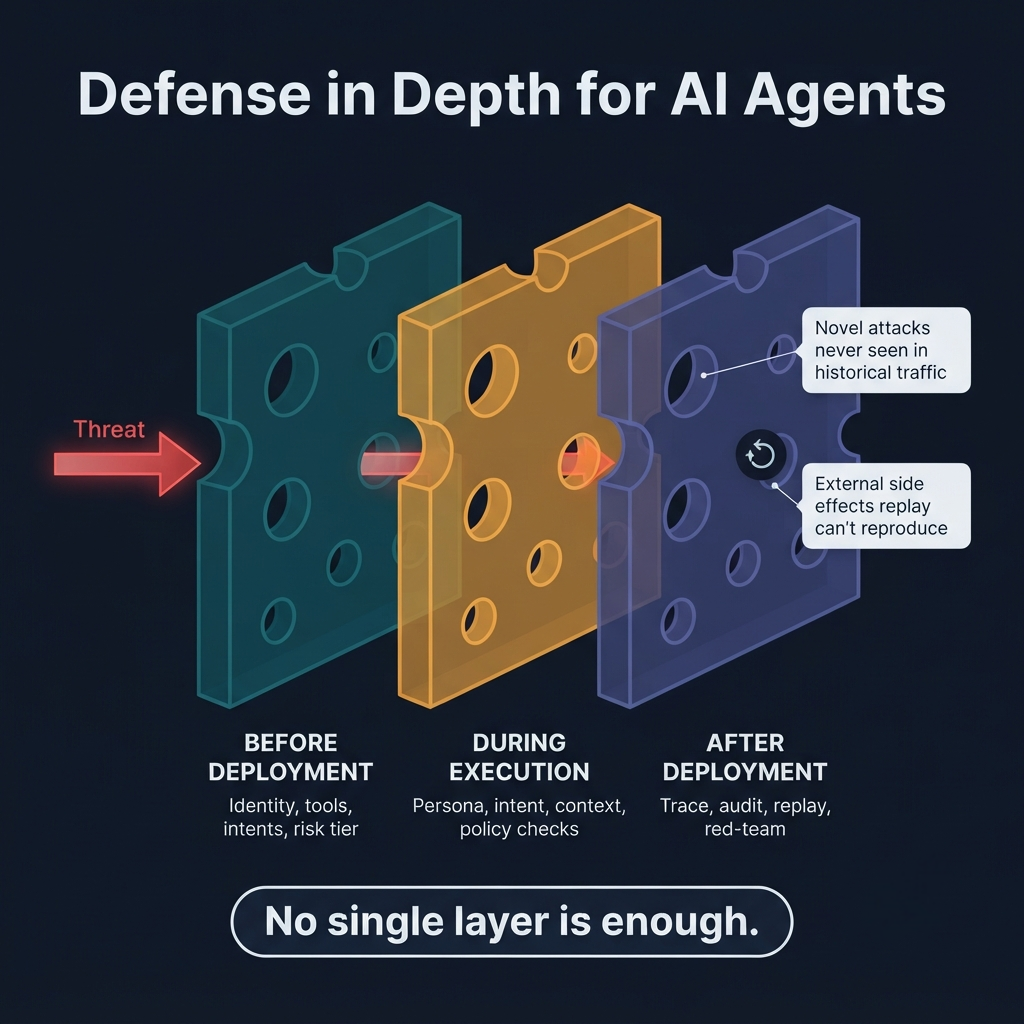
Replay is powerful, but it has limits. It validates behavior against historical traffic, so it can’t promise protection from an entirely new kind of attack. It also can’t fully reproduce every side effect in external systems, especially when a tool call changes real-world state.
That’s why replay should complement stronger runtime controls rather than replace them. Uber combines continuous assurance with provisioning-time validation, runtime behavioral enforcement, scoped intents, constraints, and prompt provenance.
The practical takeaway is that agent reliability needs defense at several layers:
- Before deployment: Validate identity, tools, dependencies, intents, and risk.
- During execution: Evaluate actions against persona, intent, context, and policy.
- After deployment: Trace, audit, replay, red-team, and keep calibrating.
The new QA boundary
For conventional software, production is often where testing stops. For autonomous AI agents, production is where the most important testing starts.
The organizations that run agents reliably won’t just monitor them after launch. They’ll build execution traces detailed enough to reconstruct decisions, replay environments safe enough to test changes without breaking production, and governance controls strong enough to make that evidence useful without creating new privacy risks.
Uber’s approach makes the case plainly: a unified execution trace and replay capability aren’t just security features. They’re the foundation for making non-deterministic, multi-agent systems dependable at scale.