
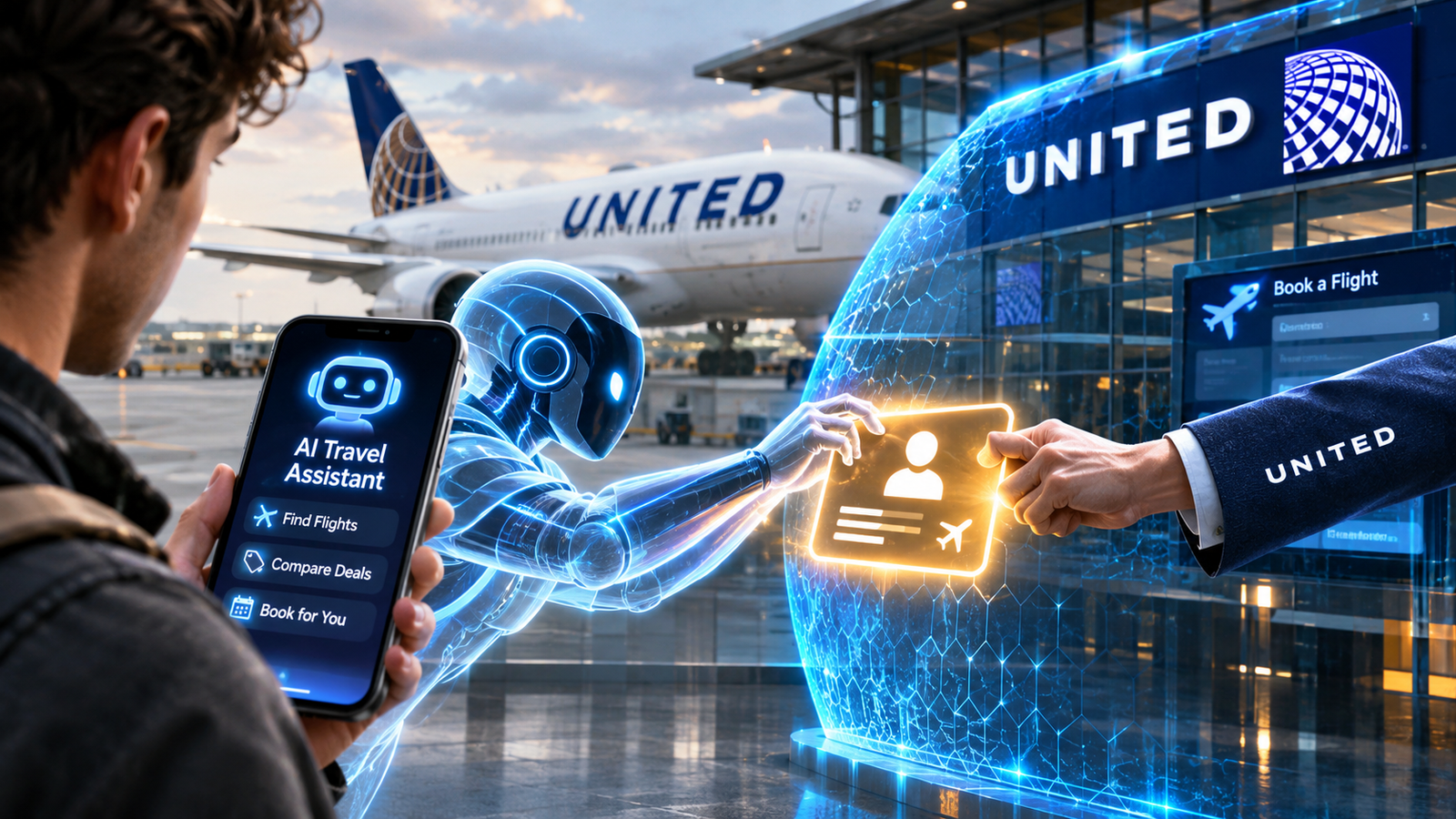
United Airlines says its new restrictions on third-party AI agents are about data security. That’s true, as far as it goes. But read the announcement alongside what the CEO said, and a bigger story shows up: United doesn’t want an AI platform to become the next gatekeeper between the airline and its travelers.
United’s stated worries are real. Handing your login to an outside assistant can expose personal data, trigger purchases you never meant to make, burn through MileagePlus miles, and create regulatory headaches. But Scott Kirby put it more bluntly: “I do not want to create another middleman.” That line tells you what the airline is actually afraid of. Not rogue bots, but an AI agent that owns the traveler’s attention, the comparison shopping, the checkout, and the relationship that follows.
The ban behind the press release
On November 11, United said it would restrict access to its digital platforms for unauthorized third-party personal AI agents, both directly and through travel agencies and aggregators. The airline also said it was updating its booking, ticketing, and distribution rules to match.
The security case holds up. Give an outside assistant your credentials and it can buy things, change reservations, or spend miles without you clearly signing off. United also points to rules specific to aviation, like the human acknowledgment at check-in that your bag doesn’t contain prohibited items such as explosives.
Still, those risks don’t fully explain why United is guarding its app, website, checkout, and distribution channels so tightly. The real issue is control of the interface. United’s app lets customers book, pick seats, and deal with disruptions without leaving United’s own environment. If an AI agent becomes the layer people use to search, choose, pay, and manage trips, United risks turning into a back-end fulfillment service sitting behind someone else’s screen.
What United actually banned
The policy is narrower than the headlines suggest. It’s not a blanket ban on AI.
Third-party agents can still display United flights and prices. What they can’t do is complete a booking on United’s site or log into customer accounts to transact for a traveler. So United is fine with AI helping you discover options, but not with AI executing the purchase.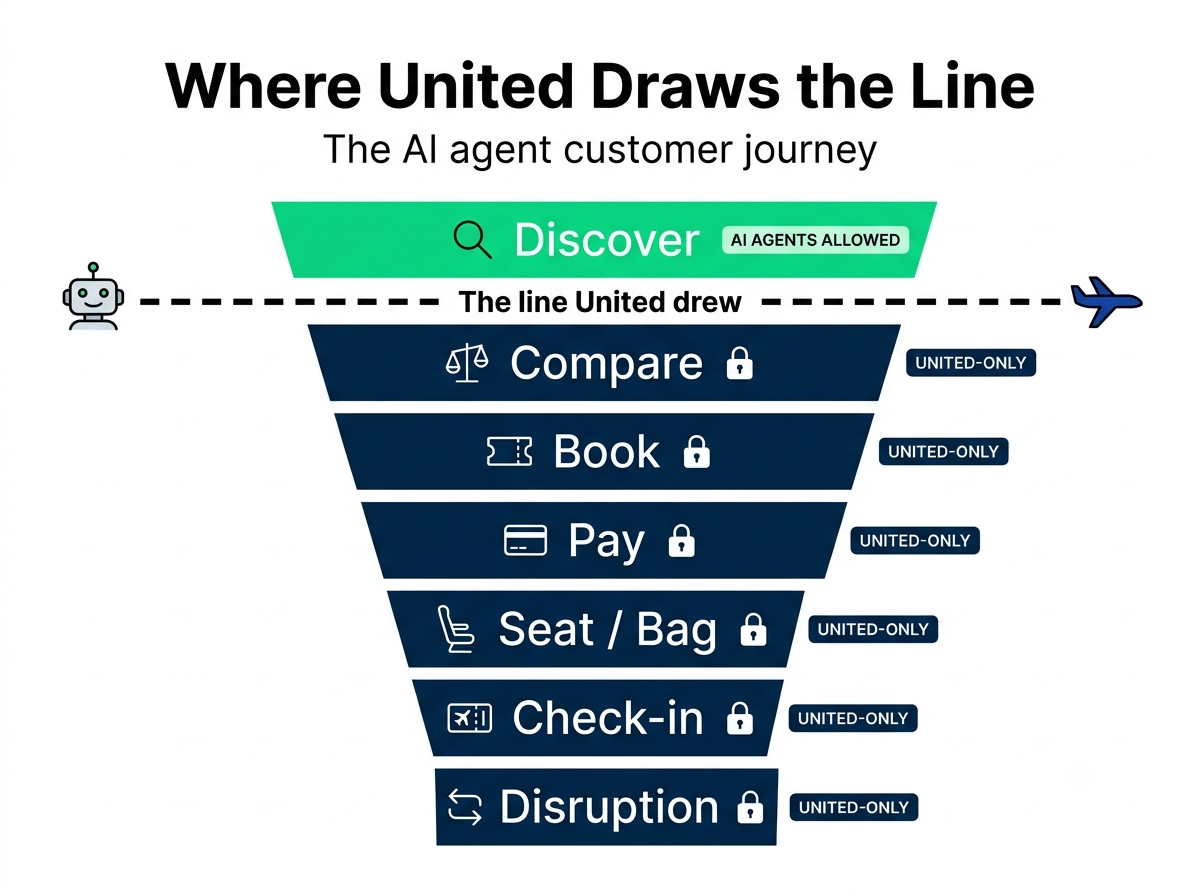
The distinction matters. United is happy for you to use AI to research a trip, compare options, and maybe get a recommendation. But when it’s time to enter payment details, pick a seat, add a bag, redeem miles, or sort out a disruption, United wants you back on its own turf.
It’s a compromise with a clear logic: let AI platforms help generate demand, but don’t let them own the transaction.
Kirby’s real message: “another middleman”
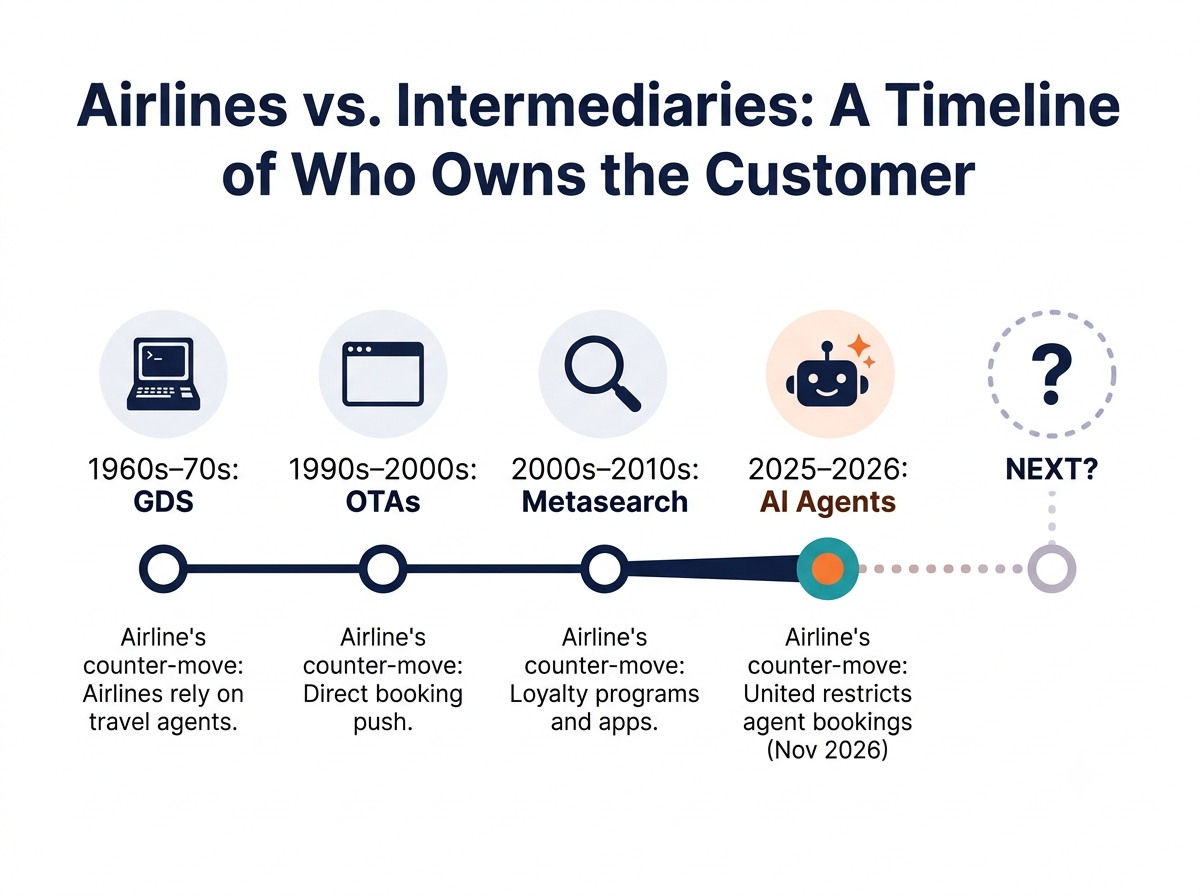
That middleman comment is the best clue to United’s thinking. Airlines have spent years trying to pull bookings away from third-party distributors and toward their own channels, where they control pricing, merchandising, loyalty, service, and data.
An AI booking agent could bring back the online-travel-agency problem in a stronger form. At least an OTA announces itself as a marketplace. An AI agent could sit quietly between the traveler and every airline, deciding which options show up, how offers get framed, and whose brand gets the booking.
That’s a lot of influence over customer choice. The agent might optimize for the cheapest fare, the fastest route, or whatever deal it has with a supplier. Whichever it picks, United’s premium cabins, seat selection, bundles, loyalty perks, and flexible fares could shrink to a single line in a comparison list.
United doesn’t want to compete on price alone inside someone else’s interface. It wants to keep selling the whole journey.
The commercial assets at stake
| Asset | Why an AI middleman threatens it |
|---|---|
| Direct customer relationship | The agent, rather than United, becomes the traveler’s default travel interface. |
| Ancillary revenue | Seat upgrades, bags, preferred seating, and other add-ons may be omitted or de-emphasized when an agent optimizes narrowly for fare. |
| Loyalty and MileagePlus | Agent-mediated transactions can weaken direct engagement with United’s loyalty ecosystem and create risks around mile usage. |
| First-party data | United loses visibility into browsing, preference, and purchase behavior if an outside agent mediates the journey. |
| Merchandising | AI agents could flatten complex fare products into a basic price comparison, weakening United’s ability to differentiate offers. |
| Service and recovery | United’s app is built to manage rebooking and disruption; an external agent could intercept that relationship. |
No single booking is the prize. What United really values is the accumulated relationship: the traveler who opens the United app, knows the brand, earns miles, accepts the occasional upsell, and comes back when plans fall apart.
Why “security” is necessary but incomplete
It would be too cynical to wave security away. Sharing credentials with software that can start payments, change bookings, or touch loyalty balances is risky. And aviation’s compliance obligations make fully autonomous booking and check-in harder than ordinary e-commerce, especially the prohibited-items acknowledgment for checked bags.
But security explains the policy. It doesn’t fully explain the strategy.
In principle, United could build secure, permissioned integrations for trusted AI agents. It could require explicit approval for each transaction, limit what data agents can see, and keep a human in the loop for sensitive actions. The fact that it’s restricting unauthorized agents instead suggests it’s also protecting a commercial boundary.
Security is the public reason. Interface ownership is the strategic motive. Both can be true at once.
Enterprises are building AI walls
United isn’t alone here. The airline itself says leaders in banking and retail have taken similar steps on AI agents, and it urges other companies to consider measures that protect customer data and safety.
The pattern is easy to spot. Big consumer businesses are starting to see autonomous agents not just as productivity tools but as possible unauthorized intermediaries. The question isn’t whether AI can help customers. It’s whether an outside agent should get to operate inside a company’s accounts, checkout, and service systems.
For established companies, the app has become a moat. It holds identity, payment credentials, preferences, loyalty status, purchase history, personalization, and upsell opportunities. An agent that can act across all of that doesn’t just use the app. It could replace it.
That’s the wall around the app.
The counterargument: customers may not care
There’s a strong case on the other side.
Travelers may not want a separate app for every airline, hotel, rental-car company, and restaurant. They might much prefer one AI assistant that researches the whole trip, compares suppliers, books the pieces, watches for disruptions, and rebooks when something goes wrong.
If that experience is clearly better, people may gladly hand the relationship over to the agent. In that world, United’s insistence on its own checkout starts to feel like friction, not protection.
There’s competitive risk too. JetBlue has been more accommodating, with its president saying airlines should respond to what customers want as AI booking tools catch on. If rivals make agent-based booking easy and United doesn’t, United could lose some demand, even if it keeps tighter control over the customers it does win.
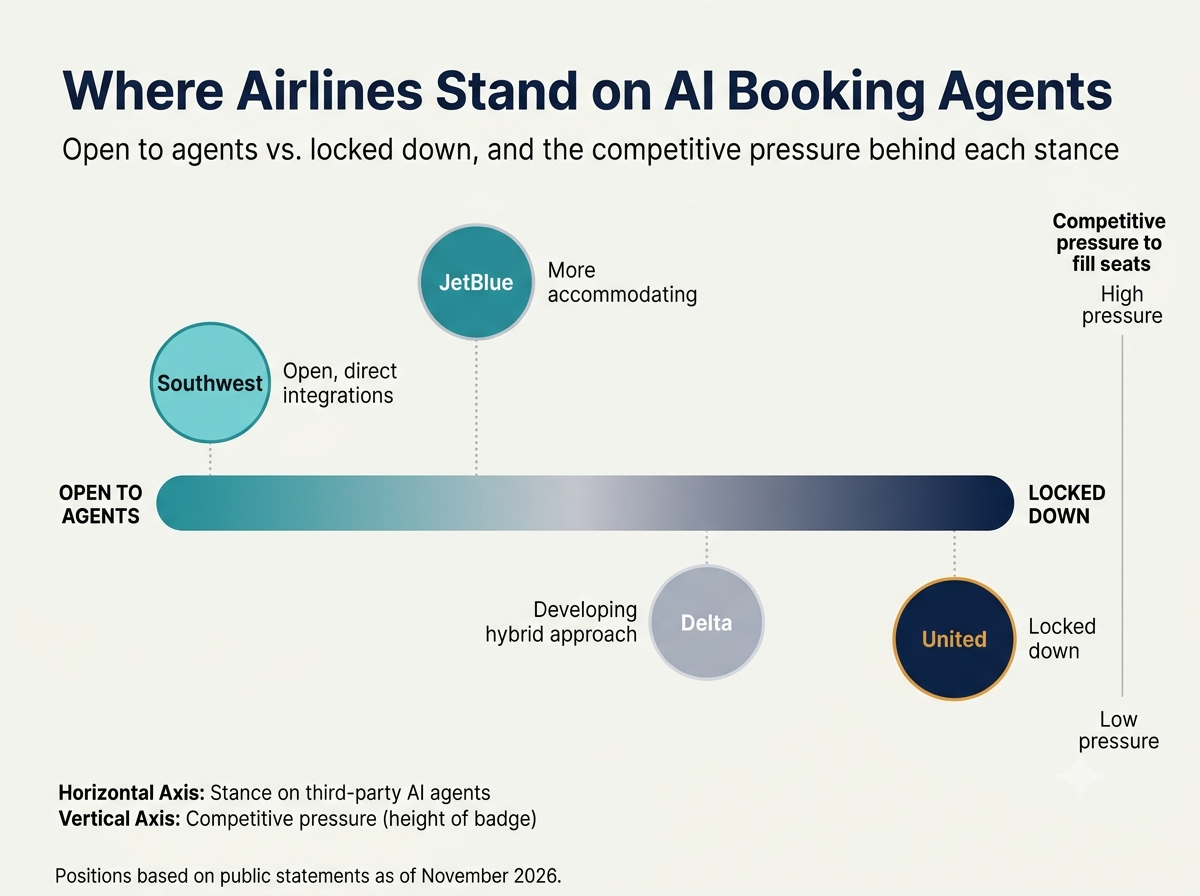
United is betting that its scale, profitability, and loyalty base give it enough leverage to hold out. JetBlue, under more pressure to fill seats, may not be able to make the same bet.
What United is really negotiating for
United probably won’t oppose AI agents forever. More likely, this is an opening position in a coming negotiation over agentic commerce.
The end state won’t be “no AI agents,” and it won’t be “AI agents control everything.” It will be a set of rules about what agents can do, what data they can touch, and who owns the transaction. A few models could emerge:
- Agent-assisted, airline-owned checkout: AI finds and recommends; the traveler completes the purchase in United’s app or website. This is close to today’s policy.
- Authenticated agent access: Agents get limited, revocable permissions instead of raw account credentials.
- Human-in-the-loop controls: Payment, check-in, safety declarations, and changes to nonrefundable tickets require explicit customer approval.
- Commercial terms for agent referrals: Airlines decide whether agent-originated bookings earn compensation, preferred placement, or access to inventory.
- Data-governance rules: Airlines require transparency about how agents use itinerary, loyalty, preference, and payment-related data.
Right now, United’s policy lets it benefit from AI-driven discovery while keeping the transaction and the customer relationship. That isn’t anti-AI. It’s anti-disintermediation.
Implications beyond airlines
This fight won’t stay in air travel.
Any business with a strong direct channel faces the same question: if an AI agent becomes the customer’s main interface, does the brand still own the customer?
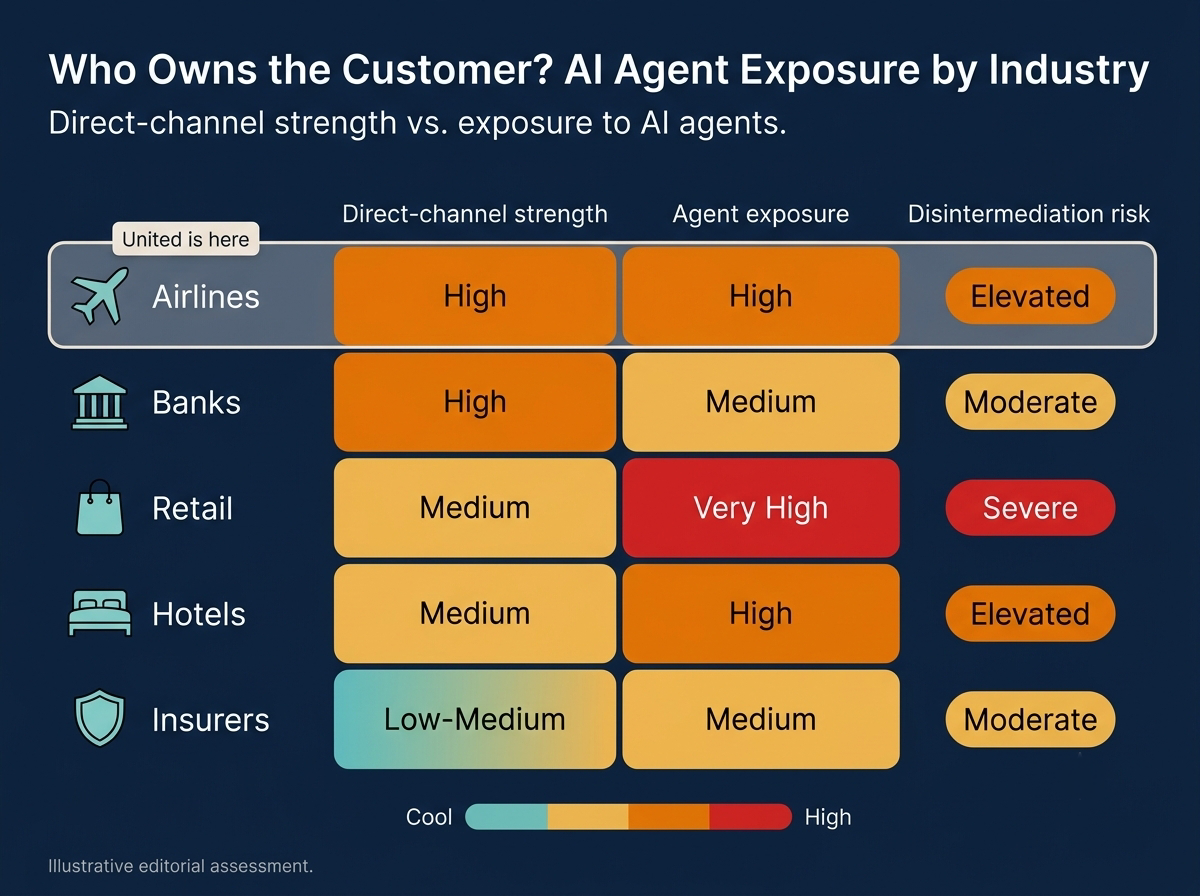
Airlines have unusually high stakes because they combine frequent purchases, loyalty programs, add-on revenue, personalization, and service needs that spike during disruptions. But banks, retailers, hotels, insurers, healthcare providers, and subscription businesses all face some version of the same threat.
The question is no longer “Should we build an app?”
It’s “Who will be the default interface between our customer and our product?”
The interface is the business
United’s AI ban isn’t a rejection of artificial intelligence. It’s a refusal to accept a future where another company owns the moment a customer makes a choice.
United can live with AI as a discovery layer, and it may even profit from it. What it’s fighting for is the role of transaction, loyalty, service, and data layer.
Whether that wall holds won’t be settled by a security policy. Travelers will settle it, by deciding whether they value United’s ecosystem more than the convenience of a powerful AI agent that works across airlines. United has chosen to defend its interface. The open question is whether customers will still want to walk through it.