
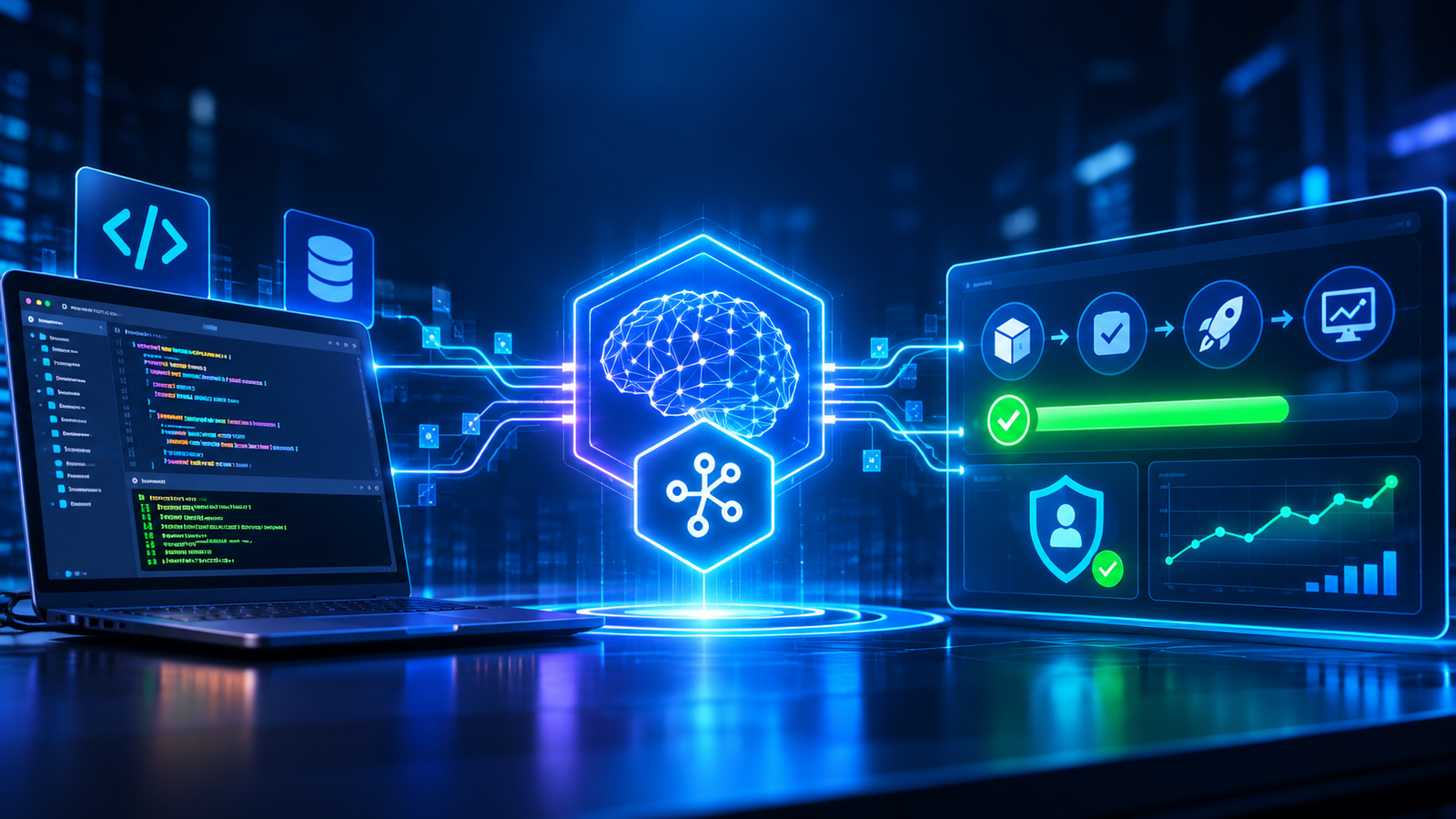
For years, AI coding agents have lived mostly inside the editor. They can read a repository, write a patch, run the tests and suggest a commit. But the moment the work moves into deployment, release orchestration, incident analysis or production change control, a human has to pick up another tool and carry on from there.
The Model Context Protocol (MCP) is starting to change that. It gives AI agents a standard way to discover and use the capabilities of external systems, which means tools like Cursor, Claude Code and Codex can be used for more than writing software. They can help operate the systems that ship it. Digital.ai’s Release 26.3 shows what that looks like in practice. Its Release MCP Server lets developers and agents start, analyze and optimize release workflows without leaving their preferred AI coding tool.
That is more than a convenience for developers. It points to a bigger shift in architecture: the IDE is turning into a control plane for enterprise software delivery.
The Agent Has Left the Editor
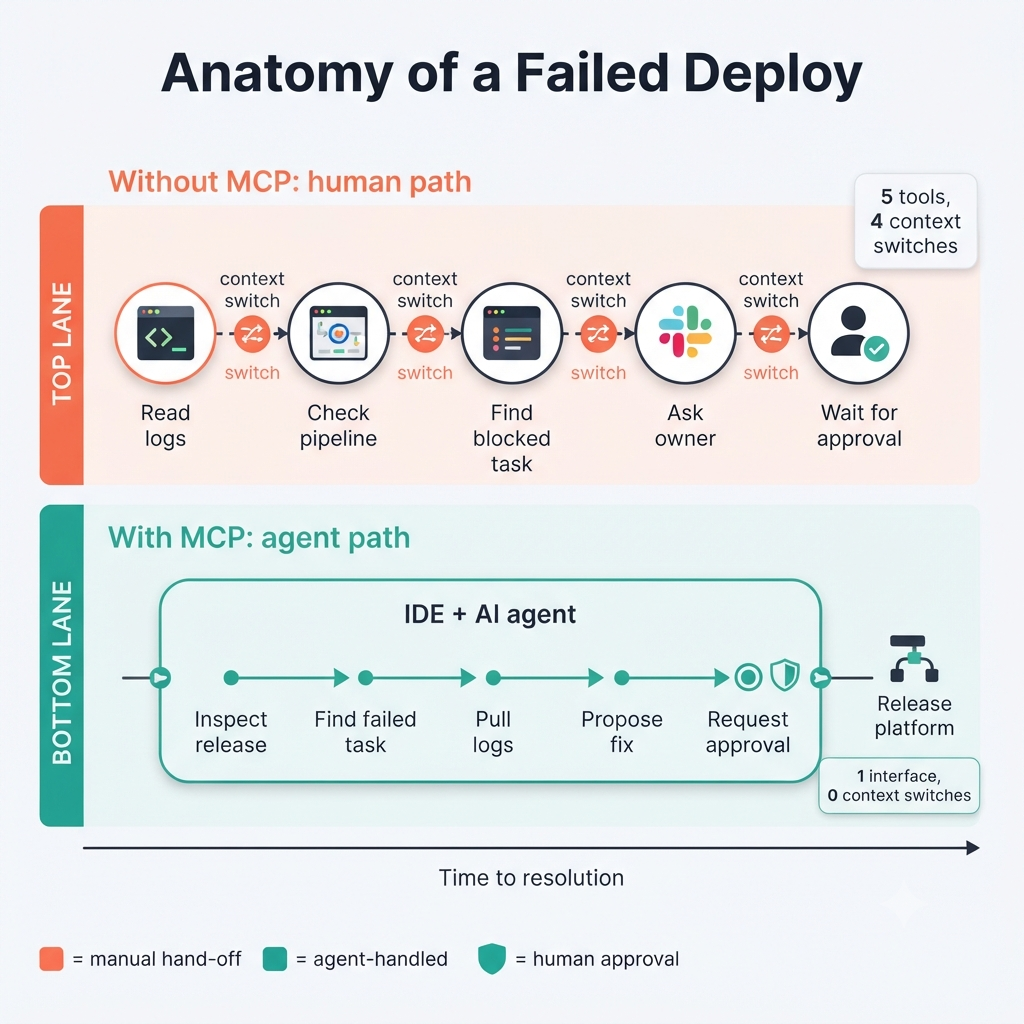
Picture a familiar moment. A developer tells an AI agent, “The staging deployment failed. Find out why and prepare a fix.”
In a traditional setup, the agent can read logs, edit configuration and propose a change. But working out whether the release is blocked, which task failed, who owns the next approval or whether a downstream integration is involved usually means opening a release dashboard, reading pipeline state and checking with other people and systems.
With an MCP-connected release platform, the agent can do much more of that itself. It can look at the release context, find the failed task, pull diagnostic logs, suggest a remediation and, where it has been authorized, act on the release workflow. Digital.ai describes its Release MCP Server as a way to bring AI-powered automation, orchestration and integration to release pipelines.
What matters here is not that an agent can call an API. Agents have been able to do that for a while. What’s new is that the agent works through a structured, discoverable interface to a production delivery system.
From Code Assistant to Delivery Operator
Most coding agents today are tuned for a narrow slice of the software lifecycle: understand the code, change the code, check the change, hand it off. MCP widens that slice.
| Capability | Traditional coding agent | MCP-connected delivery agent |
|---|---|---|
| Primary role | Generate and modify code | Operate across the delivery lifecycle |
| Context | Local files, tests, terminal output | Code plus release state, templates, tasks, variables, and integrations |
| Actions | Edit, test, commit, sometimes deploy | Initiate, inspect, diagnose, and optimize release workflows |
| Workflow | Developer switches between IDE, CI/CD, and release tools | Agent acts within the IDE and connected release system |
| Governance | Often outside the release system | Actions occur within the release platform’s policy and audit model |
Digital.ai Release’s MCP capabilities cover release management, template operations, task and phase management, configuration management, variable management, monitoring, failure analysis, attachment handling and a read-only exploration mode.
That last item deserves attention. An MCP-enabled agent isn’t autonomous in some open-ended sense. It is an operator whose scope is set by the systems it can reach, the tools exposed to it and the policies enforced around it.
MCP
MCP is a protocol for connecting AI applications to outside context and capabilities. It has three main parts: a host, one or more clients, and specialized servers.
- Host: The AI application running the experience, such as Cursor, Claude Code, Codex, VS Code or Claude Desktop.
- MCP client: A component the host creates to talk to one specific MCP server.
- MCP server: A service that exposes a focused set of capabilities. Here, that service is Digital.ai Release.
- Resources: Data and context the model can use, like release information or configuration details.
- Tools: Functions the model can call, such as creating a release, updating a task or retrieving logs.
- Prompts: Reusable interaction patterns that guide how the agent approaches a task.
Servers expose resources, tools and prompts, while the host handles client connections, permissions, consent, authorization and context aggregation. In practical terms, MCP lets an agent ask a simple set of questions of any system it connects to: What can you do? What can I read? Which actions am I allowed to take?
Anatomy of an MCP-Native Release System
Here is how an MCP-enabled release workflow fits together.
Developer / AI agent in Cursor, Claude Code, or Codex
                    |
              MCP client
                    |
           Release MCP Server
                    |
       Digital.ai Release orchestration
                    |
     Jenkins | Git | Jira | deployment targets
And here is how a request moves through it:
- A developer states an intent in plain language: “Diagnose why the staging release is blocked and prepare a safe remediation.”
- The agent uses MCP resources to inspect the release, its tasks, variables, templates and the state of relevant integrations.
- It calls MCP tools to carry out permitted actions, such as updating a task, retrieving activity logs or starting a release.
- The Release platform applies its existing permissions, workflow rules, approvals and audit trail.
- The agent reports back in the IDE, ideally with evidence and not just a vague summary.
Digital.ai’s Release MCP Server supports creating and managing releases, designing and reviewing templates, handling tasks and phases, working with systems like Jenkins, Jira and Git, managing variables, retrieving activity logs, analyzing failures and handling diagnostic files.
The release platform stays the system of record. The agent becomes a new kind of participant inside it.
What “Autonomous Release Manager” Actually Means
The phrase “autonomous release manager” can sound like an overclaim, and in its loosest reading it is. A more accurate way to put it is bounded operational autonomy. The agent does real delivery work, but inside limits set by policy, permissions and human oversight.
Some practical examples:
- Release triage: Find a failed task, read the logs, connect the failure to recent changes or integration state, and propose a fix.
- Pipeline preparation: Create or revise release templates, tasks, phases and variables in response to a change request or an incident.
- Deployment coordination: Start a release, watch its progress, surface blockers and update the workflow as things change.
- Failure analysis: Pull activity logs and diagnostic attachments, summarize what they show, and recommend a root cause or next step.
- Workflow optimization: Review a release template and suggest ways to cut manual handoffs, redundant gates or unclear dependencies.
Digital.ai positions Release 26.3 as a way for agents to work alongside people and traditional automation as first-class participants in governed delivery processes, with human approval required wherever policy demands it.
The point isn’t to get rid of release managers. It’s to take away the low-value coordination work that keeps them from spending their time on risk, quality and delivery strategy.
Why This Is an Architectural Leap
The integration boundary has moved
Before MCP, connecting an AI agent to enterprise delivery infrastructure usually meant building a custom integration, exposing a CLI, or relying on a person to copy context from one system to another. MCP standardizes that connection layer.
The protocol uses a client-host-server model built on JSON-RPC, with capability negotiation between clients and servers. Servers can expose tools, resources and prompts while staying isolated from one another, and the host controls the security boundaries rather than handing over a server’s entire context.
Context becomes actionable
An agent no longer needs a developer to paste in release logs, pipeline status, ticket details and configuration. It can ask for structured context through MCP resources and act through MCP tools.
So context stops being something a human assembles by hand and becomes something the agent can find and use on its own.
The IDE becomes a control plane
The editor turns into a place where code changes and operational decisions meet. A developer can go from “this test failed” to “this release is blocked because of X, so update the task, notify the owner and rerun the affected step” without leaving the agent workflow.
Digital.ai says the Release MCP Server lets developers and agents start, analyze and optimize release workflows from tools including Cursor, Claude Code and Codex, while the existing delivery infrastructure stays where it is.
Existing delivery systems remain central
This part is essential for enterprise adoption. The MCP server doesn’t replace the release engine, the CI/CD tooling, the deployment targets or the approval processes. It gives agents a protocol-native way to take part in them.
Digital.ai’s approach deliberately keeps existing delivery infrastructure in place and adds agents to the orchestration layer. That matters because enterprises don’t need yet another disconnected AI tool. They need AI that works inside the controls they already trust.
The New Operating Model
Once MCP-connected agents are in the picture, the division of labor across software delivery starts to shift.
| Actor | Responsibility |
|---|---|
| Developer | Defines intent, reviews proposed changes, approves high-risk actions |
| AI agent | Gathers context, executes permitted tasks, explains evidence, drafts remediation |
| Release platform | Enforces workflow, permissions, auditability, approvals, and integration logic |
| Platform and DevOps teams | Define tool exposure, read-only boundaries, guardrails, and escalation paths |
| Security and compliance | Govern identity, token scope, action logging, change control, and incident response |
The practical result is a move from human-operated release consoles to human-governed agent operations.
A well-designed system doesn’t ask whether the agent can do everything. It asks which actions the agent can perform, in which environments, with what evidence, and who can override it.
The Governance Gap: The Hard Part
MCP makes agent-driven operations possible. Governance decides whether they are safe.
The real risk isn’t that an agent can technically call a tool. It’s that production systems are full of consequential actions: starting a release, changing a deployment target, modifying credentials, bypassing a gate, triggering a rollback.
The key controls are:
- Least privilege: Give agents narrowly scoped identities and permissions, not broad administrative access.
- Read-only first: Start with analysis and inspection before allowing any write actions. Digital.ai’s Release MCP Server includes a read-only mode for exploring and analyzing an environment without changing it.
- Human approval: Require explicit confirmation for production deployments, rollbacks, sensitive configuration changes and workflow modifications.
- Auditability: For every consequential action, log the prompt, the tool call, the arguments, the outcome, the approver and the rollback path.
- Environment separation: Don’t let development, staging and production share the same default agent permissions.
- Prompt-injection defense: Treat repository content, issue comments, logs and third-party tool output as untrusted input that could be used to manipulate the agent.
- Failure containment: Make sure a mistaken agent action can be detected, paused, reversed or escalated quickly.
Digital.ai stresses that its platform treats agents as first-class citizens alongside people and automation, subject to organizational policies, approvals and audit trails. That framing is the right one. Autonomy without governance isn’t an enterprise capability. It’s an operational liability.
A Practical Adoption Path
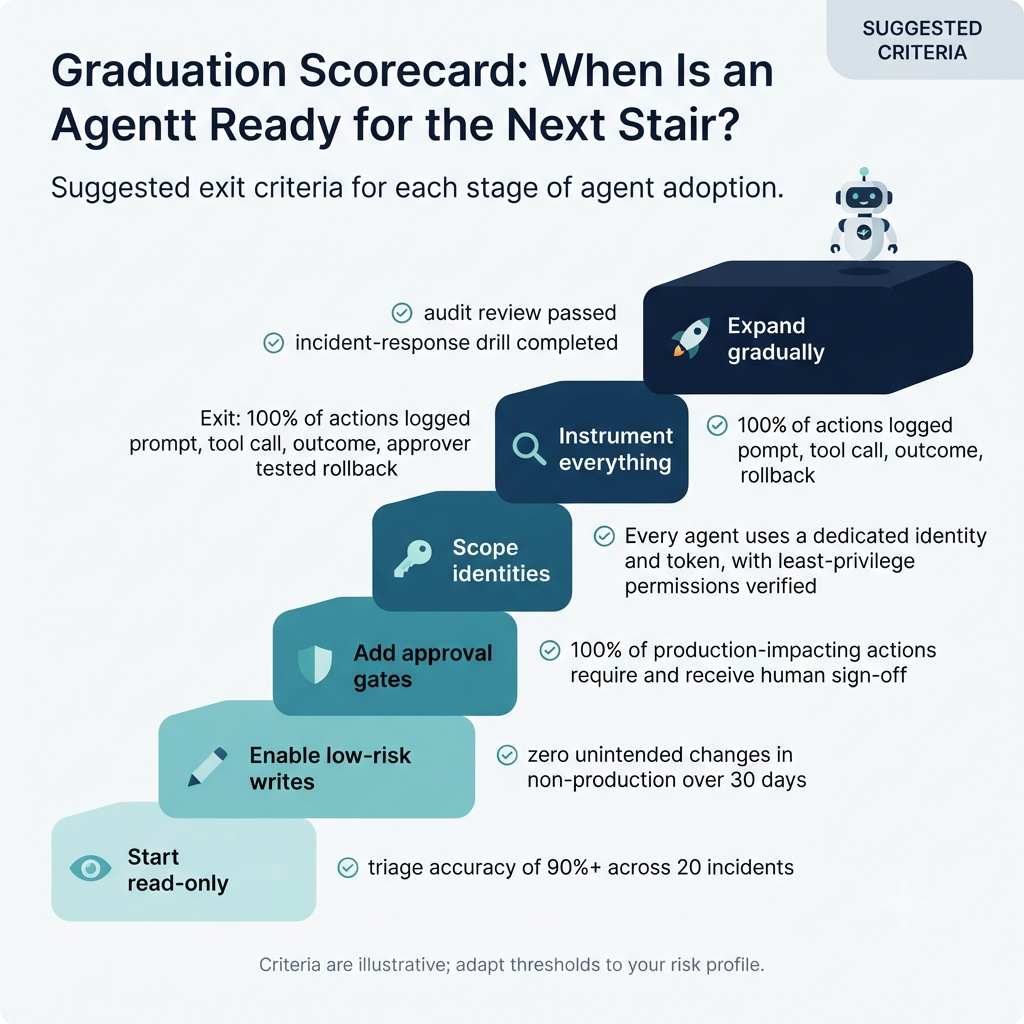
Nobody should start by handing an AI agent write access to production. A safer path looks like this:
- Start read-only. Let agents inspect releases, analyze failures, summarize logs and spot workflow bottlenecks.
- Enable low-risk writes. Allow updates to non-production tasks, variables, documentation or draft templates.
- Add approval gates. Require human confirmation for release starts, production changes, rollbacks and sensitive configuration updates.
- Scope identities. Use dedicated agent identities, narrowly scoped tokens and environment-specific permissions.
- Instrument everything. Capture prompts, tool calls, arguments, outcomes, approvals and rollback paths.
- Expand gradually. Move from triage and analysis to controlled execution only after reliability, auditability and incident response have been proven.
Done this way, MCP stops being a novelty and becomes an operational capability.
What Changes for Engineering Teams
For developers, the first benefit is less context-switching. Instead of hopping between an IDE, a CI dashboard, an issue tracker and a release console, they can describe the outcome they want and let the agent coordinate the steps in between.
For release engineers, the value looks different. There’s less repetitive coordination, but a bigger need to design workflows that are explicit, observable and safe for automated participants.
For platform teams, MCP becomes part of the internal developer platform, sitting next to APIs, CLIs, GitOps and service catalogs. For security and SRE teams, it brings a new class of identity, authorization, observability and incident-response requirements.
And for leadership, it opens the door to faster delivery without giving up control. Digital.ai presents the shift as a way for organizations to increase agentic innovation while still meeting audit requirements, with agents complementing traditional automation in governed pipelines.
Agents as First-Class System Actors
The deeper implication of MCP is that AI agents are becoming first-class actors in enterprise systems. They are no longer just chat interfaces sitting on top of software. They can read operational context and use governed tools across an entire delivery workflow.
That stretches the unit of automation from a single coding task to a whole release process: diagnose a failure, update the workflow, coordinate an integration, start a release, monitor progress and report the result.
The organizations that benefit most won’t necessarily be the ones with the most aggressive automation. They’ll be the ones that pair agent capability with strong boundaries: clear permissions, auditable actions, human checkpoints and well-designed release workflows.
The question is no longer whether AI agents can write code. It’s whether production systems are ready to let them operate, safely, visibly and on the organization’s terms.