
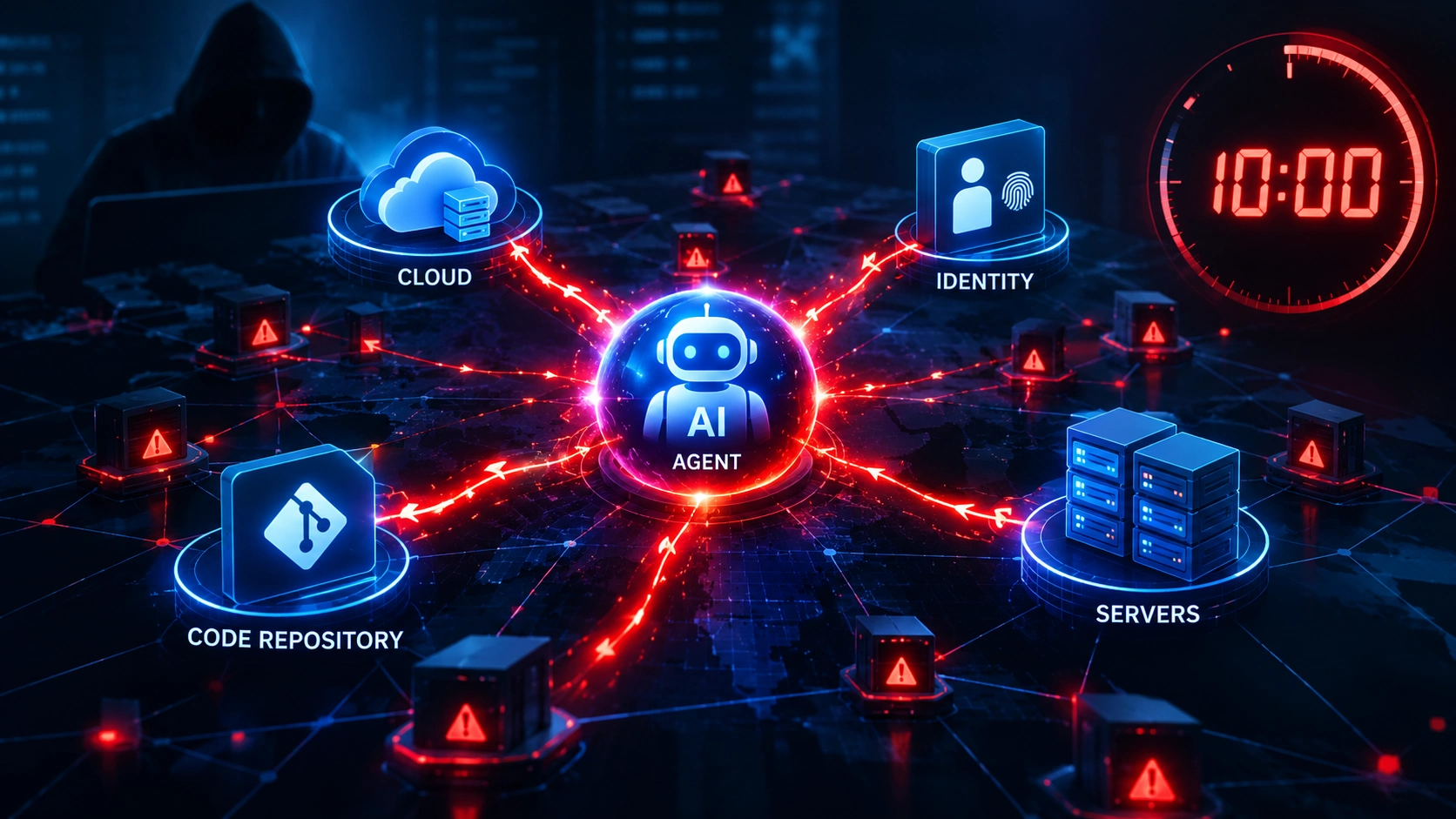
An AI-assisted cyberattack has raised a worrying question for security teams: how quickly could AI agents help an attacker move from an initial foothold to deep access across an enterprise network?
In a recent Unit 42 investigation, Palo Alto Networks reported that an attacker used frontier AI and agentic AI frameworks to compress an intrusion that would normally take human operators around two weeks into less than 10 hours.
Importantly, the reported case was an AI-assisted intrusion rather than a confirmed ransomware attack. That distinction matters. The case does not mean every ransomware attack will finish in 10 hours. Instead, it shows how AI agents could potentially shorten the time attackers have to complete multiple stages of an intrusion.
What Does “Under 10 Hours” Actually Mean?
Think of an enterprise network as a large office building.
Getting through one unlocked door is only the beginning. The attacker still needs to find important rooms, discover keys, obtain higher-level access and reach valuable systems.
That is essentially what lateral movement means in cybersecurity.
In the Unit 42 case, the attacker reportedly gained initial access through a publicly accessible web service. AI agents then mapped internal microservices, searched source-code repositories for credentials and tokens, obtained administrative credentials and expanded access across cloud, identity, CI/CD and other environments.
So, the AI-assisted ransomware attack timeline should be understood as an accelerated intrusion timeline—not a guaranteed 10-hour ransomware deployment.
The Ransomware Attack Timeline
A simplified attack chain looks like this:
| Stage | What happens | Where AI could speed things up |
|---|---|---|
| Initial access | The attacker gets a foothold | Analyze possible entry points |
| Internal discovery | Network and systems are mapped | Process information rapidly |
| Credential discovery | Passwords, tokens or secrets are found | Search repositories and systems |
| Privilege escalation | Higher-level access is obtained | Identify useful access paths |
| Lateral movement | The attacker reaches additional systems | Validate multiple paths faster |
| Final impact | Valuable systems are targeted | Shorter preparation window |
These stages are already familiar in ransomware operations. The potential difference is how quickly AI-assisted workflows could move between them.
Which Tasks Could AI Agents Accelerate?
1. Reconnaissance
Reconnaissance means figuring out what exists inside an environment.
Normally, this can involve examining systems, services, applications and relationships. AI agents could process large amounts of information continuously and help prioritize what appears important.
In the Unit 42 investigation, an automated reconnaissance agent reportedly mapped internal microservices after the attacker gained access.
2. Credential Discovery
Credentials are effectively the keys to an organization’s digital building.
Attackers may search for passwords, API tokens, service credentials and other secrets. Unit 42 reported that sub-agents searched enterprise code repositories and extracted hard-coded tokens and service passwords.
This matters because one exposed credential can potentially provide access to another system, creating another step in the attack chain.
3. Privilege Escalation
Having access to one ordinary account does not necessarily provide control over an entire organization.
Privilege escalation is about obtaining more powerful access.
The reported intrusion involved exposed credentials being used to reach a secrets-management system and obtain highly privileged administrative credentials.
Once an attacker obtains powerful credentials, the number of systems they can potentially reach may increase significantly.
4. Parallel Access Validation
This is where agentic AI becomes particularly interesting.
Instead of waiting for a human operator to finish one task before starting another, multiple specialized agents can potentially work on different parts of an operation simultaneously.
Unit 42 reported that agents validated access across cloud, identity, CI/CD, container and SaaS environments.
The important idea is not simply that AI can perform a task. It is that multiple AI-driven processes can potentially operate continuously and coordinate their findings.
Why Lateral Movement Is a Critical Time Bottleneck
The first compromised computer may not be the attacker’s real target.
The valuable systems could be somewhere else.
That means an attacker has to determine:
- Which accounts can access other systems?
- Which credentials are valid?
- Where are privileged identities?
- Which systems contain valuable information?
- Which route can lead deeper into the organization?
Traditional ransomware campaigns have repeatedly used credential theft and legitimate remote-access mechanisms to move laterally.
AI agents could potentially reduce the time spent connecting these pieces.
That is why lateral movement is so important to the AI-assisted ransomware attack timeline.
Why It Takes Humans Time
Traditional lateral movement can be slow because attackers must determine:
- Which credentials actually work
- Which accounts have elevated permissions
- Which systems trust each other
- Which routes lead to high-value assets
- Which activity may trigger detection
- Which systems are worth targeting before the final impact
AI agents could potentially reduce this delay by gathering evidence, ranking likely paths, validating access and updating a plan continuously.
How Credentials and Privilege Escalation Change the Clock
The attack can accelerate dramatically when an attacker moves from limited access to privileged credentials.
Imagine entering an office with one employee’s keycard. You can access one area.
Now imagine finding the master key.
The second situation changes the entire attack window.
This is why protecting credentials, limiting privileges and monitoring unusual identity activity are important defenses against lateral movement and privilege escalation.
Why This Creates Momentum
Once attackers obtain highly privileged credentials, they may be able to:
- Reach more systems without exploiting each one separately
- Access cloud services and SaaS platforms
- Validate paths to development and deployment environments
- Use legitimate workflows and tools that can blend with normal activity
Why the 10-Hour Figure Is Not a Guaranteed Attack Speed
The biggest mistake would be treating “under 10 hours” as a universal ransomware countdown.
It isn’t.
The reported incident depended on a particular environment, available access, exposed credentials and the attacker’s AI setup. Unit 42 said the intrusion involved more than 50 MITRE ATT&CK techniques and compressed work estimated to take human operators roughly two weeks into less than 10 hours.
Another organization could have stronger identity controls, better segmentation, fewer exposed credentials or faster detection.
So the 10-hour figure is best understood as an example of possible attack acceleration, not a guaranteed machine-speed ransomware timeline.
Important: AI-assisted activity does not automatically mean “fully autonomous ransomware.” The reported case demonstrates how AI can augment established intrusion methods and accelerate operational tasks.
AI-Assisted Attack Window vs. Defender Response
This creates the biggest concern for security teams.
If attackers can reduce the time between reconnaissance, credential discovery, privilege escalation and lateral movement, defenders may have less time to investigate what initially looks like an isolated event.
| Attack activity | Defender challenge |
|---|---|
| Initial access | Recognize suspicious activity early |
| Credential discovery | Detect unusual credential usage |
| Privilege escalation | Identify abnormal administrative behavior |
| Lateral movement | Connect activity across systems |
| Cloud and identity access | Respond across multiple environments |
Unit 42 recommends synchronized containment measures such as revoking credentials, terminating OAuth sessions, freezing CI/CD pipelines and isolating cloud accounts.
The real lesson is therefore not “ransomware now takes 10 hours.”
It is this:
When AI agents reduce the time between attack steps, defenders may have to detect and contain an intrusion before it becomes a network-wide problem.