
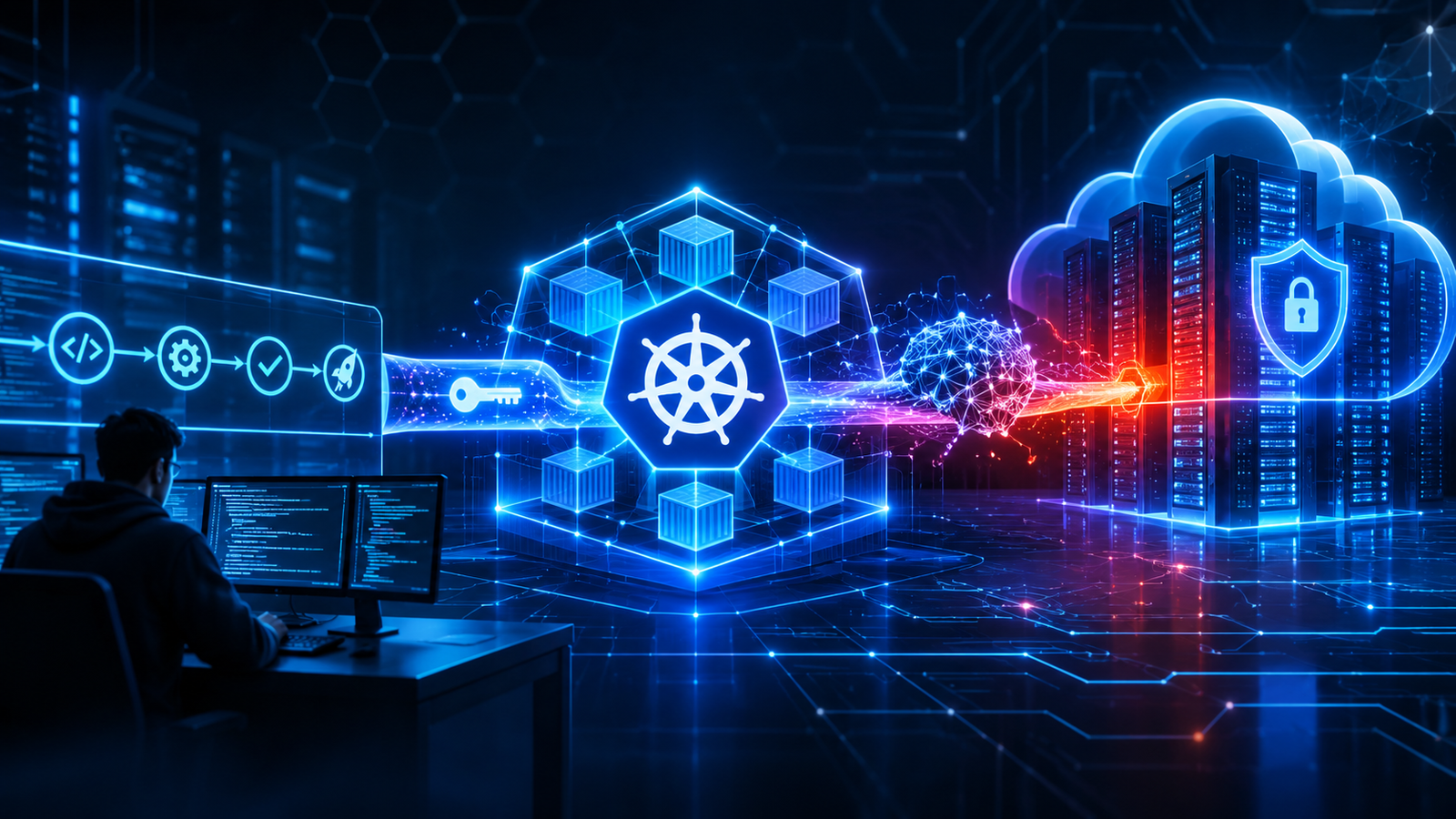
A CI pipeline finishes a routine deployment. Nothing unusual runs, nobody logs in from a strange location, and the Kubernetes API gets a perfectly valid request from an authorized service account. A few minutes later, a privileged pod has mounted the node’s root filesystem, found cloud credentials, and started quietly moving data out.
This isn’t a story about AI “hacking Kubernetes.” It’s about an older and more stubborn problem: CI/CD systems often hold far more identity and permission than any single build job should need. Autonomous AI agents just make that over-trust exploitable at machine speed, turning a developer tool into a bridge from source control to Kubernetes and, eventually, the cloud control plane.
Microsoft describes ARTEX as an AI-driven, multi-agent penetration-testing framework that can run reconnaissance, exploitation, verification, and reporting with little or no human involvement. Its agents don’t invent new attack techniques. They take familiar tools and techniques and run them with fast iteration, parallel execution, and adaptive planning.
The trusted insider nobody profiles
Security teams spend a lot of time thinking about human identities: admins, developers, contractors, break-glass accounts. In a cloud-native environment, though, one of the most consequential identities may belong to a CI runner.
We trust CI/CD to build code, run tests, pull dependencies, publish artifacts, and deploy changes. To do all that, it usually needs access to repositories, secrets, container registries, Kubernetes APIs, and cloud deployment permissions. The access is necessary, but it also forms a powerful chain of identity.
So the “invisible intruder” doesn’t have to be new malware or an exotic Kubernetes exploit. It can be a compromised CI workload using a service account that Kubernetes already trusts.
The core issue: if a CI service account can create privileged pods, reach sensitive node paths, and assume cloud roles, a compromised build job inherits the power of the whole deployment pipeline.
Why CI/CD is a high-value identity target
CI/CD sits right where developer productivity meets production infrastructure. On any given day it handles:
- Source code, build definitions, and infrastructure-as-code
- Secrets, API keys, signing credentials, and cloud tokens
- Container registry credentials
- Kubernetes service accounts, kubeconfigs, or workload-identity credentials
- Permissions to create, modify, or deploy workloads
- Access to cloud resources, storage, databases, and secret managers
That makes the runner a very attractive target. An attacker who gets into it may not need a developer’s laptop, a stolen password, or a Kubernetes exploit. They can simply work from inside an identity that’s already authorized to act.
Threat reporting on ARTEX shows why this matters. Its agents can hunt for exposed secrets, run credential attacks, exploit web applications, read sensitive config files, map cloud permissions, and abuse captured cloud identities. The Cloud Security Alliance also describes ARTEX and its forks as a commodity class of agentic attack infrastructure, not a single tool you can reliably block with signatures.
The trust chain: from commit to cloud
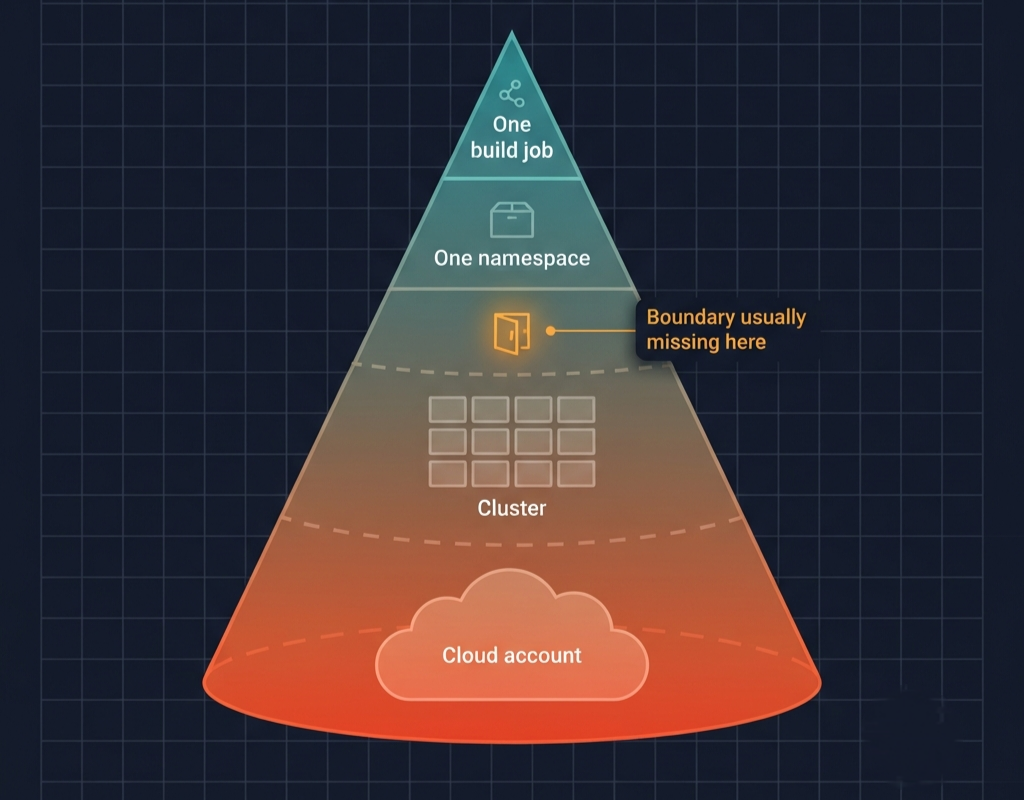
A typical deployment path looks harmless:
Developer commit
      |
      v
CI/CD pipeline trigger
      |
      v
CI runner workload identity
      |
      v
Kubernetes service account / deployment credential
      |
      v
Kubernetes API authorization
      |
      v
Pod creation / node access / secret access
      |
      v
Cloud metadata or cloud credentials
      |
      v
Cloud resource access and exfiltration
Every link exists for a good reason:
- Developer trust: a commit or pull request authorizes a pipeline run.
- CI trust: the runner is trusted to build, test, scan, and deploy.
- Kubernetes trust: a service account authorizes API operations.
- Node trust: certain pod configurations can expose host resources.
- Cloud trust: a workload may pick up cloud identity through metadata services or federated credentials.
Trouble starts when these links are chained together with no deliberate limits. A CI runner may need to deploy one application. That doesn’t mean it needs to create arbitrary privileged pods in every namespace, read every secret, or touch cloud resources outside its deployment scope.
The exploit path: stolen identity to privileged pod
What follows is a conceptual walkthrough, not an operational recipe. The point is to help defenders recognize the sequence and break it early.
Step 1: Obtain a CI workload identity
There are plenty of ways in: a compromised dependency, an exposed runner, a malicious pipeline change, a leaked credential, vulnerable build tooling. Once inside, the attacker may land on an identity Kubernetes already recognizes as legitimate.
That’s why the initial compromise matters less than the blast radius of the identity it reaches. A stolen developer token is serious. A stolen CI service account with broad deployment rights can be catastrophic.
Step 2: Discover the identity boundary
Before escalating anything, an agent needs to know what its current identity can do. It can look through environment variables, mounted secrets, pipeline context, Kubernetes config, and the API operations it’s allowed to call.
This is identity reconnaissance, and the question is simple: what can this service account do? Can it list pods? Create them? Patch deployments? Read secrets? Work across namespaces? Bind roles? Run commands inside workloads? Each “yes” is a possible route upward.
Step 3: Create or modify a workload
If the service account can create pods, or change existing workloads, the agent may try launching a pod with elevated Linux capabilities, a more sensitive service account, or a hostPath volume.
A privileged pod isn’t malicious by nature, and some operational tooling genuinely needs one. The problem is what happens when a CI identity has that kind of power: a deployment credential turns into a potential foothold on the node.
Step 4: Mount the host root filesystem
A hostPath mount exposes part of the node’s filesystem to a pod. If the pod can read sensitive host directories, it may find kubelet credentials, cloud instance metadata, SSH keys, container runtime data, or other secrets.
This is the pivot point, where a Kubernetes identity can become a cloud identity. The attacker doesn’t need a separate vulnerability to compromise the node. A legitimate permission to create workloads may be enough to reach host-level material.
Step 5: Pivot into cloud identity
From the node or a cloud-connected workload, an agent can go looking for metadata endpoints or locally stored credentials. With a cloud identity in hand, it can enumerate resources, check permissions, access storage, modify roles, or set up persistence.
Microsoft reports that ARTEX agents map the permissions of any credentials they capture, and have used flaws like XXE to query cloud metadata services for role credentials. In one observed case, an AI agent went from searching GitHub for client secrets to pulling data out of Azure Key Vault in five minutes.
Step 6: Exfiltrate through trusted channels
The last stage often doesn’t look like classic exfiltration. Rather than opening an obvious outbound connection, an agent can use channels the environment already trusts:
- Artifact uploads
- Container registry pushes
- Log-shipping pipelines
- Backup jobs
- Approved SaaS integrations
- Webhook or file-transfer services
The Cloud Security Alliance suggests that lasting detection should focus on behavior and volume: bursts of control-plane activity, new authentication sources, bulk data access, and connections to webhook, OAST, or tunneling services.
Why autonomous agents change the economics
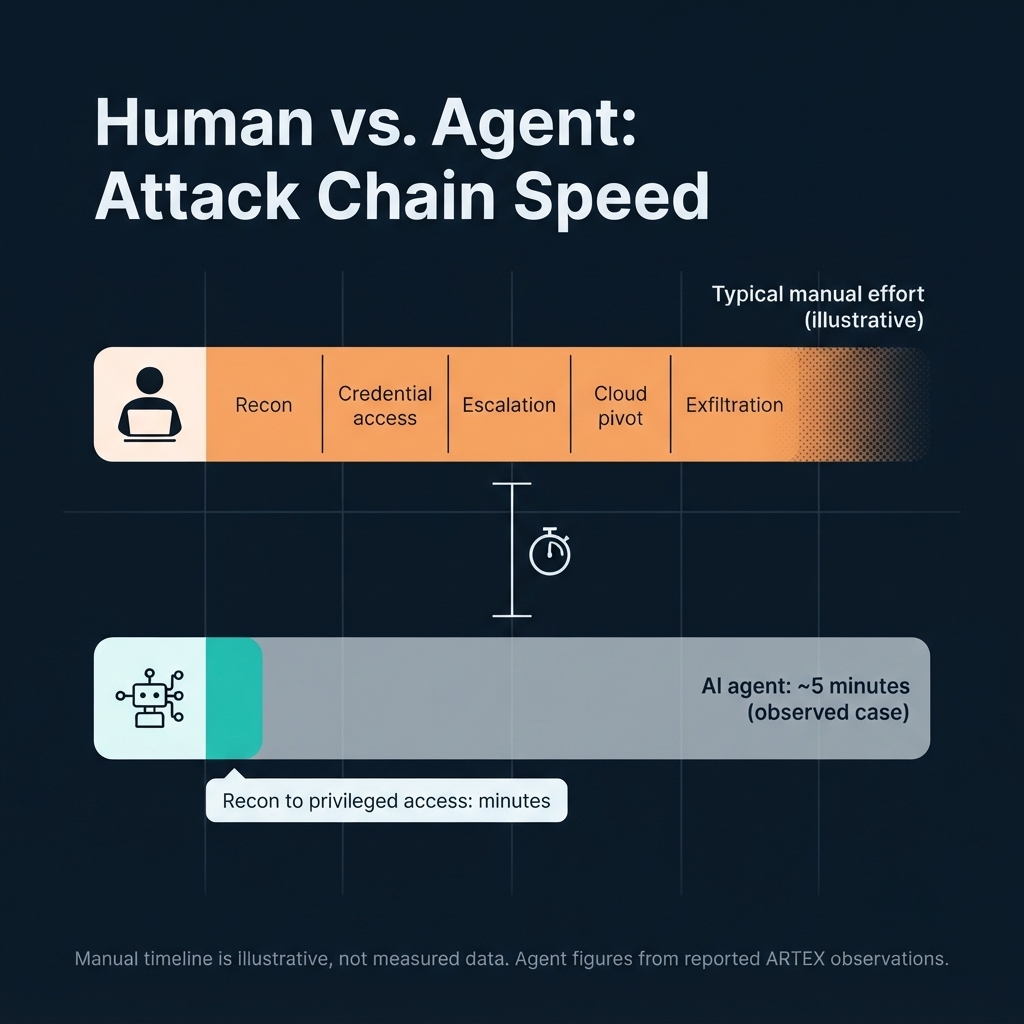
AI agents don’t create a new category of vulnerability. What they do is shrink the time, expertise, and coordination needed to chain together weaknesses that already exist.
An autonomous agent can:
- Parse pipeline definitions and infrastructure-as-code files
- Find secrets, environment variables, and mounted credentials
- Test Kubernetes API permissions
- Chain pod creation, hostPath access, and cloud metadata discovery
- Adapt when one path is blocked
- Work across several attack stages with little human input
- Write up the access it gained and the data within reach
Microsoft observed that ARTEX can go from reconnaissance to persistent, privileged access in minutes, depending on the target’s defenses and how the attacker configures it. The FBI has likewise warned that ARTEX-enabled activity can automate intrusions from reconnaissance all the way to data exfiltration at machine speed.
Worth remembering: the agent is an accelerator. The vulnerability is the excessive trust we give CI/CD workloads.
The invisible intruder problem
Traditional controls tend to ask, “Did this identity authenticate successfully?” That question no longer cuts it.
A compromised CI runner can present a valid token, come from an authorized system, call expected Kubernetes APIs, and reach resources its role technically allows. In a narrow sense the activity is authorized. In context, it’s malicious.
| Detection challenge | Why it happens |
|---|---|
| Valid credentials | The service-account token is legitimate. |
| Familiar API calls | Creating or updating workloads is normal CI behavior. |
| Trusted source identity | Requests originate from an authorized CI system. |
| Normal-looking egress | Exfiltration may use approved artifact, registry, or SaaS endpoints. |
| Machine-speed iteration | Agents can test many identity and permission paths rapidly. |
| Fragmented telemetry | CI, Kubernetes, cloud IAM, and data-access logs are not correlated. |
The better question is: “Is this identity doing something its workflow context justifies?”
A CI service account that normally deploys to a staging namespace shouldn’t suddenly be creating privileged pods in production, reading unrelated secrets, or assuming cloud roles nobody has seen it use before.
Where trust quietly accumulates
The attack path opens up when several shaky assumptions pile on top of each other:
- CI service accounts have broad Kubernetes RBAC.
- One identity is reused across teams, environments, or repositories.
- CI runners can create pods, exec into pods, patch deployments, or bind roles.
- Pods can run privileged containers, use host namespaces or hostPath volumes, or carry risky capabilities.
- Cloud credentials sit in CI variables or are reachable through node metadata.
- Long-lived static cloud keys are used instead of short-lived, scoped workload identity.
- CI/CD control planes are publicly reachable or poorly isolated.
- Pipeline changes, fork pull requests, or dependency execution lack strong review.
The defensive principle is simple: shrink what a stolen CI credential can reach before you assume it will be stolen. Microsoft makes the same point, recommending that each service principal or managed identity be limited to only the resources and operations it needs, so a token obtained through a metadata-service flaw can’t reach unrelated resources.
Defense blueprint: break the chain
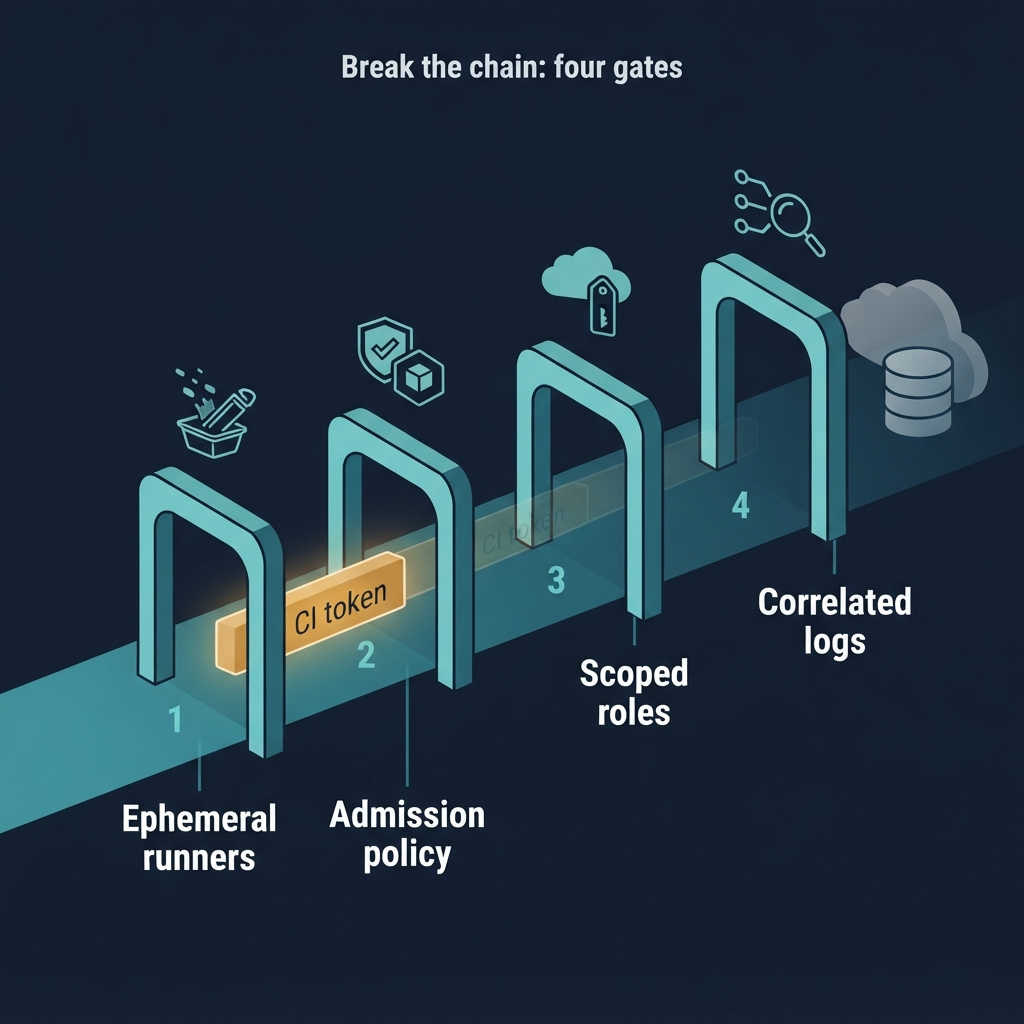
CI/CD controls
- Use ephemeral, isolated runners.
- Keep build, test, deploy, and production-release identities separate.
- Require approval and provenance checks for production deployments.
- Limit which repositories, branches, and workflows can trigger privileged deployments.
- Skip reusable broad credentials in favor of narrowly scoped, short-lived tokens.
- Protect pipeline definitions with mandatory review and branch protection.
- Keep secrets out of source code, out of pipeline variables where possible, and out of public artifacts.
Kubernetes controls
- Apply least-privilege RBAC per namespace and workload.
- Stop CI identities from creating privileged pods or using dangerous hostPath mounts.
- Use admission policies to block privileged containers, host namespaces, unnecessary hostPath volumes, and risky capabilities.
- Segment namespaces and limit cross-namespace service-account access.
- Rotate service-account tokens and don’t embed long-lived kubeconfigs in CI.
- Audit pod creation, RBAC changes, exec events, secret access, and token use.
Cloud controls
- Use workload identity federation or managed identities wherever you can.
- Scope cloud roles to specific resources, actions, and environments.
- Restrict metadata-service access and protect instance credentials.
- Watch for unusual role assumption, permission changes, storage access, and token issuance.
- Treat cloud control-plane access from CI as a high-sensitivity identity path.
Detection controls
- Baseline what normal looks like for each CI service account: namespaces, API verbs, image registries, deployment targets, and egress destinations.
- Alert when a CI identity creates privileged pods, touches host paths, reads secrets outside its usual scope, or assumes unfamiliar cloud roles.
- Correlate pipeline runs with Kubernetes audit events, cloud control-plane logs, and data-access events.
- Lean on behavioral anomaly detection rather than static indicators alone.
A practical maturity model
| Maturity level | State | Primary risk |
|---|---|---|
| Level 1: Implicit trust | CI can deploy broadly with shared credentials | One runner compromise becomes broad infrastructure access |
| Level 2: Scoped identity | CI has separate, limited identities per environment | Lateral movement is harder |
| Level 3: Policy-enforced workloads | Admission controls block high-risk pod settings | Privilege-escalation paths are constrained |
| Level 4: Identity-aware detection | CI, Kubernetes, and cloud activity are correlated | Abuse becomes visible despite valid credentials |
| Level 5: Zero-standing privilege | Just-in-time, narrowly scoped deployment access | A stolen token has minimal immediate value |
Hardly anyone needs to hit Level 5 on day one. But every organization should know where it stands today, and which identity could turn a CI incident into a cloud-wide compromise.
Executive takeaway
AI agents don’t make CI/CD insecure on their own. They make over-trusted CI/CD identities dangerous at machine speed.
If your build system can create privileged Kubernetes workloads, read node filesystems, and assume cloud roles, then your deployment pipeline is more than a software-delivery mechanism. It’s a high-value identity boundary.
Security leaders should be asking three questions:
- What can our CI service account do in Kubernetes that a human deployer couldn’t justify?
- If a CI runner were compromised right now, what cloud resources could it reach within 10 minutes?
- Can we tell a legitimate deployment from an identity-trust abuse sequence in our logs?
The answers decide whether an AI agent finds an isolated build failure or an invisible path into your cloud.