
Cybersecurity has always been a race against the clock. What’s changed is how fast the other side can run. With agentic AI, an attacker can go from first targeting an organization to holding privileged access in under three hours. Plenty of security operations centers still measure their incident response in hours, or even days.
So the question is no longer just whether you can spot malicious activity. It’s whether you can detect it, understand it, decide what to do and contain it before an autonomous attacker reaches your crown jewels.
The 180-minute problem
Picture an attacker starting to probe your organization at 9:00 a.m. By noon, they could already have privileged access to your core systems. This isn’t a thought experiment. The FBI’s November 2026 FLASH advisory on ARTEX says some intrusions went from initial targeting to privileged access in under three hours.
That creates an ugly imbalance. While a human analyst is still working through an alert queue, pulling together context and waiting on an approval, an agent-driven adversary may have finished reconnaissance, chained exploits, escalated privileges and started moving laterally.
Breaches used to be slow campaigns. Now they look more like a sprint, and many SOCs don’t realize they’re in one.
From tool leak to systemic shift
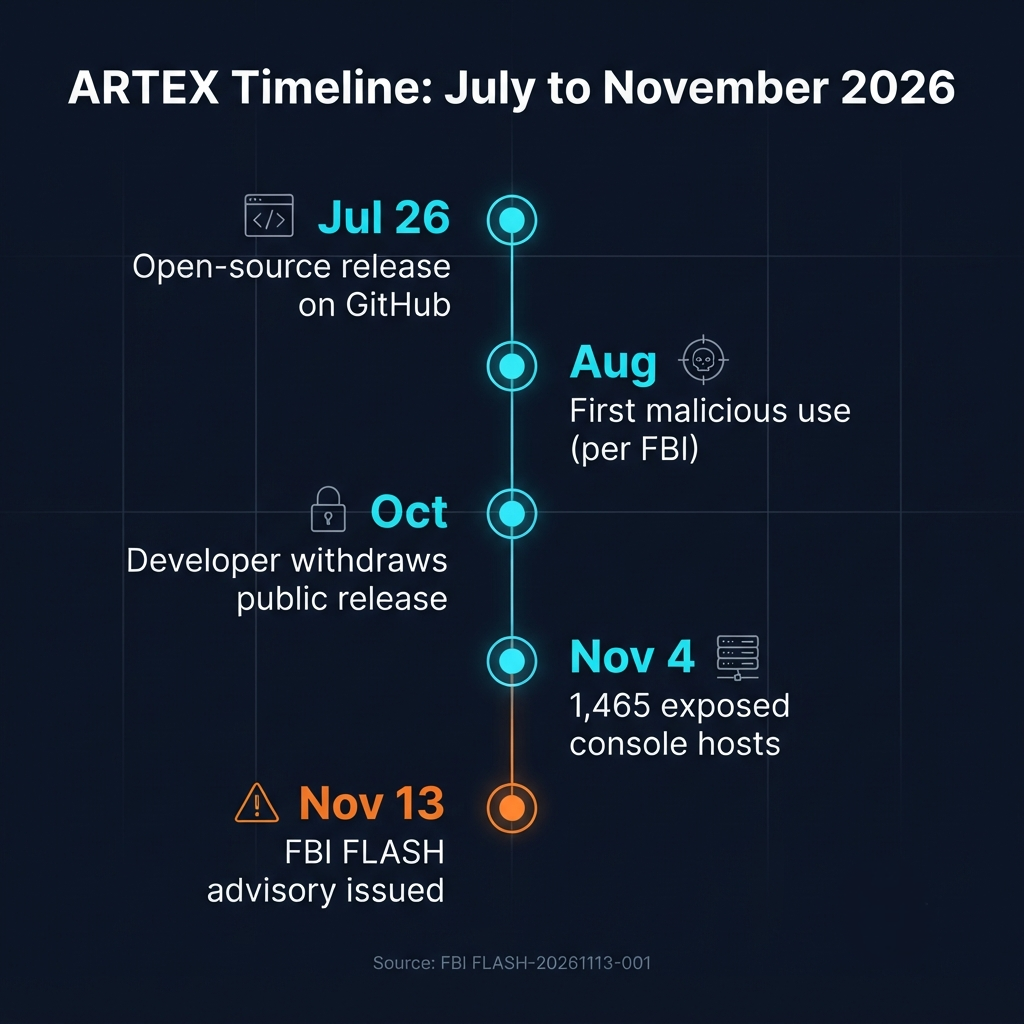
ARTEX is an open-source, LLM-driven agentic platform that threat actors have turned into a weapon. It automates multiple stages of an intrusion, from reconnaissance all the way to data exfiltration, at machine speed.
Its original developer took the GitHub repository down in October 2026 after reports of malicious use. It didn’t matter. The framework kept spreading through forks, localized variants, archived copies and even a commercial version. By early November, researchers had found more than 1,600 publicly exposed ARTEX console instances, according to the FBI.
Still, the tool itself isn’t the real story. ARTEX shows that offensive AI has become modular, easy to copy and widely accessible, enough to turn sophisticated intrusion techniques into an automated workflow.
What the leak really did was end the scarcity of advanced attack capability.
Anatomy of an agent-swarm intrusion
Traditional attacks tend to follow a familiar order: find an exposure, test it, exploit it, escalate, move on. Agentic attacks can run many of those steps at the same time, with agents adjusting as they learn.
| Attack stage | Traditional intrusion | Agentic swarm intrusion |
|---|---|---|
| Reconnaissance | Sequential scanning and manual target selection | Parallel discovery across identities, endpoints, cloud permissions, and exposed services |
| Vulnerability analysis | Human-guided testing and research | Continuous diffing of exposed assets, configurations, and exploitable weaknesses |
| Exploitation | Step-by-step chaining | Autonomous chaining of viable techniques based on live feedback |
| Privilege escalation | Often requires specialist expertise | Agents test available paths and escalate where identity or policy controls permit |
| Lateral movement | Slower and often more visible | High-frequency, parallel movement across systems and cloud boundaries |
The FBI says ARTEX lets threat actors with limited technical skill run complex, multi-target operations all at once, which speeds up attacks and widens their reach.
Pay attention to that idea of scale. One operator no longer has to babysit every stage of an intrusion. Agents can chase several paths at once, drop the dead ends and take the first route that works.
Why the traditional SOC playbook breaks
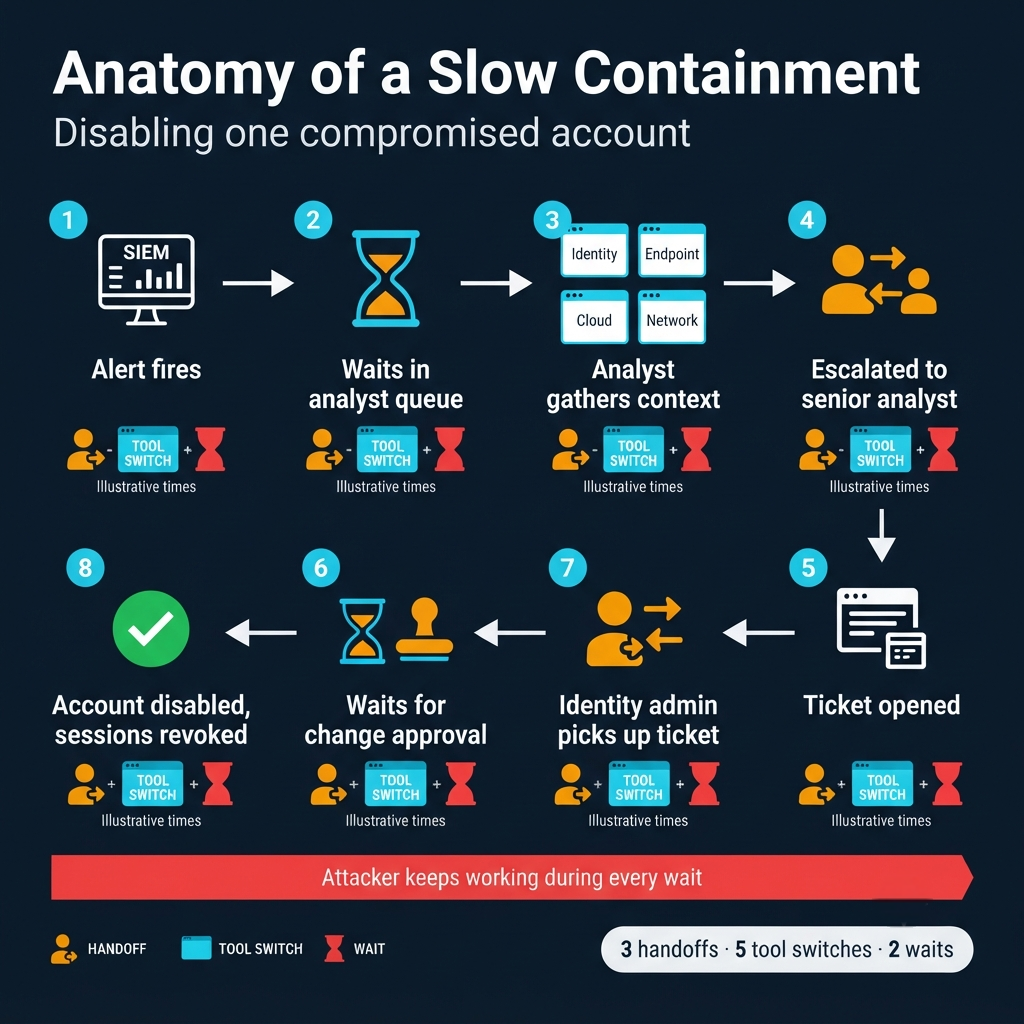
The classic SOC playbook of detect, investigate, escalate, contain was built for attackers who moved at human speed and defenders who had time to gather context. That assumption doesn’t hold anymore. Here’s where it cracks:
- Triage latency: Analysts work through queues one item at a time, while agent swarms generate signals and act on them concurrently.
- Investigation depth: A human needs context from identity, endpoint, network, cloud and application telemetry. An agent can correlate all of it continuously.
- Approval friction: Change control, escalation and manual containment are important safeguards, but they can be painfully slow during an active intrusion.
- Coverage economics: No human team can watch every identity, endpoint, SaaS permission, cloud role and API call at attacker speed.
Agentic SOCs aim to squeeze work that used to take hours into minutes, freeing analysts for deeper investigation, systemic hardening and stopping repeat attacks. Microsoft pitches its security agents the same way: helping teams respond in minutes instead of hours or days.
A playbook built around “detect, investigate, escalate, contain” quietly assumes the attacker will wait politely for each step to finish.
The false comfort of faster alerts
Many organizations will respond by buying better detection. You do need it, but it won’t be enough on its own.
Detection without fast, safe containment still leaves you exposed. You can catch an intruder a few minutes in and still give them time to escalate privileges, steal data or dig in for the long haul. The FBI’s advisory frames the danger of ARTEX around exactly this: it cuts the time needed to chain attack techniques together.
The number that really matters is the detection-to-containment gap:
Risk = Time attacker has access × Blast radius
You can have superb telemetry and still lose if you can’t act inside the shrunken window. An alert that lands in a human queue at 10:15 a.m. doesn’t help much if the attacker had privileged access by 11:45.
What autonomous defense must look like
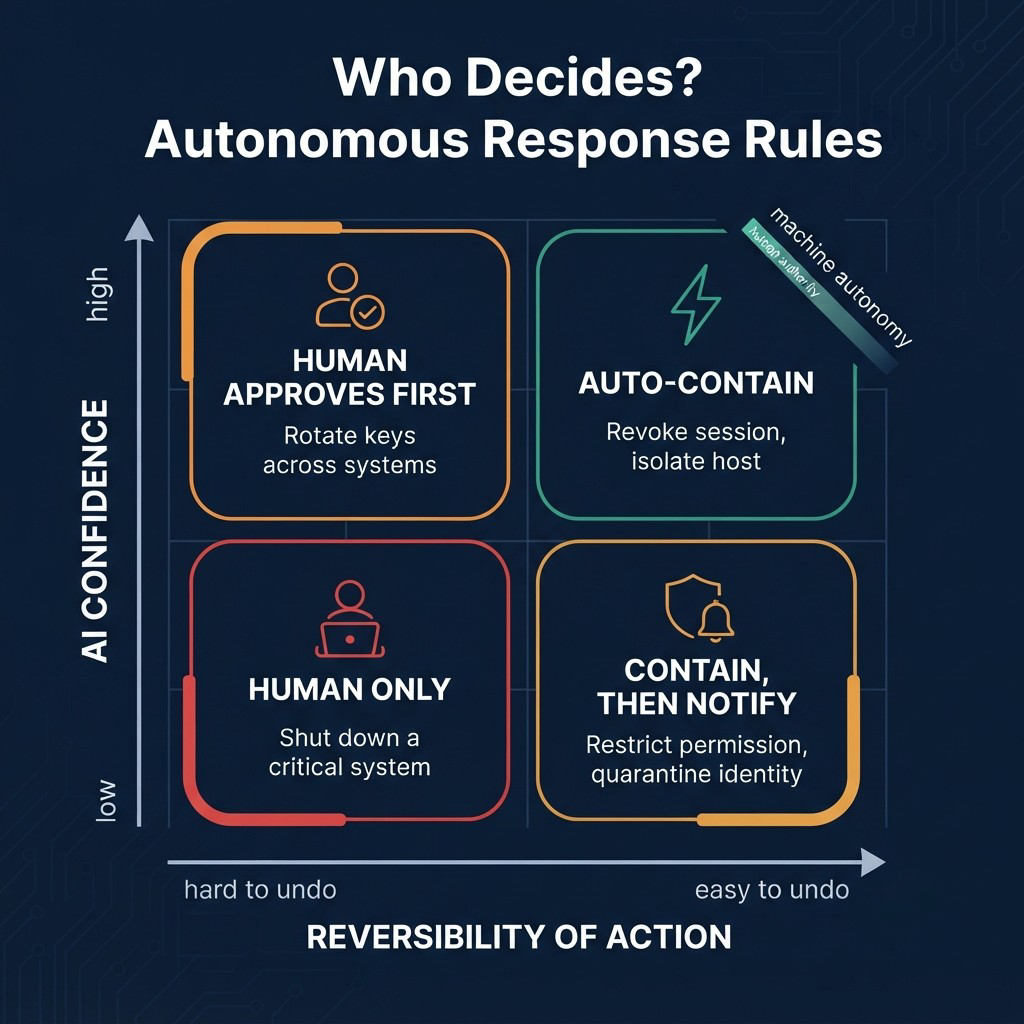
The answer isn’t to swap humans out for AI. It’s to rebuild the SOC so machines handle speed and scale while people keep judgment, accountability and control.
An effective agentic defense model needs five capabilities:
- Continuous attack-surface reasoning: Map identities, assets, exposures, permissions and dependencies before an incident happens.
- Parallel investigation: Look into related alerts, accounts, hosts and cloud roles at the same time instead of in a line.
- Confidence-scored decisions: Separate high-certainty containment actions from those that need a human to sign off.
- Pre-authorized response paths: Isolate a host, revoke a session, disable a key, quarantine an identity or restrict a permission under pre-approved policy.
- Human override and auditability: Every autonomous action should be explainable, reversible where possible, and logged for post-incident review.
Agentic AI in security is usually described as using autonomous agents to detect, investigate and respond to threats with minimal human intervention. The realistic goal isn’t a SOC that runs unsupervised. It’s a human-commanded, machine-executed containment layer.
The governance guardrail
Autonomous defense brings its own risks. A system that can revoke credentials, isolate servers or change cloud permissions needs firm boundaries.
Treat autonomous response like any other privileged system:
- Don’t hand it unrestricted “break-glass” authority.
- Set policy boundaries and approval thresholds for high-impact actions.
- Don’t let false positives become an excuse for switching containment off.
- Keep humans responsible for decisions that are ambiguous, business-critical or irreversible.
- Maintain an audit trail covering what the agent saw, why it acted, what it changed and who can undo it.
Autonomy without governance isn’t defense. It’s just one more unmanaged privileged identity.
A practical maturity model
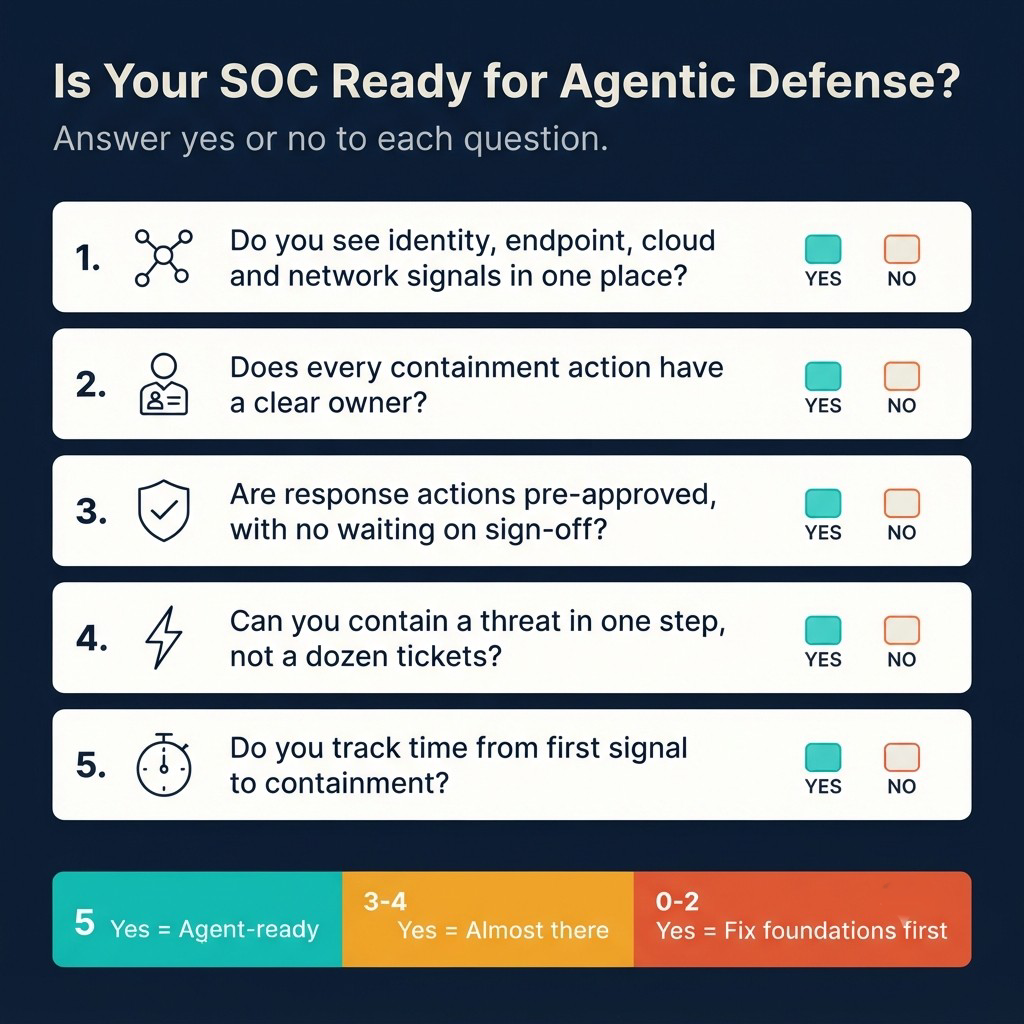
Security leaders need a realistic path, not a demand to go fully autonomous overnight.
| Maturity level | SOC behavior | Agentic-defense requirement |
|---|---|---|
| Level 1: Manual | Analysts triage alerts one by one | Consolidate telemetry and standardize incident data |
| Level 2: Assisted | AI summarizes and prioritizes alerts | Build reliable identity, endpoint, cloud, and network context |
| Level 3: Orchestrated | Playbooks automate repeatable actions | Define safe, preapproved containment actions |
| Level 4: Agentic | Agents investigate and coordinate responses in parallel | Add confidence scoring, policy limits, and auditability |
| Level 5: Adaptive | Defense learns from adversary behavior and adjusts controls | Continuously test assumptions through red-teaming and recovery drills |
Your first step isn’t buying an “AI SOC.” It’s clearing out whatever makes human response slow today: fragmented telemetry, fuzzy ownership, manual approvals, and containment actions that take a dozen tickets to carry out.
“We still need humans”
True. But that doesn’t mean nothing has to change.
People are still essential for ambiguity, business context, legal and ethical judgment, creative thinking about adversaries, and any decision with irreversible consequences. Their role shifts, though. Instead of working through every alert by hand, analysts supervise autonomous systems, set the constraints, investigate novel threats and take command during major incidents.
The strongest model is human command, machine execution. People decide what the organization will never tolerate, and machines carry out the response at the speed the attack demands.
The new SOC metric
We shouldn’t judge the SOC of the future by how many alerts it closes. We should judge it by how quickly it can stop a live intrusion without causing unacceptable collateral damage. Track these:
- Time from first malicious signal to containment
- Percentage of high-confidence incidents contained without human delay
- Time from a privilege-abuse signal to identity or session revocation
- Mean time to investigate across identity, endpoint, cloud, and network signals
- Percentage of autonomous actions that were correct, reversible, and auditable
The FBI’s warning isn’t only that AI tools can help hackers. It’s that offensive agents now work at a tempo human-only defense can’t match.
The SOC of the future won’t win by working faster at human speed. It will win by giving machines the speed to respond, and giving humans the authority to decide what machines may never do alone.