
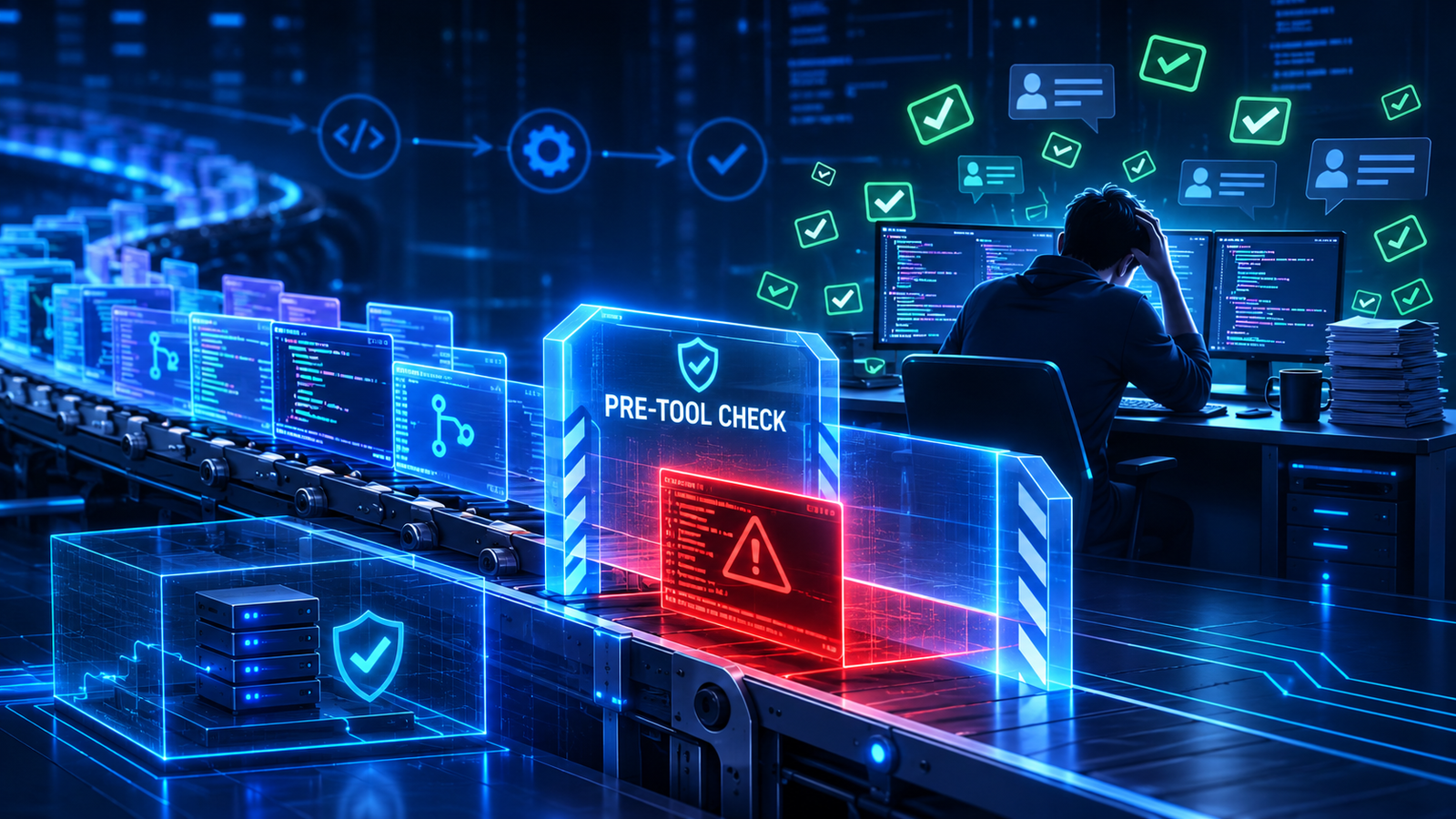
Salesforce says merged pull requests per developer went up 79% after the company standardized on Claude Code. That’s a huge number. It’s also a bit of a warning. If AI agents produce code faster than people can actually review it, the human approval step can slowly turn into a formality without anyone noticing.
I call this the velocity trap. Teams cheer the throughput and miss the widening gap between how many changes are coming in and how much real checking a person can do. Asking reviewers to try harder won’t close that gap. What works is redesigning the system so dangerous actions get stopped long before they show up in a pull request.
The Approval Queue Is Breaking
Picture a senior engineer opening their review queue on a Monday morning.
Fourteen PRs are waiting, and several came from an AI coding agent. The diffs are tidy, the tests pass, the commit messages read well. Everything looks reasonable.
But “looks reasonable” isn’t the same as “is safe.”
The reviewer has maybe a few minutes per PR, not hours, to figure out whether a change opens up a privilege issue, breaks an edge case, leaks a credential, touches infrastructure, or quietly shifts business behavior. As agent-generated PRs pile up, the sensible response is to scan, skim, and approve.
That’s how rubber-stamping starts. Engineers haven’t stopped caring. The system is just asking them to make more high-stakes calls than anyone can keep up with.
What “79% More Merged PRs” Actually Measures
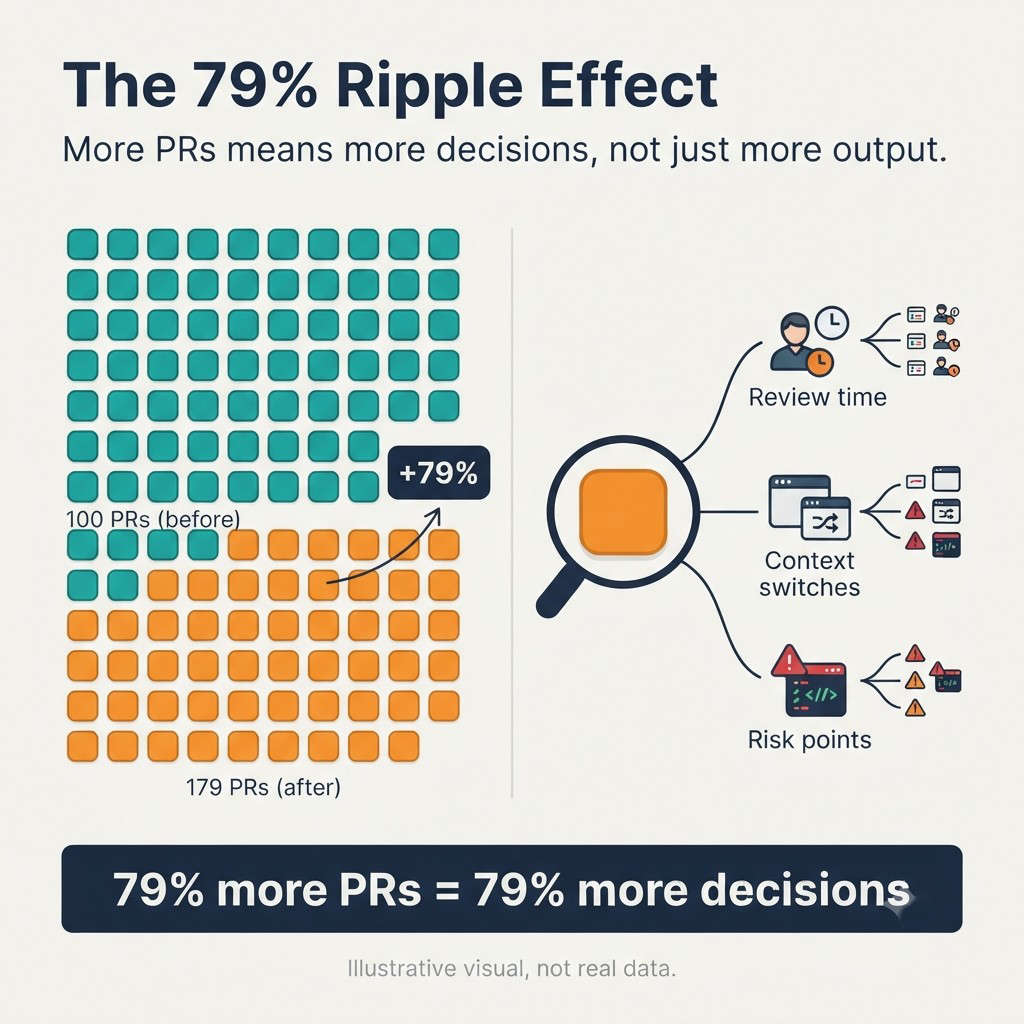
The 79% figure sticks because it’s simple: more merged work per developer. But it’s a thin picture of engineering health.
A merged PR tells you code reached the main branch. It doesn’t tell you whether:
- The change was reviewed in depth.
- The tests covered the risks that matter.
- The agent understood the intended business outcome.
- Security, privacy, and operational constraints were enforced.
- The reviewer had enough context to push back on the implementation.
- The organization can spot a problem after merge.
More PRs can be a good sign. Smaller, focused changes are often easier to understand. But they also create more review surface. A 79% increase in merged PRs means 79% more decisions, context switches, diffs, test results, and chances for a subtle mistake to slip through.
So the useful question isn’t “How many PRs did we merge?”
It’s “How confident are we in each PR we merged?”
The Rubber-Stamping Curve
Rubber-stamping isn’t an on/off switch. It creeps in as review demand outgrows reviewer capacity.
| Review condition | What reviewers experience | Likely outcome |
|---|---|---|
| Low agent-generated volume | Time to understand context and challenge changes | Meaningful review |
| Moderate volume | Reviewers prioritize obvious defects | Selective review |
| High volume | Reviewers scan diffs for “does it look right?” | Rubber-stamping risk |
| Very high volume | Reviewers rely on CI, agent summaries, or social pressure | Approval theater |
At first, people still read carefully. Then they start homing in on the most visible problems. Eventually a green CI run, a nicely written PR description, or an AI-generated summary starts to feel like enough proof that the change is safe.
That’s a failure of the system, not of the people in it. Engineers are reacting sensibly to an impossible workload. When the input rate outruns what a person can cognitively handle, they do what people do under pressure: approve, delegate, skim, or put it off.
Why Traditional Code Review Fails at Agent Speed
Code review was built for a world where humans wrote most of the code. Author and reviewer usually shared context. They knew the product, the architecture, the team’s conventions, and why the change was being made.
AI-native development breaks a few of those assumptions.
Context asymmetry
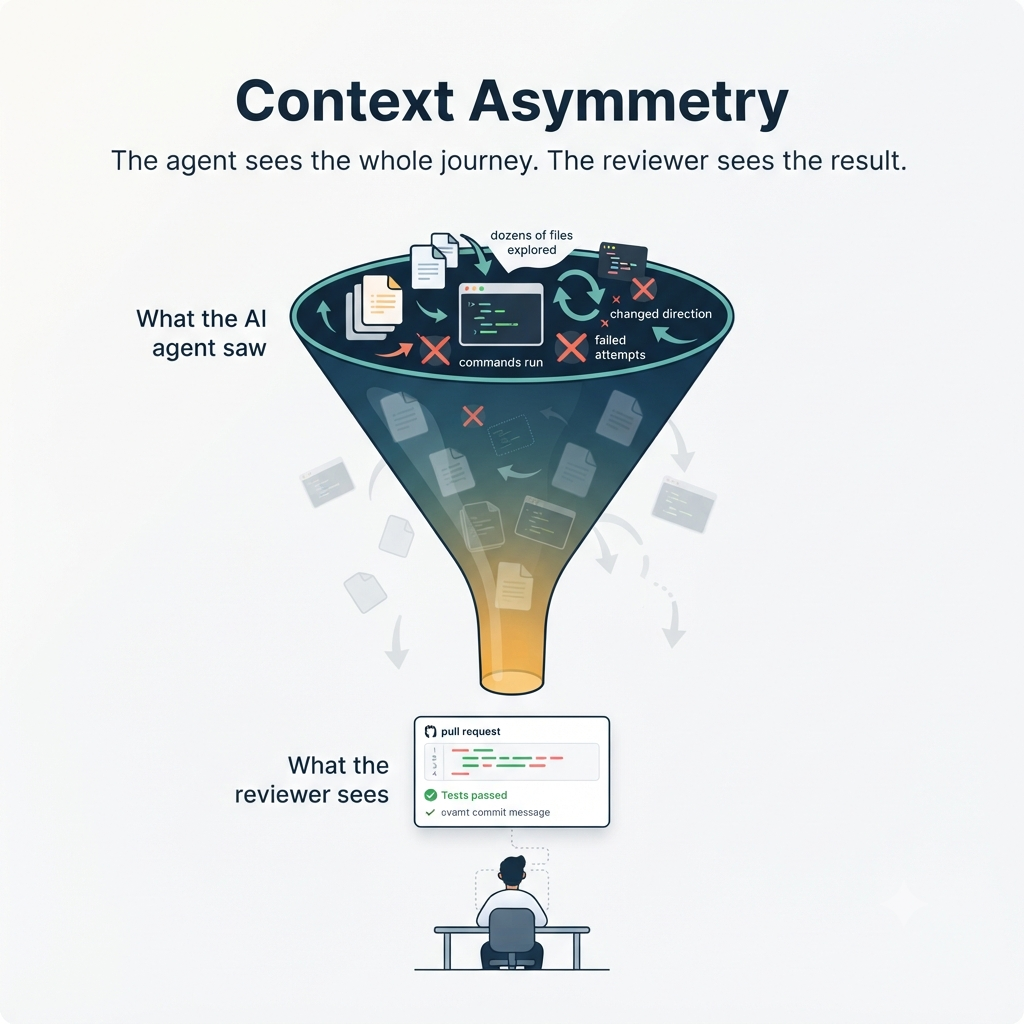
Before producing its final diff, an agent may have explored dozens of files, run commands, generated failed attempts, and changed course more than once. Most of that never makes it into the pull request.
The reviewer sees the result. The agent saw the whole process.
Diff blindness
A small change can hide a big decision.
A one-line config tweak might change how authentication works. A dependency bump might drag in a new transitive dependency. A harmless-looking helper function might become the route by which secrets, customer data, or infrastructure credentials get exposed.
Approval fatigue
When every PR looks plausible and most pass automated checks, reviewers learn, without ever deciding to, that approving is usually safe.
That is exactly the situation attackers, misconfigurations, and subtle regressions take advantage of.
False confidence from green checks
Tests, linters, type checkers, and static analysis are valuable. But they only validate what they can express.
They may not tell you:
- Whether the feature solves the user’s actual problem.
- Whether the change respects a security boundary.
- Whether an agent has access to credentials it should never touch.
- Whether a migration can be rolled back safely.
- Whether a passing test is hiding a production-only failure.
Accountability drift
When an agent writes the code and a human approves it, it gets unclear who’s responsible.
The engineer may feel they just signed off on an AI suggestion. The organization may treat that sign-off as proof of oversight. But if the reviewer didn’t have the time, context, or authority to evaluate the change, the approval isn’t oversight.
An approve button isn’t a security control if the person clicking it no longer has the capacity to exercise judgment.
The Real Fix: Move Verification Upstream
When AI-generated code feels risky, the instinct is to add more reviewers, require more approvals, or hand out longer checklists.
That usually makes the bottleneck worse.
A better move is to push verification earlier in the workflow:
- Prevent unsafe actions while the code is being generated.
- Limit what the agent can access and execute.
- Automate the checks that don’t need human judgment.
- Save human review for the decisions that matter.
Claude Code’s design points this way. Its PreToolUse hooks run before a tool call and can allow, deny, modify, ask about, or defer the action. That lets a team set deterministic rules before an agent writes a file or runs a command.
Rather than hoping a reviewer catches a dangerous command after the fact, the system can stop it from happening at all.
PreToolUse: Security as a Policy Gate
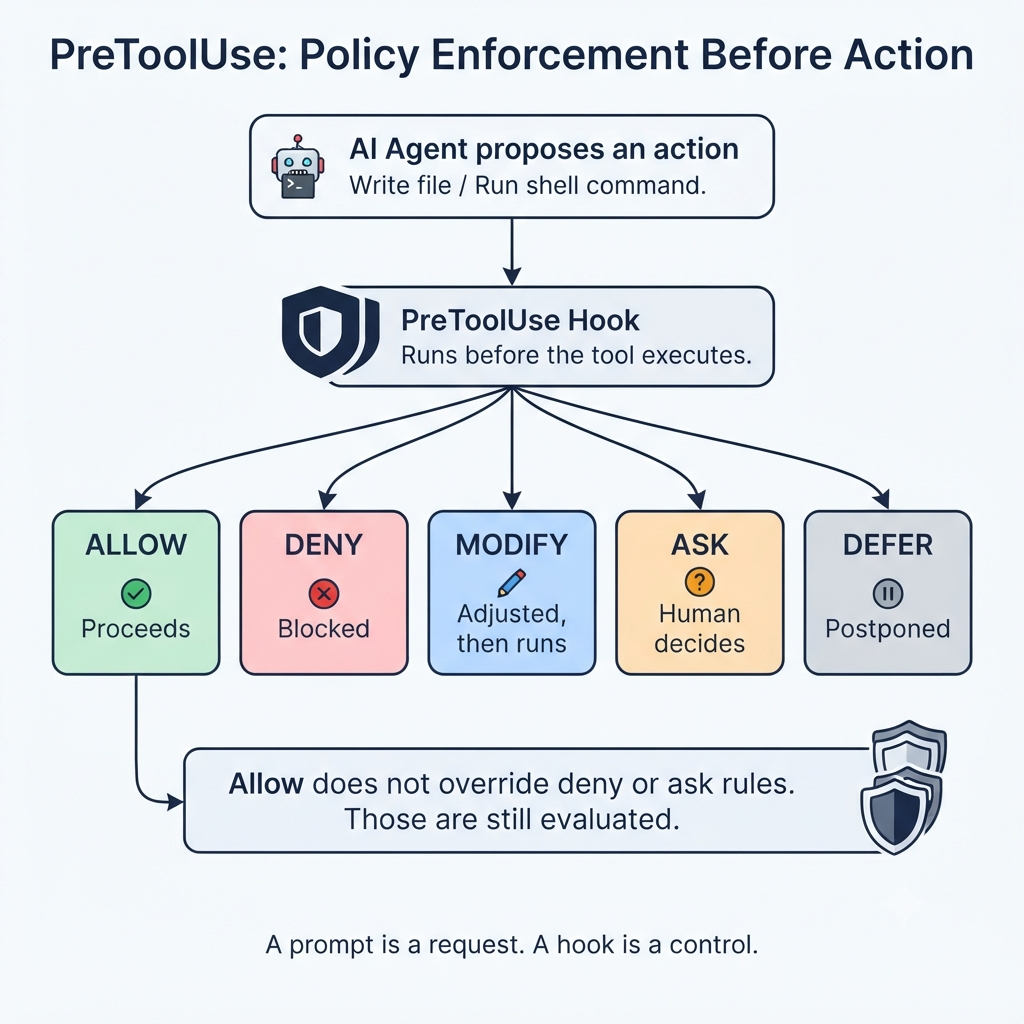
PreToolUse is one of the more important ideas in AI-native engineering because it turns policy into enforcement.
You could write “Please don’t modify production configuration” in a prompt. Or you could define a hook that blocks writes to protected directories. You could trust an agent not to run a destructive shell command, or you could intercept the command before it executes.
Here are some practical uses:
- Blocking destructive commands like
rm -rf, force pushes, or anything that changes production infrastructure. - Preventing edits to protected paths such as
.github/workflows/,infra/,migrations/, or deployment config. - Requiring approval before installing unfamiliar dependencies.
- Blocking outbound requests to domains that haven’t been approved.
- Stopping shell commands from reading credential files.
- Requiring a human decision before an agent touches a high-blast-radius system.
The difference matters. A prompt instruction is a request. A PreToolUse hook is a control.
Anthropic also notes that an allow decision from a hook doesn’t override deny or ask rules, so deny rules still get evaluated. That’s worth paying attention to, because guardrails should be layered rather than resting on a single check.
Sandboxing: Assume the Agent Will Try Something
Hooks are necessary, but they aren’t enough on their own.
An agent might misread a task. A prompt might be incomplete. A tool integration might act in an unexpected way. A careless or malicious user might ask the agent to do something risky.
That’s why execution boundaries matter.
Claude Code’s sandboxed Bash tool limits which files and network hosts shell commands can reach. It treats filesystem isolation and network isolation separately, so teams can control both which paths commands can access and which domains they can contact.
A solid baseline looks like this:
- Restrict filesystem access to the project workspace.
- Deny access to credential locations like
~/.ssh,~/.aws, and.env. - Block direct outbound network access by default.
- Allow only explicitly approved domains, through a proxy or allowlist.
- Inject credentials through a controlled mechanism instead of exposing them to the agent directly.
Anthropic’s secure-deployment guidance describes sandboxed Bash commands as limited in both filesystem and network access, with traffic routed through a proxy that permits only configured domains.
The principle is simple: an agent shouldn’t have more access than the task needs.
A New Review Stack for AI-Native Engineering
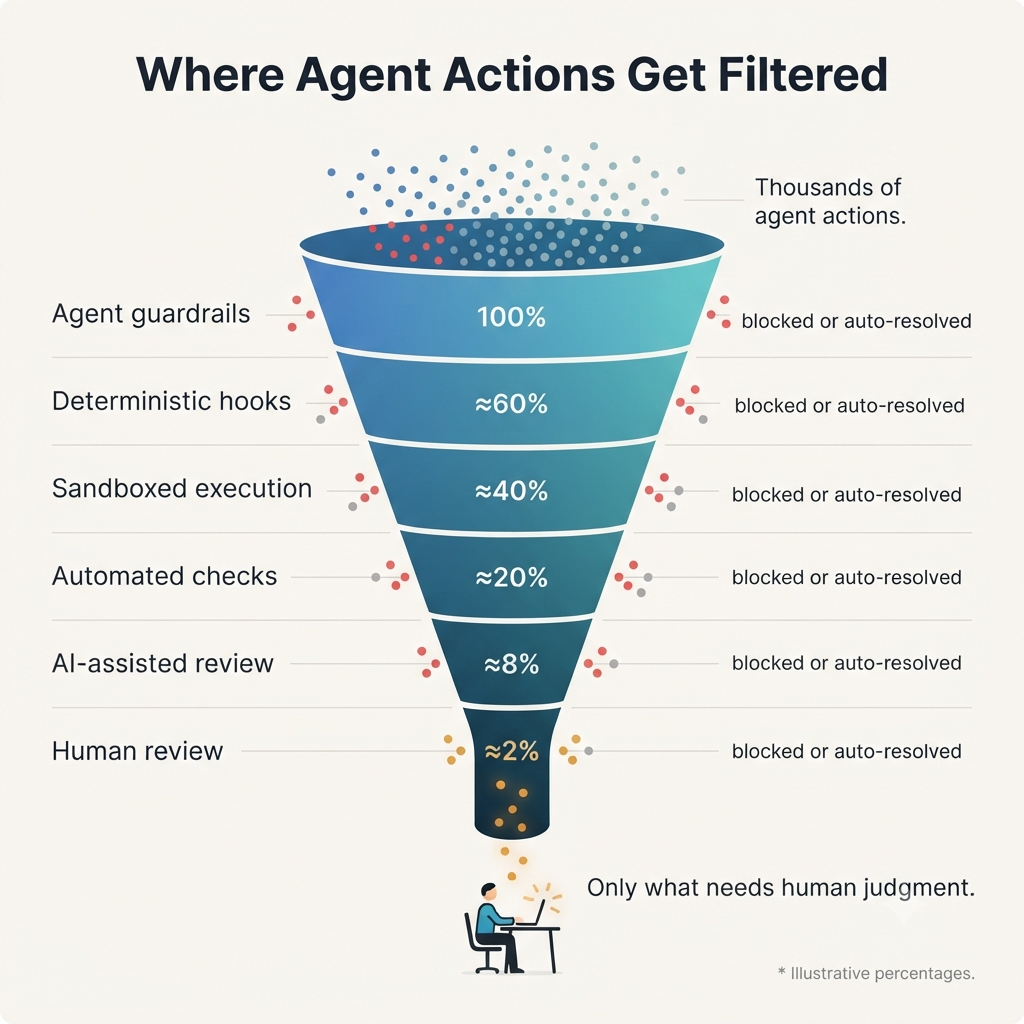
The goal isn’t to get rid of human review. It’s to make human review mean something again.
| Layer | Purpose | Human role |
|---|---|---|
| Agent guardrails | Prevent unsafe actions before they happen | Define policy |
| Deterministic hooks | Enforce organization-specific rules | Review exceptions |
| Sandboxed execution | Limit damage from mistakes or misuse | Set boundaries |
| Automated checks | Catch known classes of defects | Interpret failures |
| AI-assisted review | Surface suspicious changes at scale | Validate high-risk findings |
| Human review | Judge intent, architecture, product risk, and accountability | Approve only what matters |
In this model, people stop being universal diff inspectors. They become the designers of the control system. They decide which actions are allowed, which need approval, which paths are protected, which network destinations are trusted, and which changes need senior eyes.
What Leaders Should Measure Instead
“Merged PRs per developer” is a fine throughput metric, but it can’t be the main yardstick for success with AI-driven engineering.
Teams should also track:
- Review coverage: the share of high-risk changes that got substantive human review.
- Escaped-defect rate: security, reliability, or correctness issues found after merge.
- Change failure rate: rollbacks, hotfixes, production incidents, and customer-facing regressions.
- Policy enforcement rate: dangerous actions blocked by hooks, permissions, or sandbox rules.
- Review burden: queue depth, median review time, and how many PRs are waiting.
- Trust calibration: how often automated security findings turn out to be real versus noise.
The aim isn’t fewer PRs. It’s more confidence per merged PR.
Don’t Slow Innovation to Save Review
There’s a fair counterargument here: too many controls create friction.
If every file write needs approval, every command trips a gate, and every network request needs an exception, engineers will find workarounds. They might disable safeguards, paste code into uncontrolled environments, or just route around the process.
The answer is risk-tiered autonomy:
- Give agents wide freedom on low-risk work like documentation, tests, refactors, local experiments, and isolated feature branches.
- Tighten controls around credentials, infrastructure, CI/CD, payments, authentication, data access, and production paths.
- Auto-approve changes that are reversible and well scoped.
- Require human approval for anything irreversible, privileged, or high-impact.
- Make escalation fast, so security controls don’t become an excuse for stalled delivery.
Velocity and verification aren’t opposites. Poorly designed verification is what makes velocity unsafe.
From “Review Everything” to “Govern What Matters”
The future of engineering probably isn’t humans reading every line an AI writes. It’s humans designing the guardrails that make unreviewed lines less dangerous.
AI coding agents can raise output dramatically. But output without verification isn’t progress, it’s risk at scale. Organizations that treat the 79% PR increase as a pure win may find out too late that they optimized for merge speed while weakening the controls that keep software safe.
The teams that do well won’t be asking, “How do we review more AI-generated code?”
They’ll be asking, “How do we make it safe for AI-generated code to reach a reviewer in the first place?”
A green CI check is not consent.
A merged PR is not assurance.
Human approval is not oversight if humans no longer have the capacity to review.