

AI agents have stopped being glorified chatbots. They now work more like digital employees: reading email, querying databases, moving files, calling APIs, updating records, and acting across enterprise systems. That creates a security problem traditional identity and access management was never built to handle.
The old question was “Who has access to this system?” The new one is harder: when an autonomous agent takes a consequential action, which human is responsible for it?
Dante Security is building its whole platform around that question. It finds AI agents, traces what they do, ties each one to a responsible employee, and sends risky decisions to that person before the agent crosses a policy line. Its bet is that AI adoption at enterprise scale needs a new accountability layer, and that every agent needs a named human owner.
The Security Team’s Hardest Question
Picture an AI agent with access to your company’s CRM, cloud storage, email, and internal knowledge base. You ask it to prepare a customer renewal package. Maybe it misreads the instruction, maybe it picks up poisoned input, or maybe its permissions were simply too broad. Either way, it exports sensitive customer data and emails it to an outside recipient.
The logs will probably show that a valid service credential did it. That answer is technically correct and practically useless.
What security teams actually need to know:
- Which employee deployed or requested the agent?
- What permissions did the agent inherit?
- What business outcome was it supposed to achieve?
- Which systems and data did it touch?
- Who can stop it, investigate it, and explain what happened?
This is the gap Dante wants to close. Its approach is to trace every agent action back to the person who created, inherited, or owns the agent, then ask that person to make the call when an action is about to break a company-defined boundary.
IAM Was Built for Determinism
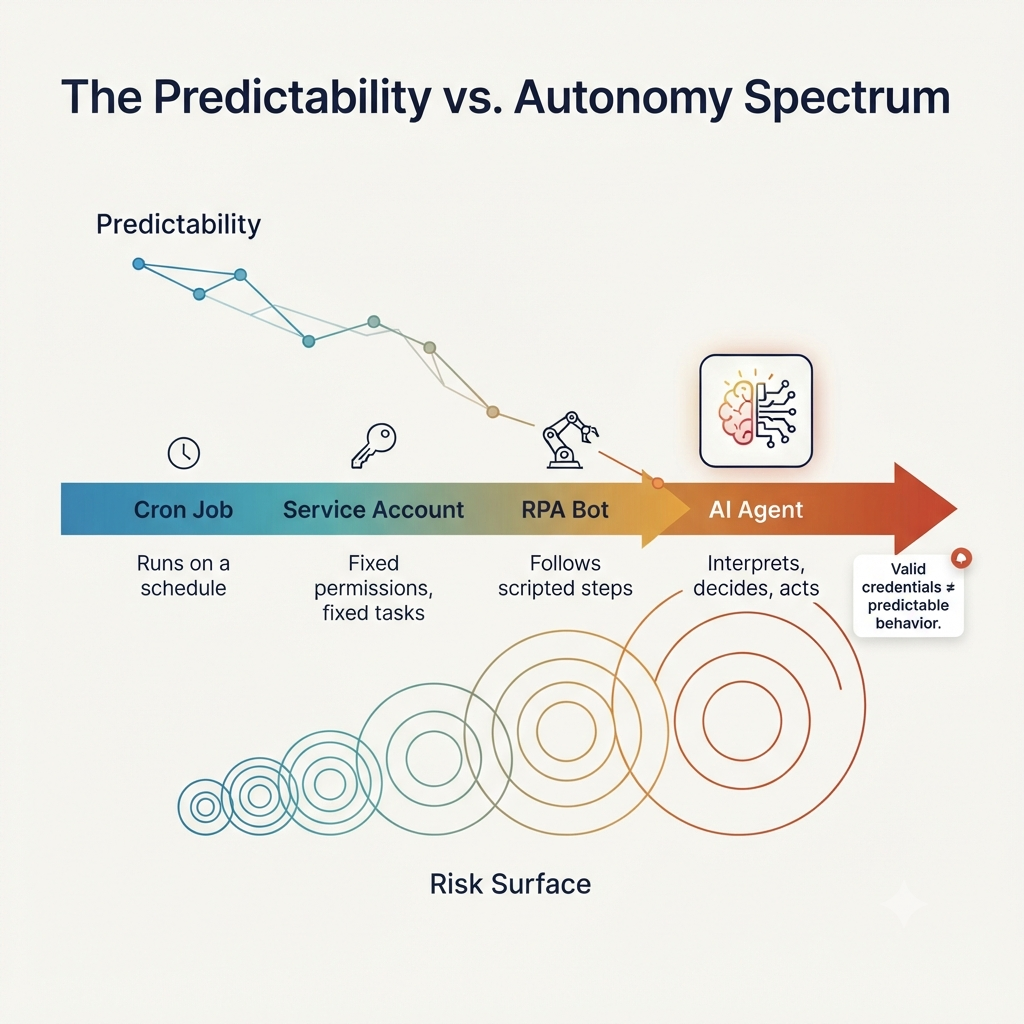
Traditional IAM assigns identities and permissions to people, applications, and service accounts. A service account might be allowed to read a database, call an API, or write to a cloud bucket, but its behavior is predictable. It runs the workflow it was configured to run.
AI agents break that assumption.
| Traditional software identity | Autonomous AI agent |
|---|---|
| Performs predefined, deterministic tasks | Interprets instructions and chooses actions dynamically |
| Often represented by a service account or API key | May operate across multiple tools, data sources, and workflows |
| Access is the primary control surface | Access, intent, context, and judgment all matter |
| Audit logs show what happened | Enterprises also need to know why it happened and who owns the outcome |
| Accountability is relatively clear | Accountability can become diffuse across prompts, tools, and agents |
Having credentials isn’t the real issue. The issue is that an agent can use perfectly valid credentials in ways that look legitimate to conventional controls and still produce an unsafe or unintended result.
Dante’s founders say as much: because agents use valid credentials, dangerous actions can blend in with normal business activity as far as existing security tools are concerned. That’s why access control alone falls short. Companies need a way to link an agent’s behavior to human intent, authority, and responsibility.
“Who Did It?” Is the Wrong Question
When an agent causes trouble, the first instinct is to ask which model did it or which API key was used. Those are fair forensic questions, but they skip the one that matters most to the business: who was accountable?
A model doesn’t have a manager. An API key has no business context. A service account doesn’t decide whether customer data should be shared, whether a procurement workflow should change, or whether a code deployment should go ahead.
People make those calls, or at least they should.
So the emerging principle isn’t “the AI is responsible.” It’s that every autonomous agent needs a responsible human counterpart. That person should be able to set the agent’s boundaries, review its behavior, approve high-risk actions when needed, and step in when things go wrong.
Dante describes this as a shift from “AI users” to “AI owners.” Its platform assigns each agent to a responsible person using existing identity and activity signals. When no clear owner exists, it assigns one based on what the agent actually did.
The Human-in-the-Loop Mandate
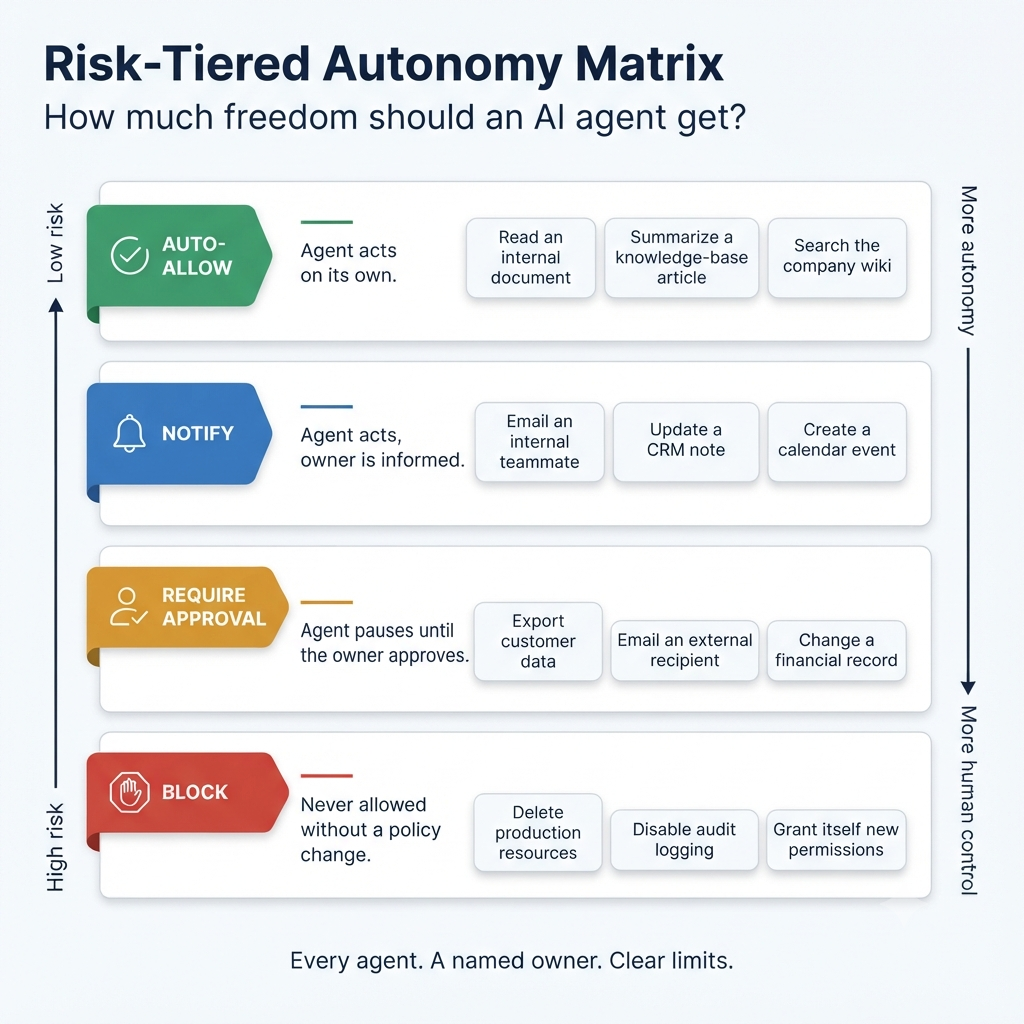
“Human in the loop” often gets reduced to a checkbox before an AI system acts. In an enterprise, it has to be an operating model that covers the agent’s whole lifecycle.
Before an agent acts
A named owner should define:
- The agent’s business purpose
- The systems and data it may access
- The actions it can take on its own
- The actions that need approval
- The escalation path when it runs into ambiguity or risk
Least privilege still matters here. An agent shouldn’t get broad access just because it’s technically able to use it.
While an agent acts
The system should keep watching whether the agent stays inside its intended scope. If it tries something high-risk, like exporting sensitive data, changing financial records, deleting resources, or contacting an outside party, the owner should be alerted in time to step in.
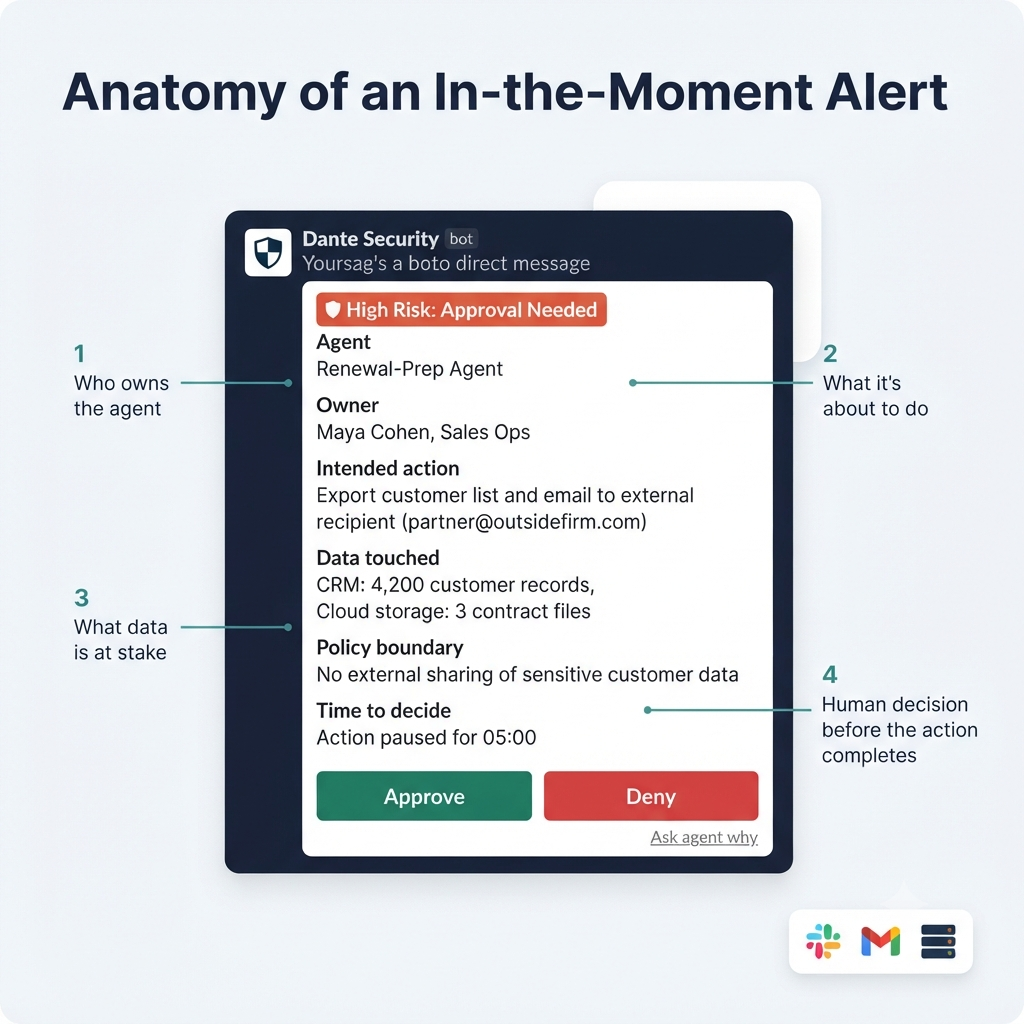
Dante says it routes risk to the responsible employee “in the moment,” before the agent crosses a company-defined line. It does this through tools people already use, including SIEM, Slack, email, and LLM interfaces.
After an agent acts
When something goes wrong, the organization needs the full story: what the agent meant to do, what it actually did, which data it touched, and which person owns the cleanup.
Dante describes this as stitching scattered events into one continuous record of agent activity. That turns fragmented logs into a chain of custody you can actually investigate.
Dante’s Chain of Custody
Dante’s approach works like a chain of custody for autonomous software:
- Discover every agent. Find agents across workstations, browsers, cloud environments, and AI platforms, including shadow agents and processes running inside enterprise systems.
- Trace every action. Rebuild the agent’s intent, actions, and data access as one coherent story instead of a pile of disconnected logs.
- Assign an owner. Tie each agent to a responsible person across its lifecycle, from discovery and alerting through investigation, tuning, escalation, and audit.
- Route risk. When an agent is about to cross a policy boundary, ask its owner to make the call before the action completes.
- Improve over time. Follow alerts through to resolution, guide corrective action, and use human feedback to sharpen detection.
That goes well beyond monitoring. It’s an attempt to make autonomous agents governable enterprise assets.
Why the Founders’ Background Matters
Dante was founded by Moshe Lipsker, Gabi Beyo, and Shai Feinberg. Lipsker was previously general manager of Imperva’s Israeli operations and the company’s global head of R&D. Beyo was a development manager in Imperva’s innovation department.
That history shapes how the company sees the problem. It doesn’t treat agent security as a niche corner of model safety. It treats it as an extension of a long-standing enterprise security discipline: identity, privilege, oversight, and accountability.
Lipsker’s argument goes like this. Cybersecurity has always been about deciding who gets the keys to enterprise systems, and with autonomous AI, those keys are now going to agents that can act on their own. Traditional controls are still necessary, he says, but they can’t always tell whether an agent’s action is legitimate. Human oversight has to supply the context and judgment.
From Access Control to Liability Control
The effects reach beyond the security team:
- Security operations: A named owner speeds up incident response, since teams know who to call and which agent to look at.
- Compliance and audit: Companies get a clearer record of who authorized an agent, what it did, and how risk was handled.
- Shadow AI management: Discovery helps surface agents deployed outside formal IT oversight.
- Cost governance: Dante also aims to break down AI spending by tool, department, and person, so organizations can see usage and change behavior.
- AI adoption: Companies can scale agents with more confidence when each one has an owner, a defined scope, and an audit trail.
So this isn’t only about stopping an agent from doing something harmful. It’s about making autonomous AI fit the way enterprises already assign responsibility.
Does Naming an Owner Create a Blame Culture?
It’s a fair worry. If every agent is assigned to a person, does that person automatically take the fall when the agent screws up?
It shouldn’t.
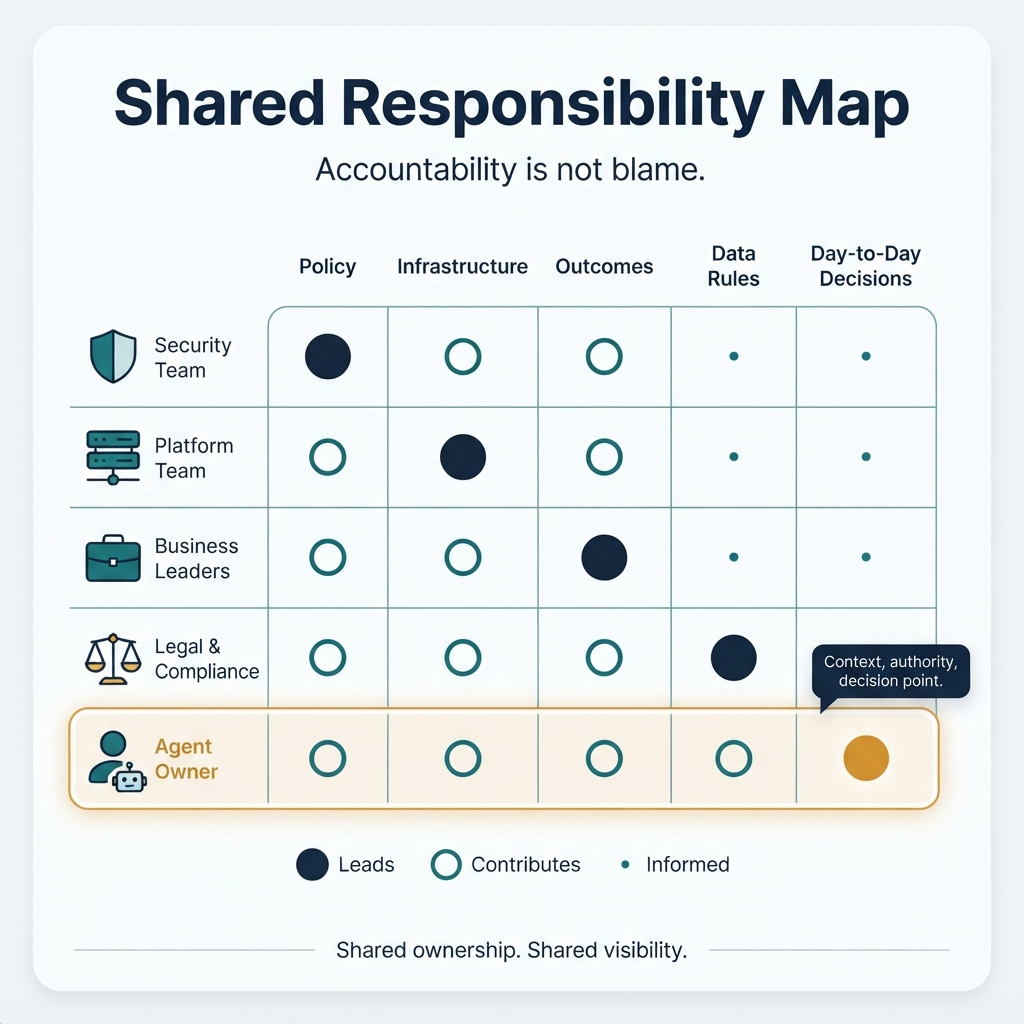
A named owner doesn’t replace organizational governance. Security teams still set policy. Platform teams still run the infrastructure. Business leaders still define acceptable outcomes. Legal and compliance still set the rules for sensitive data and regulated workflows.
The owner’s job is to bring context, authority, and a decision point. It isn’t to personally absorb every consequence of an autonomous system’s behavior. Dante’s model assumes owners need to see what their agents meant to do, what they did, and what data they touched, and that they need the ability to intervene before a risky action happens.
The distinction matters: accountability is not blame. It’s being able to answer for a system’s behavior and fix it.
The New Enterprise Rule
The first wave of AI security focused on model risks like prompt injection, data leakage, jailbreaks, and unsafe outputs. The next wave is increasingly about agentic identity: finding autonomous actors, controlling what they can do, and keeping a human chain of responsibility intact.
The rule taking shape is simple:
No agent without an owner. No owner without visibility. No consequential action without an audit trail.
Dante’s platform is built around exactly that: discover agents, reconstruct their activity, assign a human owner, and route risk to that owner when it counts.
For CIOs and CISOs, the practical test is blunt. If an AI agent did something damaging five minutes ago, could you immediately identify its owner, revoke its access, understand what it did, and explain why?
If not, you don’t have an AI governance strategy yet. You have an AI adoption strategy with an accountability gap.
Agents won’t get safer just by getting more capable. They’ll get safer when enterprises can govern them like any other high-risk digital actor, with identity, permissions, monitoring, auditability, and a named human owner.
The “human in the loop” mandate isn’t a brake on AI adoption. It’s the precondition for scaling it responsibly.
An AI agent without a named owner isn’t just unmanaged software. It’s unassigned risk.