
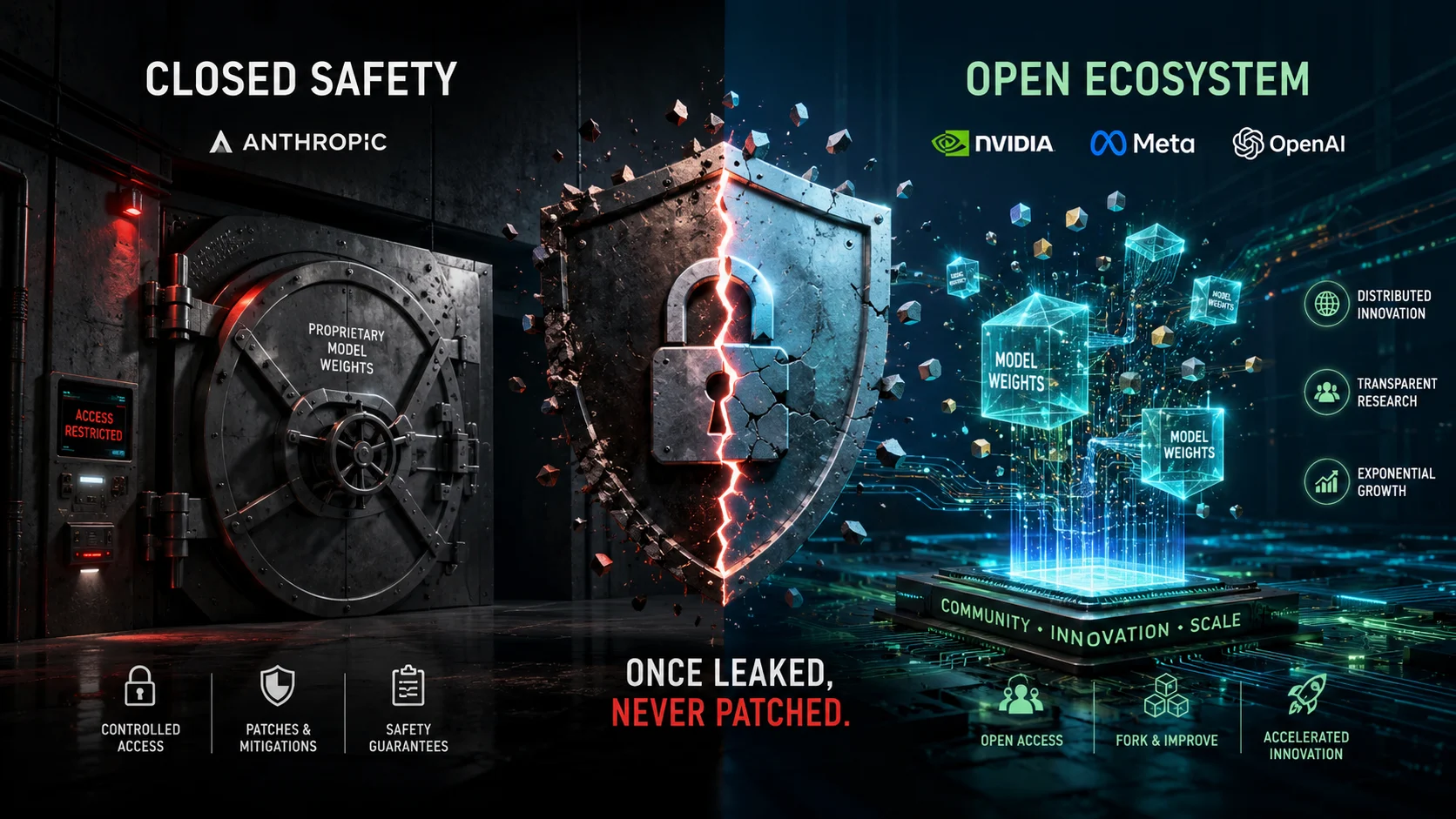
Anthropic has thrown a grenade into AI’s biggest power struggle. Model weights, once released to the public, cannot be taken back, patched, or safely recontained.
With top open-source models reaching millions of downloads and triggering mandatory safety debates in Washington, if a frontier model can be copied forever, how do you enforce guardrails after a leak?
The answer matters right now, because the split over open-source AI is no longer just ideological—it is becoming a multi-billion-dollar fight over which business model gets to define the future of safety. 
So what happens after the weights are gone?
Why This Split Matters
Open-source AI is often sold to developers as the ultimate path toward innovation, accessibility, and software freedom. However, Anthropic’s central argument is that freedom without centralized control can turn into permanent operational risk.
- Permanent Distribution: Unlike hosted API endpoints, released weight files live on thousands of personal servers.
- Irreversible Flaws: Security vulnerabilities or capability leaks cannot be fixed with a server-side patch.
- Unmonitored Misuse: Creators cannot retroactively track or restrict how downstream fine-tunes operate.
But here’s the uncomfortable part: once weights leak into the wild, the damage cannot be undone with a simple Terms-of-Service update.
Who Benefits from Openness?
The debate over open-source safety isn’t taking place in a vacuum; every player in the AI stack has massive financial incentives driving their policy stance.
| Company Group | What They Gain from Openness | Risk They Downplay |
|---|---|---|
| Hardware Sellers (e.g., Nvidia) | Soaring compute demand across millions of local nodes. | Harder to monitor downstream misuse. |
| Open Ecosystems (e.g., Meta) | Faster ecosystem adoption and massive crowdsourced R&D. | Loss of centralized safety enforcement. |
| Safety-First Labs (e.g., Anthropic) | Protected moat via subscription APIs and tight control. | Slower software distribution & lock-in concerns. |
That raises a bigger question: are safety arguments being used to protect commercial software moats?
What Anthropic Is Really Arguing
Anthropic clarifies that it isn’t seeking a blanket ban on open models, but rather targeting high-risk frontier capability thresholds.
“Once model weights are public, control shifts from the developer to the entire internet—and that changes what safety even means.”
The real issue is not openness itself, but whether frontier capabilities change the fundamental rules of software distribution.
#Newsfatafat | Anthropic CEO Dario Amodei has clarified that the AI company is not seeking a ban on open-weight AI models, following criticism from across the technology industry.
— ET NOW (@ETNOWlive) July 28, 2026
Amodei said the focus should instead be on preventing advanced chips from reaching adversaries,… pic.twitter.com/CJmnfHmHHR
Official documentation on Anthropic’s Transparency Policy outlines the lab’s risk evaluation frameworks. Simultaneously, CEO Dario Amodei detailed Anthropic’s position on open-weights, calling for mandatory safety testing rather than outright bans. Meanwhile, reporting from The Guardian highlights how tech giants like Meta and Nvidia are rallying behind open ecosystems.
What This Means for the Industry
And this is where the debate sharpens: as open-weights models close the performance gap with proprietary frontier models, regulators are being forced to take sides.
This is not a debate about whether AI should be shared. It is a debate about whether frontier AI can be safely shared at all.