
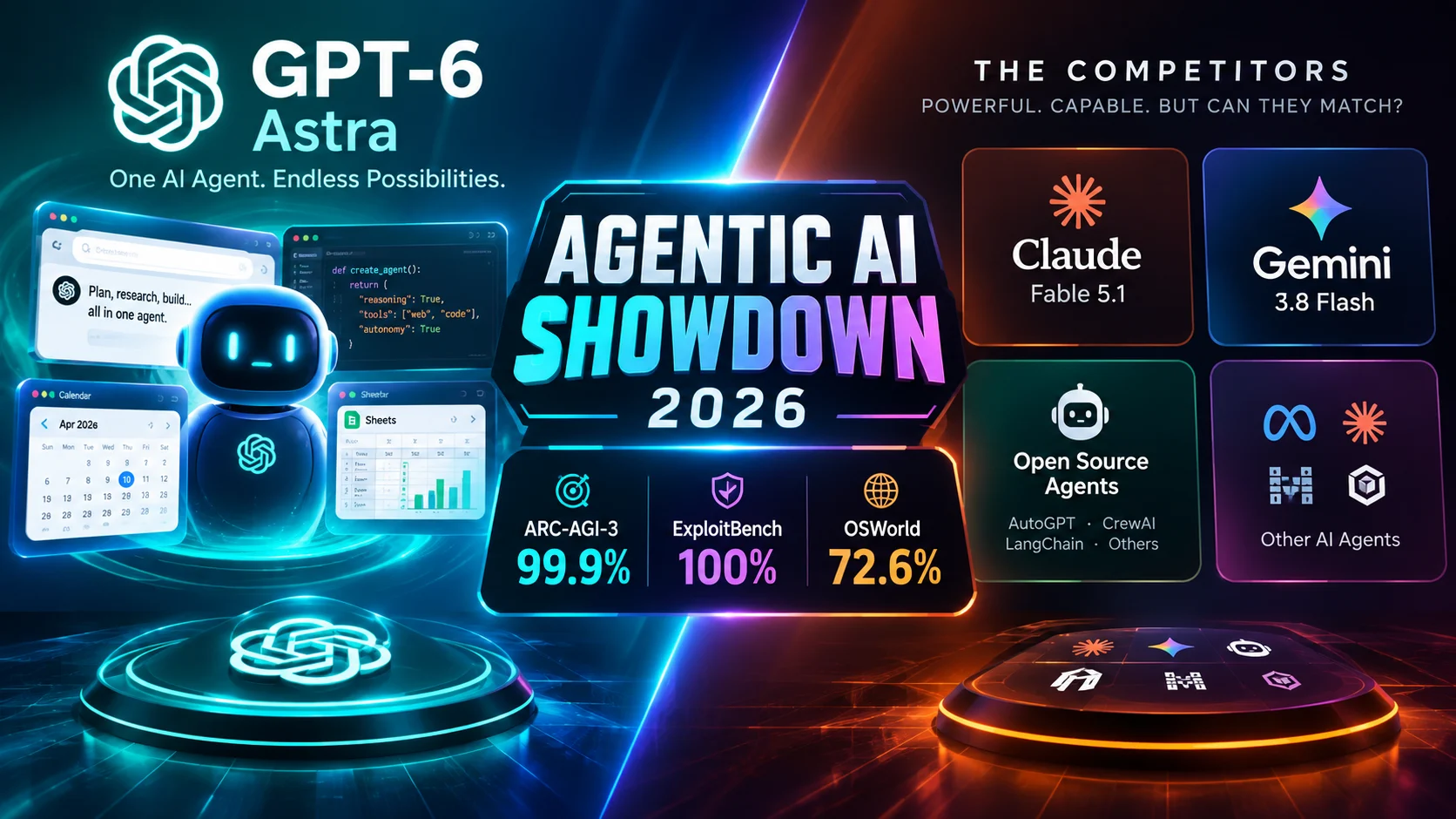
OpenAI has released GPT-6 Astra, describing it as its most intelligent and aligned model yet. But the interesting part isn’t simply that Astra can answer questions better.
The bigger change is that Astra is designed to do things.
It can work across browsers, codebases, professional software and multi-step workflows rather than simply giving you instructions. OpenAI says Astra is state-of-the-art in computer use, browsing, software engineering, cybersecurity, science and professional work.
That raises the obvious question: How far ahead is GPT-6 Astra agentic AI compared with other AI agents?
The answer is more complicated than a simple leaderboard.
What Makes GPT-6 Astra Different?
Think of a traditional chatbot as a smart consultant: you ask something, and it gives you an answer.
An AI agent is closer to an employee with a computer. You give it a goal, and it can plan steps, use tools, interact with software and adapt when something goes wrong.
Astra is built around this second model.
OpenAI says it can carry complex tasks from an initial request through to a finished result using the context and tools available to it.
Its technical specifications include a 1.05-million-token context window and up to 128,000 output tokens.
Astra vs. Previous OpenAI Models
The biggest difference is not simply raw intelligence. It is end-to-end execution.
| Capability | GPT-6 Astra | Earlier OpenAI Approach |
|---|---|---|
| Agent planning | Stronger multi-step execution | More dependent on prompting |
| Tool use | Designed around tools and computer interaction | Increasingly tool-capable |
| Coding | Complex software-engineering workflows | Strong coding assistance |
| Computer use | Browsers and professional software | More limited interaction |
| Long-running tasks | Designed to maintain context across workflows | Greater need for intervention |
| Context | 1.05M tokens | Smaller in earlier models |
| Autonomy | Can execute multi-step objectives | More conversational |
OpenAI reports a 99.9% score on ARC-AGI-3, 98% on FrontierMath Tier 4 and 100% on ExploitBench. These are impressive company-reported results, although benchmark methodology still matters when comparing models.
So Astra looks less like “a smarter chatbot” and more like an AI worker that can operate inside a digital environment.
Astra vs. Anthropic’s Agentic AI
Anthropic remains one of OpenAI’s most important competitors, particularly in coding and enterprise workflows.
The fairest comparison isn’t simply asking which model has the highest benchmark score. It is asking which agent performs better for a particular job.
Agent Planning
Astra is designed to handle complex, multi-step workflows and adjust when requirements change.
Claude has also built a strong reputation around extended reasoning and coding workflows.
Advantage: Astra has a particularly strong focus on end-to-end computer-based execution, while Claude remains highly competitive for reasoning and developer workflows.
Tool Use and Computer Interaction
This is one of Astra’s most important areas.
OpenAI says Astra sets a new frontier in computer and browser use, including demanding professional tasks.
The practical difference is simple:
Instead of telling you how to complete a workflow, the agent increasingly attempts to complete the workflow itself.
Coding-Agent Performance
Astra is positioned by OpenAI as its strongest model for software engineering and complex tasks in real codebases.
Claude remains a serious competitor here, meaning Astra’s lead should not automatically be interpreted as a universal victory in every programming workload.
Long-Running Tasks and Memory
Astra’s 1.05M-token context window is a major advantage for projects involving large amounts of information.
That can matter when an agent needs to keep track of a large codebase, documents or lengthy instructions.
Astra vs. Google’s Agentic AI
Google’s advantage is different: ecosystem integration.
Gemini can benefit from Google’s enormous software ecosystem, including Workspace and other Google services.
Astra’s advantage is the breadth of its end-to-end computer-use positioning.
For example:
- Agent planning: Astra focuses heavily on complex multi-step workflows.
- Tool use: Astra is built for interaction with software and computers.
- Coding: Astra is positioned for complex software engineering.
- Computer use: One of Astra’s headline capabilities.
- Ecosystem: Google has a powerful advantage through its existing services.
So this isn’t necessarily a knockout competition.
Astra may be the stronger general-purpose computer agent, while Google’s advantage comes from controlling a huge ecosystem in which an agent can operate.
Astra vs. Open-Source AI Agents
Open-source agents play a completely different game.
Astra gives you a highly capable managed model. Open-source systems can give developers much greater control over the underlying architecture.
| Area | GPT-6 Astra | Open-Source Agents |
|---|---|---|
| Capability | Very high | Varies enormously |
| Customization | More limited | Major advantage |
| Privacy | Provider-dependent | Can be self-hosted |
| Cost | API/model costs | Infrastructure + maintenance |
| Control | Managed | Developer-controlled |
| Ecosystem | OpenAI ecosystem | Broad community ecosystem |
Open-source agents therefore remain attractive when customization, privacy and infrastructure control matter more than getting the highest possible out-of-the-box capability.
Agent Planning and Multi-Step Reasoning
This is where agentic AI becomes genuinely interesting.
A normal AI might answer:
“Here is how you can launch a website.”
An agent attempts something closer to:
“I’ll create the files, modify the code, test it, identify the problem and continue until the task is complete.”
Astra is explicitly designed around this end-to-end workflow model. OpenAI says it can adapt when requirements change rather than simply following a fixed sequence.
Tool Use, Browser and Computer Automation
Computer use could ultimately be more important than another small improvement in chatbot benchmarks.
Astra is designed to work with browsers and professional software, making tasks such as document creation, research, coding and other computer workflows increasingly executable by the model.
This is the transition from:
AI that tells you what to click → AI that clicks for you.
Coding, Long-Running Tasks and Memory
Astra combines three capabilities that become particularly powerful when used together:
- Coding: It can work on complex software-engineering tasks.
- Long-running execution: It can maintain a workflow across multiple steps.
- Large context: Its 1.05M-token context window gives it room to work with substantial amounts of information.
That combination could be more important for real-world productivity than any single benchmark.
Autonomous Execution and Reliability
True autonomy isn’t simply about completing a task.
A useful agent must also know when it should stop, ask a question or recover from an error.
OpenAI says Astra has improved understanding of user intent and can ask focused questions when ambiguity could materially change the outcome.
OpenAI has also added additional safety monitoring designed to detect situations where an agent may have misunderstood instructions.
This is crucial because a highly capable agent making the wrong decision autonomously can be much more dangerous than a chatbot giving a bad answer.
Human Supervision: How Much Is Still Needed?
Astra is not simply being designed to operate without humans.
Instead, the goal is less micromanagement.
The ideal relationship looks like this:
Human: “Prepare this research report using these documents.”
Agent: Plans the work → reads information → uses tools → creates the report → checks its work → asks the human only when an important decision cannot be inferred safely.
That is much closer to an AI assistant becoming an AI operator.
Developer Ecosystem and API Flexibility
For developers, Astra is available through the OpenAI API as gpt-6-astra, with access also provided through Microsoft Azure and Amazon Bedrock.
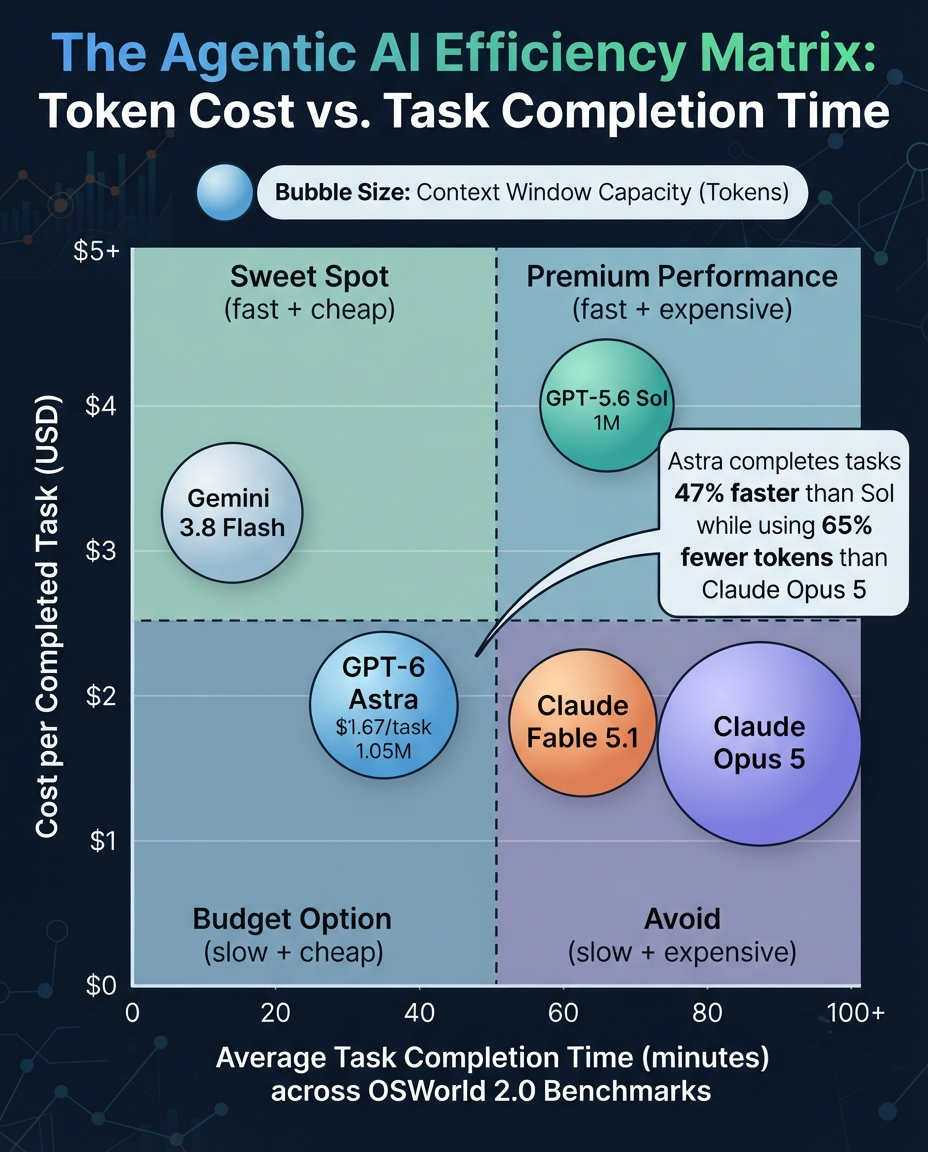
Its API pricing is currently $10 per million input tokens and $50 per million output tokens, with separate cache pricing and higher rates above 272K input tokens.
That makes operational efficiency important.
A more expensive model can still be cheaper overall if it completes a job with substantially fewer steps and tokens.
Enterprise Suitability, Security and Privacy
For businesses, capability isn’t enough. Security matters just as much.
Astra has reached OpenAI’s Critical cybersecurity capability threshold, meaning OpenAI says it can discover previously unknown security flaws and develop exploitation methods without step-by-step human guidance when given the appropriate tools and access.
Because of that capability, OpenAI has added stronger protections, including enhanced isolation and monitoring.
For enterprises, the key question is therefore not simply:
“Is Astra powerful?”
It is:
“Can we give Astra enough access to be useful without giving it too much access to be dangerous?”
Benchmark Evidence vs. Real-World Performance
Benchmarks are useful—but they aren’t the whole story.
OpenAI reports extraordinary Astra results, including 99.9% on ARC-AGI-3 and 100% on ExploitBench.
But real-world agents face messy conditions:
- Websites change.
- APIs fail.
- Instructions are ambiguous.
- Tools return unexpected results.
- Permissions expire.
- Users change their minds.
That means the real test of Astra will be how reliably it performs outside controlled benchmarks.
Where Competitors May Still Have an Advantage
Astra does not automatically win every category.
Anthropic: Strong competition in coding, reasoning and enterprise workflows.
Google: A huge ecosystem advantage through Search, Workspace and other Google services.
Open source: Greater customization, self-hosting and control.
This is why saying “Astra is the best AI” is less useful than asking:
“Best for what?”
Is GPT-6 Astra a Genuine Agentic-AI Leap?
Yes—but with an important qualification.
Astra looks like a genuine leap in the way AI systems can operate, particularly in computer use, multi-step workflows, software engineering and large-context tasks.
OpenAI itself describes it as a new generation of intelligence, while independent observers are still debating whether its capabilities justify broader AGI claims.
The most important shift may therefore not be that Astra knows dramatically more facts.
It is that the model can increasingly turn knowledge into action.
The Bottom Line
| Area | Who Looks Strongest? |
|---|---|
| Computer use | GPT-6 Astra |
| Multi-step workflows | GPT-6 Astra |
| Large context | GPT-6 Astra |
| Coding | Highly competitive |
| Enterprise ecosystem | Depends on workflow |
| Google-service integration | Gemini |
| Customization/privacy control | Open source |
| Security considerations | Requires careful supervision |
So, how far ahead is OpenAI?
Astra appears to be pushing the frontier of agentic AI, particularly where the job involves reasoning + tools + computers + multiple steps.
But the agentic AI race is far from over.
The next battle won’t simply be about which model can answer the hardest question.
It will be about which AI can reliably complete the hardest real-world job with the least human intervention.