

Online shopping used to be a chore of clicks: search, compare, add to cart, type in payment details, hit “Place Order.” That’s changing. An AI agent now does most of the legwork, and you give one deliberate go-ahead at the end. The real innovation isn’t “buying with your voice.” It’s turning the final purchase into a secure approval moment where a person still has the last word.
The Checkout Is Disappearing
For about twenty years, shopping online has been a screen-first ritual. You searched, filtered, compared prices, filled a cart, typed in shipping and payment info, double-checked everything, and clicked the final button.
Agentic commerce splits that work differently. You say what you want (“Restock my usual coffee before Friday”) and an agent finds options, checks availability, compares prices, builds the cart, and gets checkout ready. Voice shopping already handles discovery, comparisons, reorders, and completed purchases. The next step is making all of that ambient instead of trapped inside a shopping app.
So the question isn’t really whether an AI agent can shop anymore. It’s how much friction should remain at the exact moment money changes hands.
“Voice Approval” Is Not the Story
The easy headline is that a platform lets you approve purchases by voice, no browser needed. That treats voice as a swap for the checkout button.
But that misses the bigger shift. Voice is the approval surface, not the whole commerce system. The agent does discovery, evaluation, cart building, and checkout prep out of sight. What’s left for you is a narrow, intentional control point.
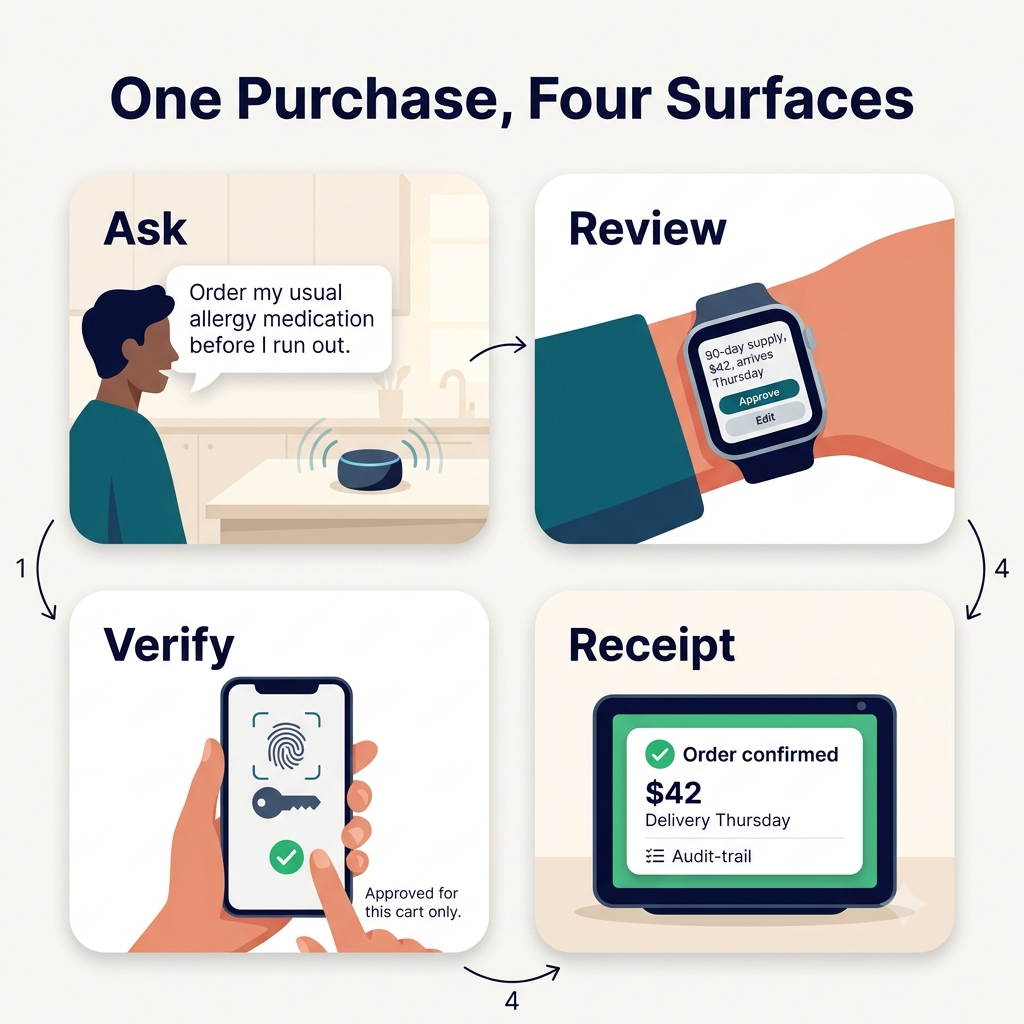
Screenless commerce doesn’t mean “no interface.” It means the interface shows up only when needed, in context, and stays minimal: a spoken request in the kitchen, a short proposal on your phone or watch, and a verified spoken confirmation.
From Screens to Ambient Commerce
| Traditional e-commerce | Ambient agentic commerce |
|---|---|
| User searches, filters, compares, and selects | Agent interprets intent and performs discovery |
| User manually adds products to a cart | Agent builds and revises a proposed cart |
| User enters or selects payment details | Stored, tokenized credentials are used under policy |
| User reviews a screen and clicks “Place Order” | User gives a scoped verbal approval |
| The interface is the primary control surface | Voice, passkeys, and trusted devices become control surfaces |
Picture this exchange:
User: “Order my usual allergy medication before I run out.”
Agent: “I found your preferred 90-day supply at $42, arriving Thursday. I excluded a higher-priced alternative. Approve the $42 purchase?”
User: “Approve.”
That isn’t a chatbot replacing e-commerce. It’s an approval protocol replacing a checkout workflow.
The Human-in-the-Loop Bottleneck
Calling human approval a “bottleneck” suggests we should get rid of it. In commerce, we shouldn’t. It’s a trust and safety check, and the job is to make it radically efficient.
A sound setup keeps autonomous work separate from consequential action. The agent can research, compare, prepare, and stage a transaction, but it stops before payment. Purchases can’t be undone easily, so that’s where human oversight matters most. The system should verify who you are, describe exactly what’s about to happen, and grant permission only for that task.
Roughly, the split looks like this:
- Low-risk work: product search, availability checks, price comparison, and cart drafting.
- High-risk work: payment authorization, subscription commitments, address changes, and purchases above a set threshold.
- Human role: approve, edit, reject, or defer, rather than operate every step.
The goal isn’t to take people out of the loop. It’s to take the unnecessary labor out of it.
Anatomy of a Voice-First Approval Protocol
A credible ambient checkout needs more than a microphone and a payment API. It needs a clear protocol that makes the agent’s proposal easy to understand and the user’s approval meaningful.
- Intent capture. The user states an outcome, constraint, budget, timing, or replenishment rule.
- Agent planning. The agent identifies candidate products, merchants, delivery windows, and total cost.
- Cart staging. The agent builds a proposed order without charging anyone.
- Context briefing. The system summarizes what’s being bought, from whom, at what price, and when it arrives.
- Identity verification. Voice alone isn’t enough. Pair it with a passkey, device presence, a biometric check, or a trusted-device challenge.
- Scoped authorization. The approval covers a specific cart, amount, merchant, and time window. It is not a blanket “let AI buy things.”
- Execution and receipt. The agent pays only after approval, then sends back a clear confirmation.
- Audit trail. The system records the proposal, the inputs, who approved it, the scope of the approval, and the final transaction.
Whatever the system does, the user should see the exact action, target, amount, and content, and be able to approve, edit, or reject before anything actually happens.
Why “Yes” Is Not Enough
A one-word confirmation feels effortless, but it can’t carry the whole trust model. “Yes” has to authorize a specific, inspectable proposal, not an open-ended mandate.
Voice brings real risks: misheard requests, ambiguity, background noise, impersonation, replay attacks, accidental approvals in shared spaces, and pressure to say yes without enough context. Agents can also simply get things wrong, like the product, quantity, price, delivery address, or subscription terms.
The fix is a “brief but complete” approval:
- State the item, seller, price, delivery date, and total.
- Let people correct things before execution: “Use the cheaper option,” “Remove the second item,” or “Change delivery to Friday.”
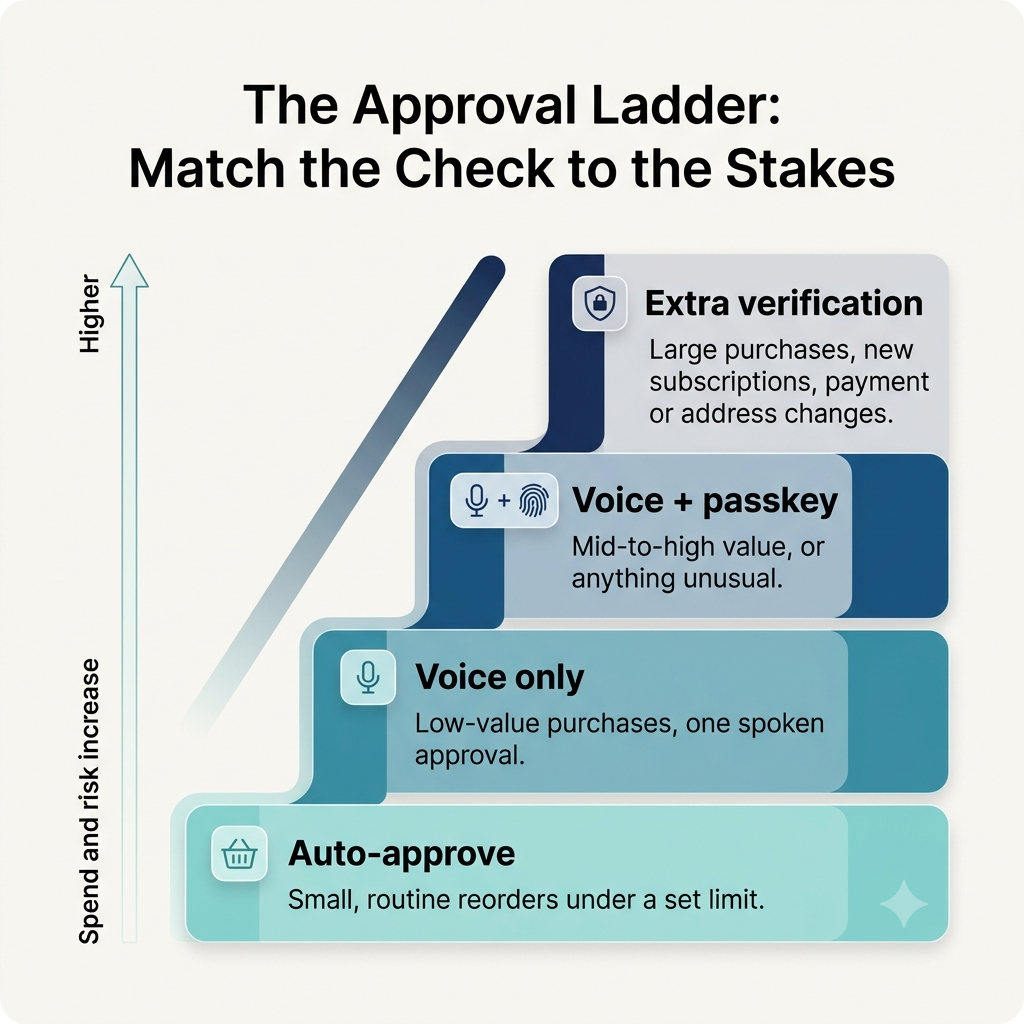
- Require a second factor for high-value, unusual, or recurring transactions.
- Keep the task alive after a rejection so users can refine it instead of starting over.
- Give a visible or spoken audit trail after the purchase.
Human-in-the-loop design should be triggered by consequence, not just by how confident the model feels. If an action is costly to reverse, hard to verify, or financially significant, the system should propose it and the human should commit to it.
Voice Plus Passkeys, Not Voice Alone
Ambient voice approval needs layered identity checks. Voice is convenient, but it should never be the only proof that the right person is approving a purchase.
Passkeys are FIDO cryptographic credentials tied to your account and a specific online service. They use public-key cryptography and are designed to resist phishing. You authenticate the same way you unlock your device, with a fingerprint, face scan, PIN, or pattern.
A stronger model combines:
- Voice for convenience and confirming intent.
- Passkeys for cryptographic, phishing-resistant identity verification.
- Device presence to make sure approval happens on a trusted device.
- Transaction context so the approval is tied to a particular cart, amount, and merchant.
Passkeys are bound to the service’s origin, which keeps credentials from being replayed on phishing sites. NIST guidance, as cited by the FIDO Alliance, recognizes synced passkeys as meeting Authentication Assurance Level 2 and device-bound passkeys as meeting Level 3. It also treats correctly deployed synced passkeys as phishing-resistant.
For agent-initiated purchases, approval should also be scoped and revocable. You might okay a $50 grocery reorder without okaying a $1,200 electronics purchase, a new subscription, or a change to your saved payment method.
UX Engineering Principles
Product teams should think of the approval moment as the new checkout page. It has to be fast, understandable, correctable, and safe.
- Make the proposal clear in under 10 seconds. Something like: “Buy two boxes of oat milk from FreshMart for $11.80, delivered Tuesday.”
- Separate browsing freedom from spending authority. Let agents research freely, but require explicit approval for payment.
- Use progressive disclosure. Offer a one-line spoken summary, with a detailed cart available by voice or on screen if wanted.
- Design for correction, not just confirmation. Commands like “change the size” or “use the lower-priced option” should work naturally mid-flow.
- Make rejection painless. A “no” should keep the context so the user can tweak the request.
- Support interruption and takeover. Users should be able to stop the agent, look at the details, or finish the purchase manually.
- Log consequential actions. Record what was proposed, what data informed it, who approved it, and what actually ran.
The best approval interface isn’t necessarily the one with the fewest words. It’s the one that gives people enough context to decide well without dragging them back into a traditional checkout flow.
What Merchants Must Build
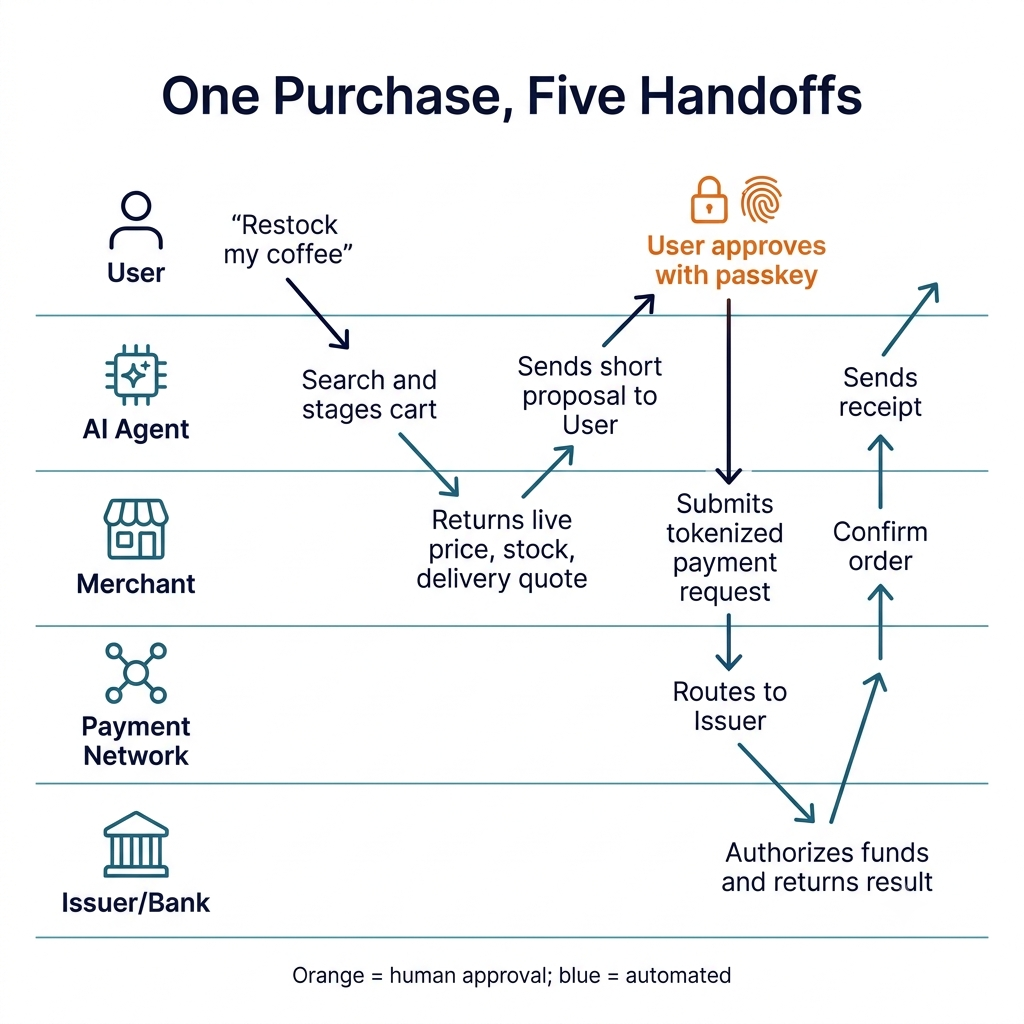
Ambient commerce will expose weak product data and rigid checkout systems. Merchants need infrastructure that agents can read reliably and securely.
- Machine-readable product data: availability, variants, price, delivery estimates, return terms, and compatibility.
- Agent-ready checkout APIs: cart creation, quotes, tax and shipping calculation, payment tokenization, and order-status updates.
- Policy controls: spending limits, merchant allowlists, category restrictions, time windows, and recurring-purchase rules.
- Receipt and dispute flows: clear proof of authorization, itemized orders, cancellation options where possible, and support paths when an agent makes a mistake.
- Trust signals: an explanation of why the agent picked a product and which alternatives it considered.
The FIDO Alliance is already working with card networks, issuers, merchants, payment providers, and standards bodies on phishing-resistant authentication, checkout delegation, and agent-initiated commerce.
The New Conversion Metrics
Once checkout becomes an authorization moment, the usual funnel metrics need some company. Teams should track:
- Proposal acceptance rate.
- Time from intent to authorization.
- Approval abandonment rate.
- Correction rate before purchase.
- False-approval and dispute rate.
- Authorization-scope reuse.
- Customer trust, complaint, and refund signals.
The checkout is no longer a page. It’s a decision moment. The best-designed approval is fast, easy to understand, reversible where possible, and impossible to mistake for blanket permission.
The Human Becomes the Authorizer
Screenless commerce doesn’t take humans out of purchasing. It changes their role from operator to authorizer.
The winning experience won’t be the one that asks for the fewest approvals. It’ll be the one that makes the right approval feel effortless: a concise proposal, strong identity verification, clear boundaries, and one confident “approve” that reflects an informed decision.
Ambient voice approvals can take the friction out of checkout without taking away human control. That balance, not voice for its own sake, will decide whether agentic commerce earns mainstream trust.