

Zoho just made a quiet but pointed move. Businesses can now build and deploy AI agents on every paid Zoho Desk plan with no extra platform fee. The only thing you pay for is the LLM tokens those agents burn through. You can also bring your own key (BYOK) and pay your model provider directly. That’s a direct challenge to the per-conversation and per-action pricing that has become the norm in enterprise AI.
The real story isn’t that Zoho Desk has AI agents. Everyone has AI agents now. The story is that Zoho has decided not to charge for the orchestration layer.
Free agents on paid tiers
Zoho’s new Blended Agents for Zoho Desk mix AI execution with human judgment. They can pull up information, take actions across connected apps, and hand a case to a human support agent with all the context attached.
The headline is simple: create and deploy these agents on any paid Zoho Desk plan without an extra agent fee. Zoho-hosted models come with up to 30 million free tokens a month, depending on the model tier. If you’d rather use your own, you can plug in an OpenAI, DeepSeek or Azure OpenAI key.
Compare that with how this usually goes. AI agents tend to show up as a premium add-on, a consumption bundle, or a separately licensed “digital workforce.” Zoho skipped all of that.
Runtime and compute are different businesses
The key is to separate two things that vendors usually blur together:
- Agent runtime: the software that builds, deploys, routes, monitors and governs agents.
- Model compute: the tokens consumed when an LLM reasons, summarizes, classifies or writes a reply.
Traditional SaaS vendors bundle both. You pay for the platform, you pay for the agent feature, and somewhere in there you’re also paying a margin on the underlying model usage. Zoho makes the first two layers effectively free and makes the third one visible. Under BYOK you pay the model provider directly. On Zoho-hosted models you get a monthly token allowance.
Zoho says plainly that Zia Agents are free to build, deploy and manage. With BYOK, the provider bills you at its standard token rate, and Zoho adds no markup.
| Cost layer | Conventional enterprise AI model | Zoho’s model |
|---|---|---|
| Agent builder and deployment | Often bundled into a premium AI tier or separately licensed | Free with Zoho Desk paid plans and Zia Agents |
| Orchestration and management | Frequently priced as part of the AI platform | Free; Zia Agent Studio handles creation, deployment, and management |
| LLM compute | May be bundled, marked up, or charged through platform credits | BYOK: paid directly to the model provider; Zoho-hosted models include a free monthly allowance |
| Pricing unit | Often per conversation, per action, or per credit | Primarily per token, with the customer able to choose the model provider |
What Agentforce charges, and why it matters
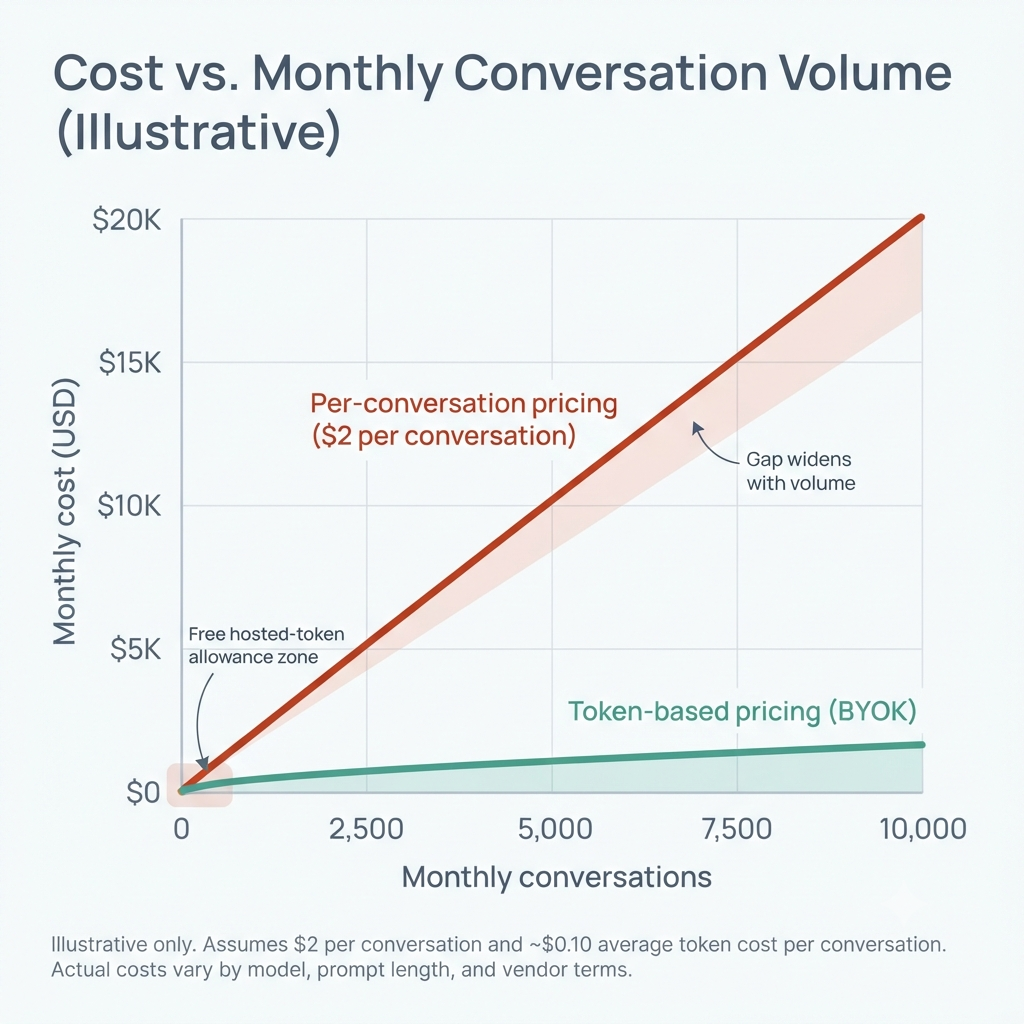
Salesforce Agentforce has two main pricing models: Flex Credits and Conversations. Conversations are listed at $2 each. Flex Credits cost $500 per 100,000 credits, and a standard action uses 20 credits (about $0.10), while a voice action uses 30 (about $0.15).
None of that is unreasonable on its face. Enterprise platforms carry real costs for integration, security, governance, support and uptime. But it does create a particular incentive. The more conversations or actions you run, the more you pay, even when the actual model cost behind each one is small.
| Scenario | Agentforce-style cost | Zoho-style cost logic |
|---|---|---|
| 1,000 customer conversations per month | $2,000 under the $2-per-conversation model | Token usage only; potentially within Zoho’s free hosted-model allowance, or billed directly by the chosen LLM provider under BYOK |
| 10,000 conversations per month | $20,000 under the per-conversation model | Scales with model consumption, not a fixed per-interaction platform charge |
| A low-volume internal workflow agent | Still pays per conversation or per action if it is customer-facing and usage-based | Can be built and run with minimal or no incremental platform cost, depending on model usage |
| A high-volume automation with short prompts | Cost rises with each conversation or action | Cost rises with tokens, which may be far lower for concise, structured tasks |
To be fair, this doesn’t prove one platform is cheaper across the board. Agentforce may bring integrations and enterprise controls that are worth the money for some organizations. What Zoho does is change the question you start with. Instead of “how many conversations can we afford?”, it becomes “what does the intelligence we’re using actually cost at the margin?”
BYOK is a strategic lever, not a checkbox
BYOK usually gets pitched as a compliance feature. Here it’s an economic one too.
When a customer supplies a key from OpenAI, Gemini, Claude or another supported provider, Zoho routes the request but stays out of the billing. The customer pays the provider directly, and Zia Agents adds no charge for the connection. Three things follow from that:
- It commoditizes the model layer. If compute is bought separately, a vendor can’t hide behind opaque model pricing to protect its platform margins.
- It gives customers procurement power. Teams can negotiate directly with model providers, pick models for cost or capability, and switch providers without rebuilding their agent setup.
- It makes AI economics legible. Finance can see the real inference bill instead of trying to reverse-engineer it from a blended per-conversation charge.
Zoho also offers external models through its own key system at the provider’s exact rate, with no markup, billed through Zoho credits. BYOK goes a step further: you manage the key and settle directly with the provider.
The overhead Zoho is exposing
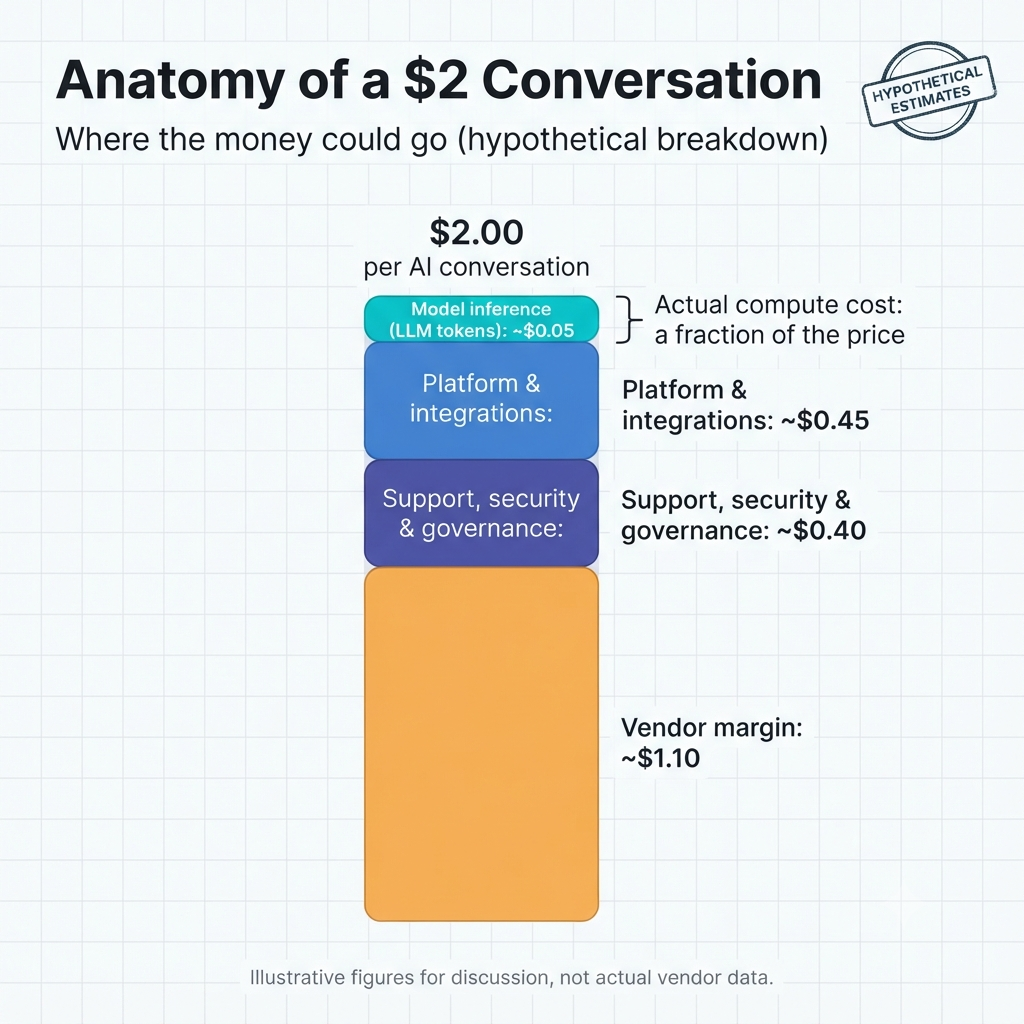
Enterprise AI bills often roll several distinct costs into one number:
- Access to the software platform.
- Rights to build and deploy agents.
- Orchestration, integrations and workflow execution.
- Model inference.
- A vendor margin spread across some or all of the above.
Zoho isn’t eliminating costs. It still makes money on Zoho Desk subscriptions, and customers can still run up charges if they exceed the hosted-model allowance or use external models through Zoho-managed keys.
What it has removed is the toll on creating and deploying agents. That forces a more honest conversation about what enterprises are really paying for. It’s not just “AI.” It’s the right to run an AI workload on one particular vendor’s infrastructure.
If the runtime is free and the compute is transparent, a $2-per-conversation fee gets much harder to defend as an unavoidable cost of AI. It starts to look like what it is: a pricing choice. And customers may start scrutinizing it as their agent volumes grow.
Why mid-market firms benefit first
Large enterprises can absorb steep AI platform fees. Mid-market companies often can’t justify them before they’ve proven any value. Zoho’s model lowers the bar for experimenting.
A support lead can deploy an agent to classify tickets, draft replies, pull from the knowledge base or update a case record, all without negotiating a separate AI-agent contract. You pay for the Desk plan you already have, then pay for model usage only when the agents actually run.
That matters because multi-agent adoption rarely happens in one big deployment. It starts with one narrow workflow, spreads to a second, and eventually becomes a network of agents handling triage, escalation, knowledge retrieval, order status, refunds and follow-ups. Per-conversation pricing makes that growth expensive by design. Token-based BYOK pricing makes it more gradual.
The competitive pressure this creates
Zoho’s move puts pressure on rivals in three ways:
- Unbundle or justify the bundle. Vendors will need to show exactly what customers get for the platform, agent and compute charges.
- Compete on orchestration value. If model access is a commodity, differentiation has to come from integrations, governance, data context, reliability and workflow design.
- Rethink consumption pricing. Per-conversation models may still appeal for predictable support volumes, but they get vulnerable once customers can compare them against direct token costs.
Worth noting: Salesforce’s pricing page says its listed prices are informational and subject to change, so buyers should check current terms before deciding anything. Still, the direction is clear. When one major vendor offers free agent creation and deployment, an “AI agent platform fee” stops being a line item nobody questions.
The practical test for buyers
Before picking an agent platform, split your expected costs into four buckets:
- Platform cost: your CRM, help desk or automation subscription.
- Agent runtime cost: fees to create, deploy, host or manage agents.
- Model cost: tokens, credits, API calls or provider invoices.
- Value-at-risk cost: what errors, escalations, compliance failures or bad handoffs to humans could cost you.
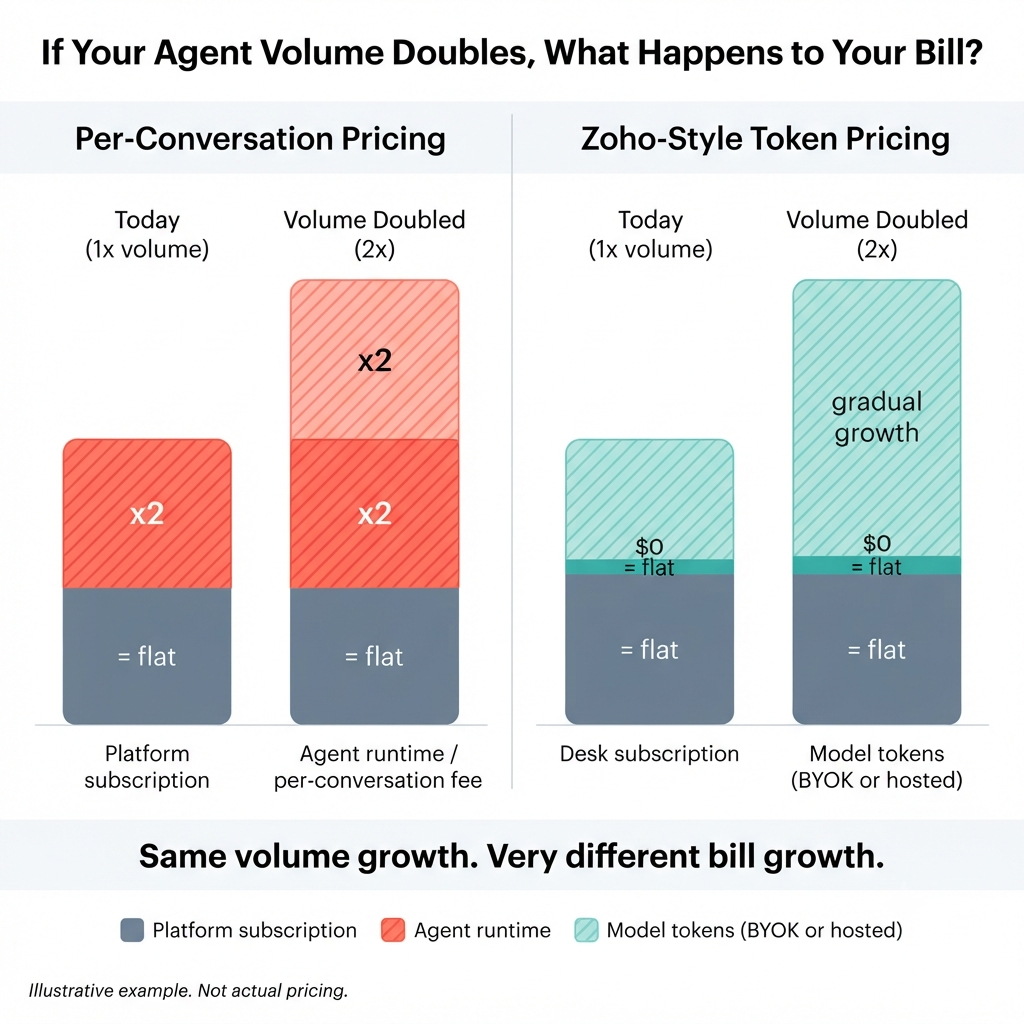
Then ask one question: if my agent volume doubles, which parts of my bill double, and which stay flat?
Zoho’s answer is refreshingly clean. The agent platform stays free, and the model bill follows usage. That doesn’t guarantee a lower total cost, but it gives you much more control over the variable that matters most.
The new economics of digital labor
The “digital workforce” pitch often implies that AI agents should be priced like employees: per seat, per conversation, per task. Zoho is arguing for a different mental model.
Agents aren’t employees. They’re software workloads that consume compute. Treat them that way, free to orchestrate and transparently priced to run, and you may do more for enterprise AI adoption than another round of premium packaging ever could.
The disruption isn’t that Zoho made agents free. It’s that by removing the platform tax, Zoho made it visible.